Speaker Toe-In Angle Calculator
Set left and right speaker aim from real geometry, listening-axis preference, room reflectivity, tweeter directivity, crossing point, sofa width, and symmetry offsets.
🎯Speaker And Sofa Presets
📏Geometry And Measurement Basis
🔊Listening Axis And Room Behavior
⚖Symmetry Offsets And Fine Trim
🎵Calculated Speaker Aim
Toe-in is a repeatable starting point. Mark the angle, listen for center focus, then move in 1 degree steps if vocals pull left, right, or become too narrow.
📊Toe-In Checkpoints
🗺Crossing Point Reference
| Strategy | Axis target | What changes | Best use |
|---|---|---|---|
| Parallel baffles | No crossing | Maximum room energy, widest but softest center | Very damped rooms or first setup baseline |
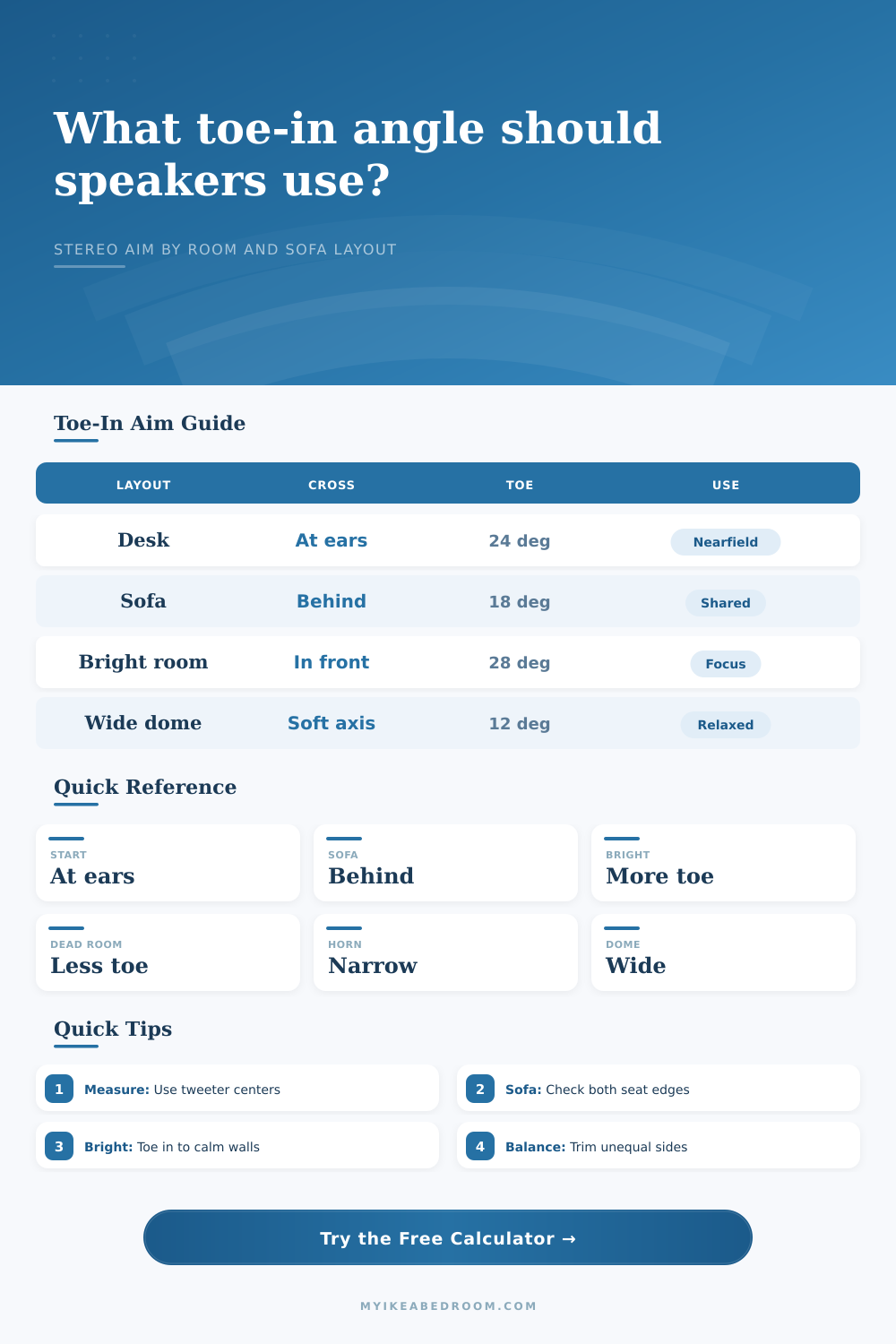
| Aim at ears | Center listening seat | Precise center, strong high-frequency focus | Desk, nearfield, single-seat listening |
| Cross behind listener | Behind the head or sofa | Less toe-in, smoother coverage across seats | Bedroom sofas, shared listening, wide seating |
| Cross in front | Between speakers and listener | More toe-in, reduced side-wall splash | Glass wardrobes, lively walls, narrow horns |
🔍Tweeter Directivity Reference
| Tweeter type | Useful window | Typical toe-in move | Watch for |
|---|---|---|---|
| Wide dome | About 20° off axis | Can sit slightly off tweeter axis | Too much toe-in may narrow the image |
| Soft dome | About 17° off axis | Moderate toe-in is usually enough | Balance between center lock and air |
| Waveguide | About 15° off axis | Responds well to measured, even aim | Unequal angles can shift vocals |
| Ribbon or AMT | About 12° off axis | Small angle changes are audible | Seat height and sofa edge tonal change |
| Horn | About 10° off axis | More precise toe-in and symmetry | Over-crossing can sound too narrow |
🛋Nearfield And Sofa Layout Guide
| Layout | Separation to distance | Crossing target | Setup note |
|---|---|---|---|
| Desk nearfield | 0.9 to 1.1 | At ears or just behind | Small changes matter because distance is short |
| Bedside or reading chair | 0.7 to 0.95 | At ears | Favor image lock over multiple-seat width |
| Compact sofa | 0.75 to 0.95 | Behind listener | Keep left and right edge seats within the tweeter window |
| Wide sofa | 0.6 to 0.85 | Behind sofa | Use less toe-in unless side walls are very reflective |
| Offset corner sofa | Varies by main seat | Custom offset | Asymmetric left and right angles can be correct |
🧭Symmetry Trim Reference
| Condition | Likely symptom | Calculator input | Listening check |
|---|---|---|---|
| Main seat is right of center | Vocal image leans toward right speaker | Positive listener offset | Right toe-in usually decreases, left increases |
| One speaker sits behind the other | Image depth differs by side | Left or right setback | Measure from the front baffle plane |
| One side wall is closer | One side sounds brighter or wider | Side-wall distance fields | Try 1 to 2 degrees extra toe on the reflective side |
| Wide sofa seat sounds dull | Edge listener is outside tweeter window | Sofa width and directivity | Cross farther behind or reduce toe-in |
💡Practical Toe-In Notes
Speaker location tends to be an exercise in guesswork by most, as if it’s a geometry issue. “How far should I have that from the wall? How wide is my sofa?”
Not much attention are paid to where the tweeter’s acoustic center is located. Often the tweeter is recessed some distance from cabinet edge. Pointing the cabinet directly toward your ear is pointing it right at your shoulder. That tiny offset destroys stereo image, and even though it’s a small thing, it matter.
Why You Need This Speaker Tool
It figures out the trigonometry, you don’t have to do it. All you enter is the distance between acoustic center of each speaker, and it calculate the angle based off that. That’s important, because it’s easy to measure from the inside edge of the baffles, but those measurements is only right if your drivers sits exactly at that edge. Tweeters typically recess into the cabinet, and the tool compensate for that inset.
It also accounts for how far you’d like the beam of high frequency sound to hit your ear. Directly on your head result in a narrow image; crossing the beams a foot or two behind you make the sound softer and wider. That’s generaly preferable for a couple of person sharing a sofa.
Hard surfaces also reflect first sound waves. Room acoustics has a greater impact than many systems takes into account. If, for instance, you have a bare brick wall or glass wardrobe on one side, it will make the sound appear to be closer and brighter. This pulls the image off center.
The calculator lets you enter wall distances on each side and how reflective they are. It then suggest angling the speaker inward more to deflect energy toward something less reflective. That’s all about time, not simply volume, since even very early reflections up to fifteen milliseconds after direct signal can blur transient detail. Delaying that reflection by angling speaker off the wall gives your brain clean data to process.
Then there’s directivity. You can forgive some tweeters for being wide-dispersion dome types. They throw sound out in a broad arc, which make it less critical where you aim them. But other tweeters such as vertical ribbon drivers or horn-loaded ones projects a narrower beam. If you’re more than about five degrees off that beam, you lose treble response.
The tool allow you to choose your tweeter type and adjust the recommended angle to match so you stay inside its useful listening window. This helps you avoid the dull sound caused by having your ears fall off-axis from a directional driver.
The last barrier is symmetry. It’s pretty and it looks good, but sometimes it doesn’t sound right. For example, if your primary listening chair is positioned off-center to the right, you don’t want to aim each speaker directly at room center. Doing so means the right speaker would of been too wide and the left too narrow; this require asymmetric toe-in.
To make up for the perceived position of soundstage, the calculator lets you specify the listener offset… Which produces varying angles between left and right channel to even things out. It also compensates for physical setbacks (e.g., one speaker might sit on a deeper shelf) by including time alignment in the angle calculation.
Begin with the numbers, then place your stands on the floor, at the angle marked by the tape on the floor. Then sit down in the chair and play something you’re familiar with and listen for direction of the vocals. If the vocals pull left, increase the right toe-in slightly. Tweak the toe-in out a little more.
If the image feels narrow and boxed in, reduce the angle or move the crossing point behind you. Back the stand off. Move the crossover point further back behind you.
It’s an iterative process but having the geometry as a starting point helps tremendously. You aren’t battling the room, you are using it. Immersion is what we’re after, and once the math lines up with the physics, the speakers vanish. All that remains is the music, and that’s the true challenge.