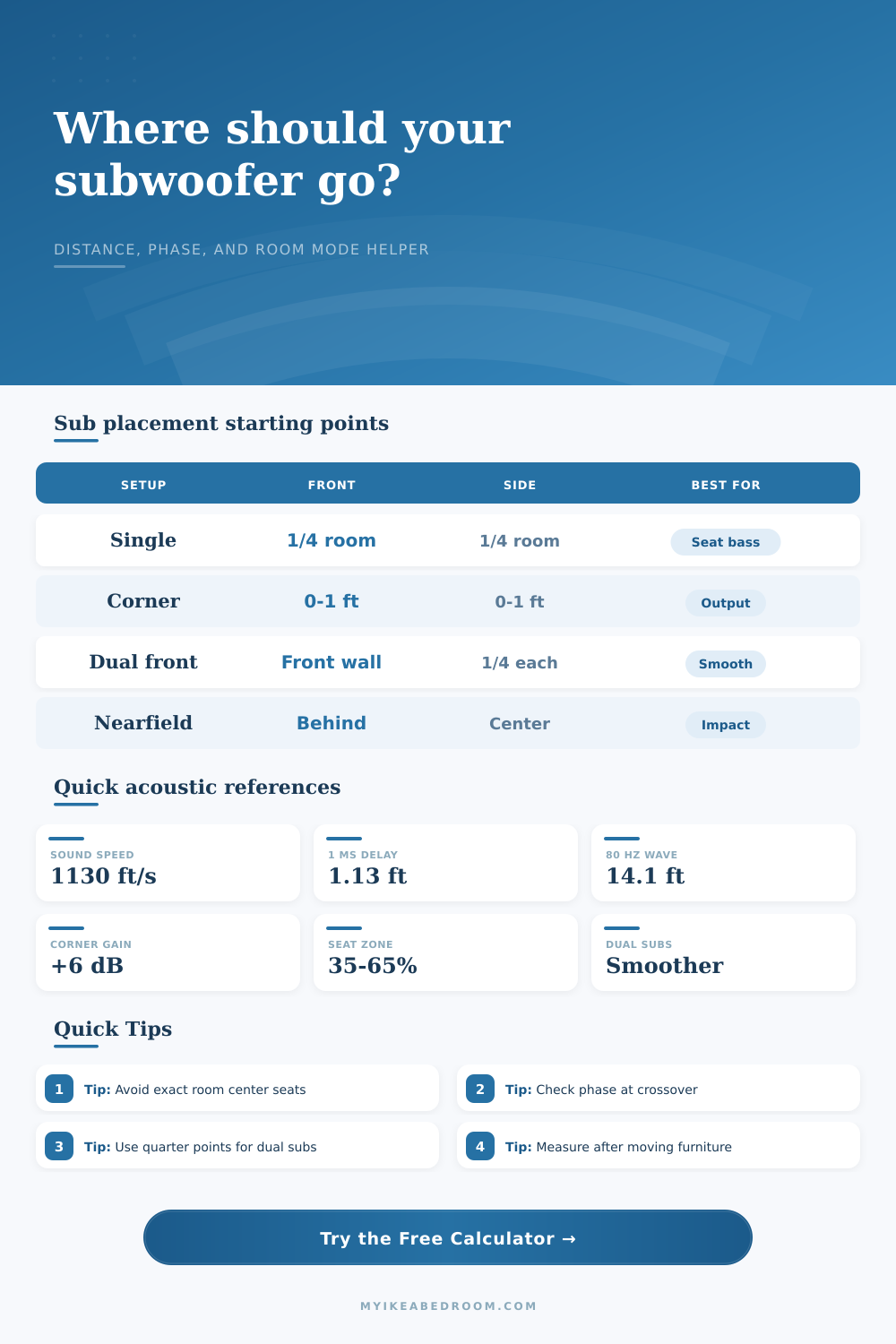
Subwoofer Placement Distance Calculator
Compare room dimensions, listening position, crossover wavelength, wall loading, phase, delay, and multi-sub layouts before moving furniture.
🎧Placement Presets
📏Room And Seat Geometry
🔊Subwoofer Position And Bass Settings
📊Room Mode Reference
The first axial modes are simple starting markers. A microphone measurement still wins when doors, openings, alcoves, wardrobes, rugs, and sofas change the room.
📐Crossover Wavelength And Delay Table
| Crossover | Full wavelength | Quarter wavelength | One cycle time | One foot phase shift |
|---|---|---|---|---|
| 60 Hz | 18.8 ft / 5.7 m | 4.7 ft / 1.4 m | 16.7 ms | 19 degrees |
| 70 Hz | 16.1 ft / 4.9 m | 4.0 ft / 1.2 m | 14.3 ms | 22 degrees |
| 80 Hz | 14.1 ft / 4.3 m | 3.5 ft / 1.1 m | 12.5 ms | 26 degrees |
| 90 Hz | 12.6 ft / 3.8 m | 3.1 ft / 1.0 m | 11.1 ms | 29 degrees |
| 100 Hz | 11.3 ft / 3.4 m | 2.8 ft / 0.9 m | 10.0 ms | 32 degrees |
| 120 Hz | 9.4 ft / 2.9 m | 2.4 ft / 0.7 m | 8.3 ms | 38 degrees |
🏠Placement Distance Starting Points
| Layout | Sub distance from front wall | Sub distance from side wall | Best use | Watch for |
|---|---|---|---|---|
| Single front quarter | 0.15 to 0.25 room length | 0.20 to 0.30 room width | Balanced first trial in rectangular rooms | Seat nulls around room center |
| Front corner | 0 to 1 ft / 0 to 30 cm | 0 to 1 ft / 0 to 30 cm | Maximum output from a small sub | Boomy peaks near the first modes |
| Side wall nearfield | Near seat depth | 0 to 1 ft / 0 to 30 cm | Impact when neighbors or apartment levels matter | Level matching and localization |
| Rear wall | 0.80 to 0.95 room length | Near seat centerline | Rooms where the front wall is full of furniture | Delay may need extra attention |
| Dual front quarters | 0 to 1 ft / 0 to 30 cm | 25% and 75% room width | Smoother bass across a sofa | Match gain and polarity |
| Four wall midpoints | 50% on front and rear walls | 50% on left and right walls | Most even response across multiple seats | Needs independent delay or DSP |
🎛Boundary Loading And Practical Living-Room Effects
| Placement condition | Typical low-bass gain | Distance clue | Useful adjustment |
|---|---|---|---|
| Free standing | 0 dB reference | More than 3 ft / 0.9 m from walls | Needs more gain, often smoother upper bass |
| Against one wall | About +3 dB | Back of sub within 1 ft / 30 cm | Good first choice for media benches |
| Floor and corner | About +6 dB | Near front and side wall | Reduce level if bass sounds heavy |
| Tight pocket | About +9 dB | Surrounded by wall, floor, cabinet side | Check port clearance and rattles |
| Behind sofa | Varies by distance | Within 1 to 3 ft / 30 to 90 cm of ears | Lower gain, align delay carefully |
🔗Multiple Subwoofer Layout Reference
| Sub count | Recommended layout | Distance target | Why it helps |
|---|---|---|---|
| One | Crawl-tested front wall or corner | Keep path close to main speakers when possible | Fastest setup, seat-specific optimization |
| Two | Front wall quarter points | Equal distance to main sofa center | Reduces width mode unevenness |
| Two | Opposing wall midpoints | Match level, delay rear sub if needed | Useful for long rooms with deep seats |
| Two | Diagonal corners | Often unequal path lengths | May smooth several seats with correction |
| Four | Wall midpoints | Independent delay preferred | Strong multi-seat consistency |
💡Room Measurement Notes
Subwoofer placement can be more of a science than a guessing game. Too often people moves the box around, hoping it will sound good, but they end up with lopsided bass that rattles the furnitures.
Low-frequency sound is different than midrange because its longer wavelengths bounce off walls to create nulls and peaks in your room. Knowing how it works will help you work with the speaker not against it. The sub is not as important as the room in regards to how it responds. Because sound travels approximately one thousand one hundred thirty feet per second, it has a definite physical length for any given frequency. An eighties hertz frequency will have a wavelength measuring approximately fourteen feet. If you are sitting halfway through that wave, it can perfectly cancel out.
How to Place Your Subwoofer for Best Bass
That’s why this calculator takes your room measurements and converts them into mode frequencies. These give you places where likely sound valleys exist. This makes all those abstract wave concepts turn into real world distances.
Why? Because Phase Alignment is a function of time. The closer the subwoofer are to your main speakers, the less distance there is for phase alignment issues. This isn’t just a matter of timing. If your sub and mains fights each other at the crossover point, you’ll get a muddy, weak low-end. Delay settings on your receiver can remedy this problem. Before doing so, however, you must understand exactly how much acoustic path difference exist between two locations. That’s where the tool comes into play. By determining the number of milliseconds of delay, it’ll ensure the bass coming from the front speakers reaches your ears simultaneously with the bass coming from the sub. This creates a cohesive sound.
Subwoofers have a feature called phase knobs, which throw people. These are coarse delay controls for low frequency. What they do is try to combine the sound of the mains with the subs, resulting in more bass. If you’re in the wrong zone, turning the knob will make the room sound hollow. Why? It’s because of the quarter-wavelength relationship that determines how it all works together. At eighty hertz, moving the sub one foot change the phase by twenty-six degrees. That’s what accounts for the need for small movements. Moving the sub back two feet to the left completely alters the character of the bass.
The good news: Corner placement doubles down on boundary gain. A 6 dB (or more) increase in output is nice for underpowered subs or small rooms. The bad news is that corner placement magnifies room modes. That’s bad because it makes boomy resonances worse. If the bass is already slow or too heavy, move the sub out of the corners. You’ll sacrifice some raw power for increased clarity and speed. The calculator estimates that boundary loading effect. It tells you whether the spot you chose will be bloated or punchy.
Irregularities are smoothed by multiple subwoofer. Placing two subs a quarter point from each end of the front wall (or diagonally, opposite corners) evens out the response. Why? Because it stimulates opposing pairs of room modes at the same time. It fills in the nulls that affect single-sub setups. More gear, careful calibration, but the reward: consistent bass for everyone in the room. Model these layouts with the tool. How will your geometry change the sound environment? Measure it, don’t guess it.
Invest in a microphone or use one of the many apps designed for a smartphone. It’s science, which uses formulas from geometry and the properties of sound waves. Rugs, furnitures and other room stuff make real rooms unpredictable. Begin with the mathematics and then listen with your ears. Continue adjusting until the bass sounds comfortabley and naturaly, and the technology feels easy to use.