Speaker Wire Gauge Calculator
Choose a practical AWG size from impedance, one-way speaker distance, amplifier power, conductor material, installation path, and your acceptable power loss.
🎵Home Audio Presets
📏Run And Load Details
⚡Wire Resistance Reference
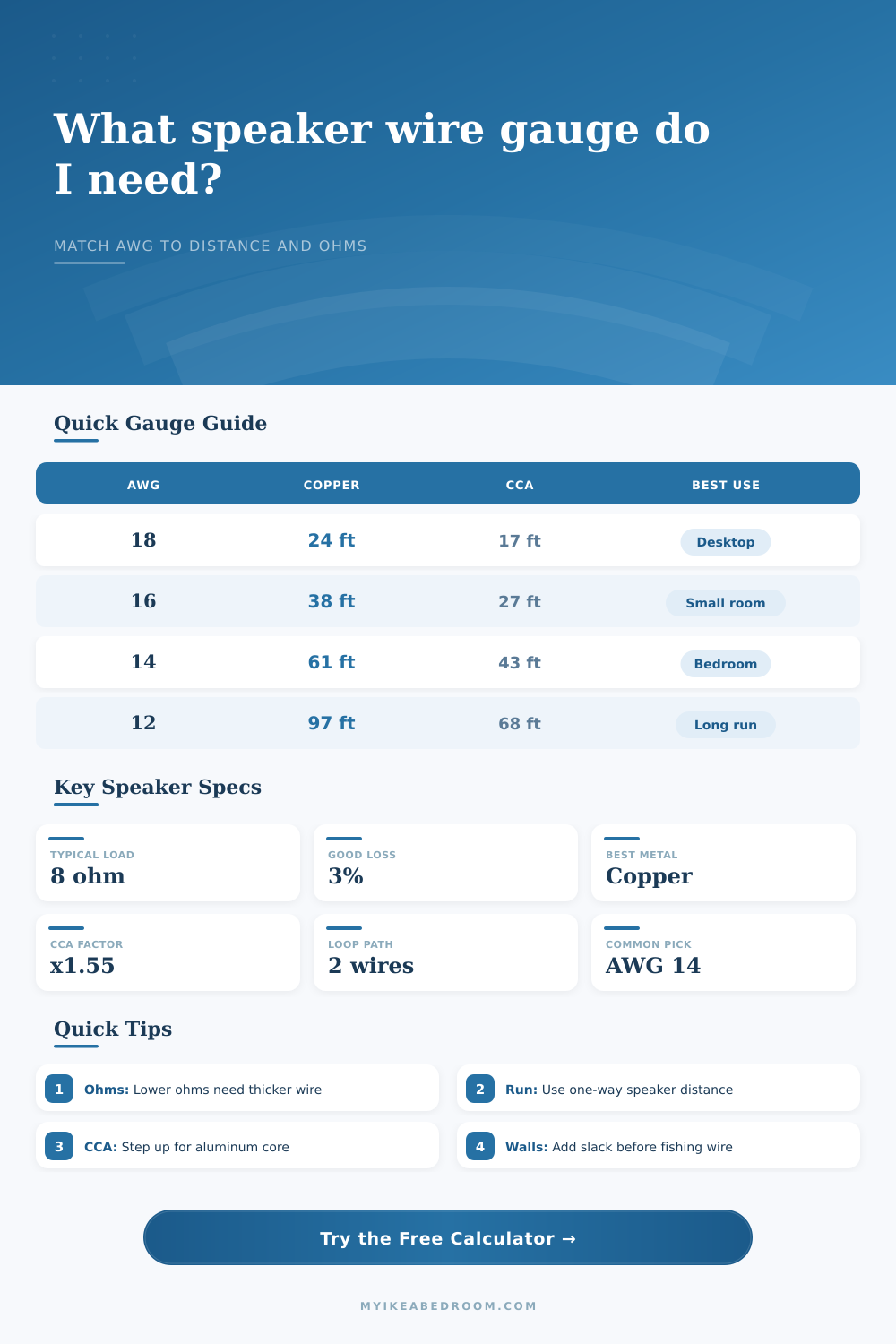
📊Copper Gauge Limits At 3% Loss
| Gauge | Resistance per 1000 ft | 8 ohm max one-way run | 4 ohm max one-way run | Typical home audio use |
|---|---|---|---|---|
| 18 AWG | 6.385 Ω | 24 ft | 12 ft | Desktop speakers, short surrounds |
| 16 AWG | 4.016 Ω | 38 ft | 19 ft | Bedroom bookshelf speakers |
| 14 AWG | 2.525 Ω | 61 ft | 30 ft | Living room front channels |
| 12 AWG | 1.588 Ω | 97 ft | 48 ft | Long in-wall or home theater routes |
| 10 AWG | 0.999 Ω | 154 ft | 77 ft | Very long low impedance feeds |
🔌Material And Path Adjustments
| Choice | Calculator factor | What changes | When it matters most |
|---|---|---|---|
| Bare copper | 1.00x resistance | Baseline AWG table | Most indoor speaker runs |
| Tinned copper | 1.02x resistance | Nearly identical to copper | Humidity or patio-adjacent routes |
| Copper-clad aluminum | 1.55x resistance | Usually needs a thicker gauge | Long runs and 4 ohm speakers |
| Dense bundle | 1.08x to 1.15x margin | Adds headroom to the limit | Equipment racks and conduit |
🏠Common Home Audio Scenarios
| Scenario | Typical run | Load | Power target | Common gauge |
|---|---|---|---|---|
| Desktop nearfield pair | 6 to 10 ft | 8 ohm | 25 to 50 W | 18 or 16 AWG |
| Bedroom bookshelf speakers | 15 to 30 ft | 6 to 8 ohm | 50 to 100 W | 16 or 14 AWG |
| Living room fronts | 25 to 50 ft | 4 to 8 ohm | 80 to 150 W | 14 or 12 AWG |
| Rear theater channels | 40 to 75 ft | 6 to 8 ohm | 60 to 120 W | 14 or 12 AWG |
| Passive subwoofer line | 15 to 35 ft | 4 ohm | 150 to 300 W | 12 AWG |
📐Power Loss Targets
| Loss target | Wire resistance limit | Sound system use | Practical note |
|---|---|---|---|
| 1% | 0.0101 x speaker ohms | Studio monitoring | Very conservative for long cables |
| 2% | 0.0206 x speaker ohms | High fidelity stereo | Good target for main listening seats |
| 3% | 0.0314 x speaker ohms | Most home audio | Balanced recommendation |
| 5% | 0.0526 x speaker ohms | Background rooms | Often acceptable for low volume zones |
💡Speaker Wire Notes
It’s probably no surprise to you that speaker wire is made of copper. But type of copper and its thickness make a difference in how much current gets to driver from the amp. It’s an overlooked detail with a big impact.
Just remember: Thinner wire is a resistor. If you’re running it a significant length, you’re not just transmitting sound; you’re sending voltage down a resistor. To see whether or not your system are choking the signal, use the calculator (above) to plug in your amp specifications and room size.
Why Speaker Wire Matters
The key idea is resistance. Each foot of wire introduce a slight bit of resistance to the current. It’s minimal on a short run such as between monitor and a stereo. But if you have to get power all the way back to rear channels, around a big living room, or perhaps through some walls, it all add up. It burns watts that should of moving driver cones instead of heating your home’s insulation below your baseboards.
That’s what most folks don’t realize, having purchased high-end speakers only to strangle them with cheap, undersize cabling. Another factor is that impedance also affect what is an acceptable amount of loss. Because a four-ohm load pulls more current than an eight-ohm load, it’s harder to drive; thus, if you have a four ohm speaker, the same length of wire will see more voltage drop. The tool takes this into account.
It allow you to specify your nominal impedance and calculates how much power is lost at that load to keep it below your selected target. For home audio, typical sweet spot is about three percent, a balance between cost and audible performance. You can go lower, but then you need thicker wire (which may be stiffer and difficultly to terminate), and it becomes safer.
You also have a choice of materials. Good ol’ pure copper is the default because it’s a good conductor, has low resistance, and all that. Tinned copper performs about the same (and the tin makes it somewhat more corrosion resistant, which might matter if you run your cables somewhere realy humid).
Copper-clad aluminum is something else again: it’s cheaper, it looks like copper… But it only conducts about half as well. The calculator account for this by effectively treating CCA as a thinner gauge than it appears. So if you’re thinking about saving some money with CCA, be warned: you’ll have to move one size up on the gauge scale if you want your signals to be transmitted accurately. It is a trade-off between upfront cost and acoustic fidelity.
It’s more important than you’d think: Installation path matter more than audio purists like to admit. Running wire over floorboards or behind walls can tack on many feet that aren’t accounted for in your straight-line measurements. It may appear the speaker sits 20 feet from the receiver. However, when you factor in extra distance required to zig-zag around corners, drop down studs, and pass up through the receiver’s rack, it could easily account for an additional 10 feet.
Measure the path, not the room dimensions. Then include a few extra inches at both ends to accommodate connections. A tight connection is more important than a thick wire. Although long cable are better, it won’t do much good if it ends with high resistance contact points. This results in intermittent signal drops and intermittent buzzes.
Look carefully at the numbers, specifically the estimated power loss and recommended gauge. The tool will recommend 14 gauge for a run to a bedroom? Run that. Don’t downgrade to 16 gauge because you save two bucks per foot. You may notice a slight difference in sound, but you’ll notice a real difference in reliability after five years.
In addition, thicker wire is more forgiving should you decide to add a subwoofer or change out the amp at some point. It’s much easier to trim down a thick cable than it is to splice in a thinner cable.
Speaker wire is like the plumbing of sound. If you had a large theater system but tried to use desktop cable to power it, you’d probably get away with it, but you wouldn’t run a garden hose from your kitchen sink and expect it to provide water to an entire home.
The idea here is to be transparent. You want the listener to hear the music, not the limits of the infrastructure. By getting the gauge correct, you ensure that the signal arrives cleanly while maintaining the detail and dynamics your amplifier are working hard to create. It is a small detail with a big payoff.