Tool Rental Cost Calculator
Estimate a rental total from your own hourly, daily, or weekly rates, planned duration, pickup buffer, idle time, fees, refundable deposit, and per-task allocation.
Rental Cost Results
| Method | Billable units | Your rate | Rental charge |
|---|---|---|---|
| Hourly | 0 hr | $0 | $0 |
| Daily | 0 day | $0 | $0 |
| Weekly | 0 week | $0 | $0 |
| Task | Allocation | Allocated cost | Allocated hours |
|---|---|---|---|
| Setup and pickup | 20% | $0 | 0 hr |
| Primary cutting | 40% | $0 | 0 hr |
| Assembly passes | 25% | $0 | 0 hr |
| Return cleanup | 15% | $0 | 0 hr |
| Rental unit | Calculator conversion | Rounded mode | Exact mode |
|---|---|---|---|
| Hourly | Billable hours | Ceils to next hour | Decimal hours |
| Daily | Hours divided by your day length | Ceils to next day | Decimal days |
| Weekly | Daily blocks divided by 7 | Ceils to next week | Decimal weeks |
| Idle time | Base hours multiplied by idle % | Then rounded by method | Kept as decimal |
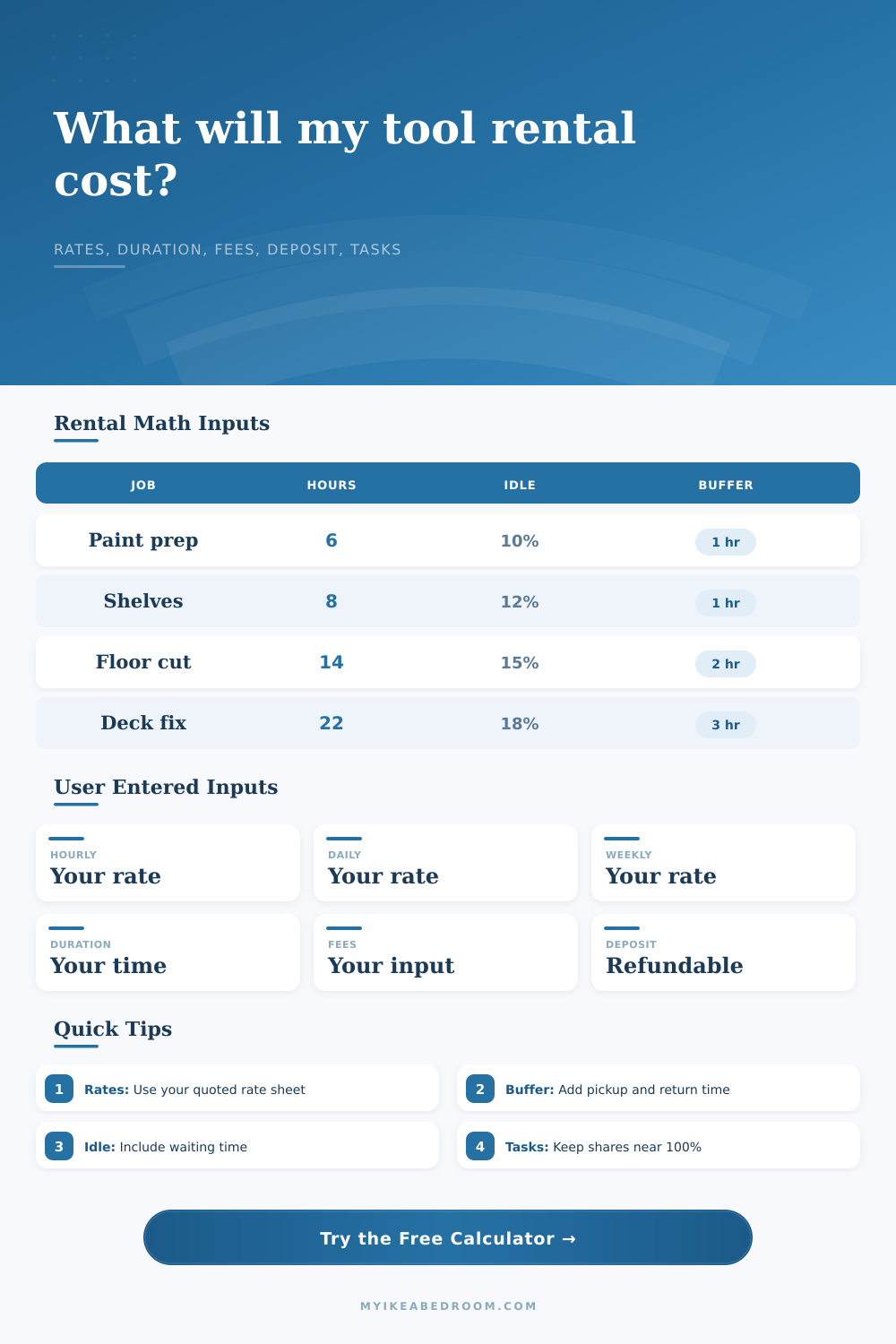
| Job preset | Active hours | Buffer hours | Allocation focus |
|---|---|---|---|
| Paint Prep | 6 | 1 | Setup weighted |
| Shelf Build | 8 | 1 | Cutting weighted |
| Floor Repair | 18 | 2 | Install weighted |
| Garage Project | 45 | 4 | Multi-day work |
You’re standing in your garage with a freshly rented angle grinder and a half-finished deck project, feeling like you underestimated the timeline. Odds are, you’re starting to realize you underestimated the timeline. Why? Chances are, you overestimated your timeline.
But you didn’t account for the time waiting at the rental shop, fighting traffic to pick it up or taking a break for sore shoulders. That’s why an accurate estimate can be the difference between a headache and a wallet-friendly weekend. Enter your estimated work time into our tool rental cost calculator and let it do the math.
How to Estimate Your Rental Time
Remember to factor in invisible hours… You know, all those minutes waiting around and driving to-and-from the rental shop. It saves you the guesswork (and those hidden minutes off your total bill).
Another point is that most folks only calculates active time (the time they’re really using the machine, whether it’s spinning or cutting). But rental shops don’t give a rat’s ass about how hard you’re working. They just want the thing off their shelf as long as possible.
So adding in buffer time for returning and picking up the thing is a crucial step. Even if you only need something for two hours of drilling, you have to drive to the store, fill out some paperwork, unload the tool, drive home, get up the next morning and do all those things again to bring it back. That’s a hidden day of rental time, and if you fail to account for that buffer, you’ll be paying for it based off the calculator.
Another factor that plays into your budget: How much time do you have to waste? That’s right. It’s the time you’re sitting there with nothing to do. Time until the concrete has hardened so you can begin drilling. Waiting around for your partner to get back from getting supplies. Your tool sits on the ground while the rental counter clock ticks away.
A percentage for idle time shows that things don’t ever go exactly as planned in a project. It’s a little thing, but it makes a difference if you’re working within a strict budget.
Daily vs. Hourly vs. Weekly: it’s all math. If you’re renting something for a few hours, an hourly rate seem like a good deal. As soon as you hit the magic number of a full day’s rent, however, those hourly rates skyrocket. A daily rate tends to create a cushion. Even if you only operate the tool for half the day, you’ve maxed out your potential spend in a single day.
For longer-term projects, a week-long rental will be cheapest, assuming that’s how long you intend to rent anyway. The calculator lays them out next to each other, so you can see the cost breakdown per hour, day, or week for each type. You’ll never have to worry about marketing-speak or fluff; just numbers.
Note: There’s a distinction between fees vs. Refunds which I think is worth noting. Some deposits are actualy just refundable payments. If you don’t wreck the tool, then the cash comes back out of your pocket. Other deposits are fees, nonrefundable costs. These are pure losses.
This tool separates them. This way, you can see what is leaving your pocket as immediate cash versus what is a permanent loss of money. It’ll help you plan your wallet strategy. Maybe you’ve got the entire amount saved up, but maybe you need the deposit today in your pocket as cash.
You’re in the habit of assigning costs to tasks. You want to know that 30% of your rental was spent setting it up, and that’s why it’s important when billing a customer (or calculating how much you should of charge yourself) to have an accurate picture of your services. Otherwise, you risk undercharging for work you can’t see.
The page breaks down how different amounts translate to billable chunks, and it will clue you into the math behind the curtain at the rental shop. There are reference tables for this on the page.
Renting is another good thing. It allows you to get expensive gear at a fraction of the cost but without the headache of maintaining and storing it. Simply adhere to the time clock. If the tool sits unused while on loan to you, then it’s costing you money every single hour it remains.
Plan for waiting times, traffic and other delays so this becomes a known cost rather than a gotcha. Return the tool to the shop before the timer hits zero and you’re done. A completed task and a rational budget.