DIY vs Contractor Cost Calculator
Compare do-it-yourself costs and a contractor quote using only the materials, tools, permits, time value, timeline factor, markup, and risk values you enter.
Comparison results
| Line | Uses | Formula | Notes |
|---|---|---|---|
| DIY cash | Materials, tools, permits | Cash inputs x scope | Direct out-of-pocket side. |
| DIY time value | Hours and hourly value | Hours x value x scope | Can be zero for cash-only. |
| DIY risk | DIY cash and time | (Cash + time) x risk % | User-entered contingency. |
| Contractor markup | Quote total | Quote x markup % | Only added when entered. |
| Contractor risk | Quote plus markup | (Quote + markup) x risk % | User-entered contingency. |
| Timeline factor | Days and daily value | Day difference x factor | Positive side has longer days. |
| Preset | DIY inputs included | Contractor inputs included | Timeline entries |
|---|---|---|---|
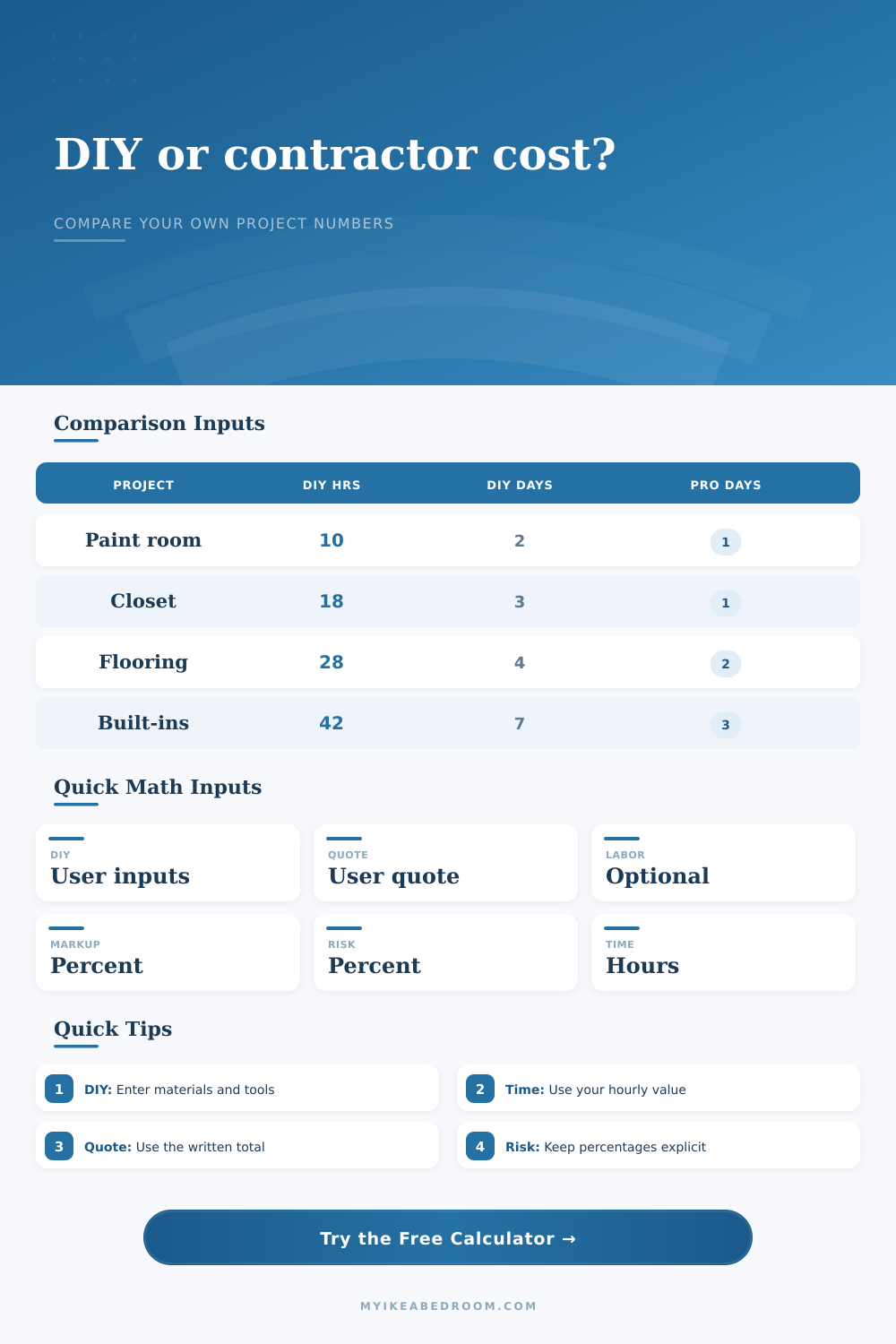
| Paint bedroom | Paint, tools, disposal, hours | Quote, labor line, material line | 2 DIY days / 1 pro day |
| Flat-pack closet | Units, anchors, tool purchase, hours | Assembly quote and crew-hours | 3 DIY days / 1 pro day |
| Laminate floor | Flooring, underlayment, rental, hours | Install quote and material line | 4 DIY days / 2 pro days |
| Tile backsplash | Tile, mortar, saw rental, permit | Quote, labor, material line | 4 DIY days / 2 pro days |
| Built-in shelves | Panels, hardware, tools, hours | Carpentry quote and crew-hours | 7 DIY days / 3 pro days |
| Output | Meaning | Positive value | Negative value |
|---|---|---|---|
| Difference | DIY adjusted total minus contractor adjusted total | DIY total is higher | DIY total is lower |
| Hours difference | DIY hours minus contractor crew-hours | DIY uses more hours | Contractor uses more crew-hours |
| Day difference | DIY days minus contractor days | DIY timeline is longer | Contractor timeline is longer |
| Line item gap | Quote minus entered labor and materials | Unassigned quote amount remains | Line items exceed quote total |
Keep quote logic separate: The calculator treats the contractor quote total as the controlling contractor input and shows labor, materials, markup, and unassigned amount as breakdown lines.
Use the same scope: The scope multiplier scales both sides, so one room, two rooms, or repeated furniture projects stay on the same comparison basis.
Separate time from cash: The DIY total displays out-of-pocket cash and time value separately before adding contingency and timeline adjustment.
Read results neutrally: Positive and negative differences are labels for arithmetic direction only; the calculator does not rank either option.
Six months later, the paint can is still sitting in the garage. You wanted to do more than you actualy did. You purchased the rollers, watched the tutorial, and felt a surge of capability, you’ve got this! That’s when reality hit: The hidden costs emerged; the weekend job lasted two weekends.
When it comes down to deciding between hiring a pro versus doing-it-yourself, it’s never just the headline price. It’s all about what you’re actualy paying for. With our DIY vs contractor cost calculator (above), we forces you to put a number on everything: time, risk, labor value, materials… All wrapped up into one comparison.
Count the Dollars and the Hours
Most people stop at material cost. Add in the material cost: the lumber, the paint, the fasteners. Compare this figure against the contractor’s quote. Yep, the contractor are expensive. But forget that they’re also purchasing the same materials as you. Yes, they also has their own time, overhead, and insurance costs. But none of that shows up when doing the simple cash comparison.
The single largest factor doesn’t show up until now. Time is money. Twenty hours spent installing a backsplash is twenty hours not spent with your family, working at your job or; god forbid!, sleeping. The tool attaches a financial value to that time. Suddenly, that weekend project has a six hundred dollar labor cost tagged to it if your time are valued at fifty dollars an hour. So the math shifts immediately.
But then there’s the risk issue. Doing it yourself is never without its learning curve and that takes some money. Missed measurements cost you more as do busted screws and chipped tiles. Our calculator includes a way to account for these risks on both sides of this debate. On the DIY front you may want to tack on an extra 10, 15% for error. On the contractor side, you’re not paying him to make errors. He’s paid for his expertise and he eliminate the risk of that sort of thing altogether. So is your confidence in your ability worth reducing that amount of risk?
Second, time matter more than we think. A contractor completes a room in a single day. Maybe you do it in three. In that third day, you live in a construction zone. You deal with dust. You don’t get to see the final product. The tool help assign a value to your additional days. It makes you ask yourself whether the savings are worth living through the process. More often than not they aren’t.
We save money because it justifies the work we put into little projects. What we fail to remember is that our effort IS the price tag. How do all these formulas work together? The page has a few reference tables to break that down. It shows that the baseline is the contractor quote. But then adjustments for risk and mark-up can skew that equation one way or another.
• On the left side, we’re paying for certainty/cost + convenience (i.e., hiring someone)
• On the right side, we’re paying with patience and potential error + time (i.e., doing it ourselves)
And neither approach is inherently superior. What matters is your set of personal constraints. If you’ve got a free afternoon and all the necessary tools, then maybe you should paint your bedroom, a relatively simple task that could lean towards DIY. On the other hand, swapping out an electrical system is quite complex. That’s risky, so you should of probably hire someone.
And there’s this: Tools. There’s no reason to buy an expensive drill when you’re doing one project. You can enter tool rental or purchase costs and disposal fees into the calculator. Those little costs accumulate. A day of renting a saw = money. Dumping your drywall debris cost you money and time. Enter all those hours and receipts, and the differental between hiring someone vs. Doing it yourself becomes a lot smaller (sometimes it’s still DIY, sometimes it’s not).
Bottom line? No more guesswork. Is this an apples-to-apples comparison? That’s not really the point, it’s not so much about the money, but rather what result you want. Do you desire fast and perfect, or do you have the time (and the satisfaction) to do-it-yourself and learn along the way?
The calculator above takes care of the math for you after plugging in your own numbers. No need for you to try to figure out conversions and coefficients; that removes the emotion out of the equation. What you’ll find is a clear breakdown of total cost that’s adjusted based on your own risk tolerance and value of your time.
Finally, will you use that garage paint can? Or will it remain in the garage? The point is to know which one makes sense to you before you even pick up the brush. No longer do you see the contractor as “just” an expense. Now you see him/her as a trade for your limited hours. No longer do you see DIY as “just” free labor. Now you see it as an investment of your own life.
It’s simple math. Your choice. Only remember: count both the dollars and the hours.