Bleach Dilution Calculator
Estimate how much liquid bleach and water to combine for a target ppm solution using C1V1=C2V2, then view the same bleach amount in ml, tablespoons, cups, teaspoons, and fluid ounces.
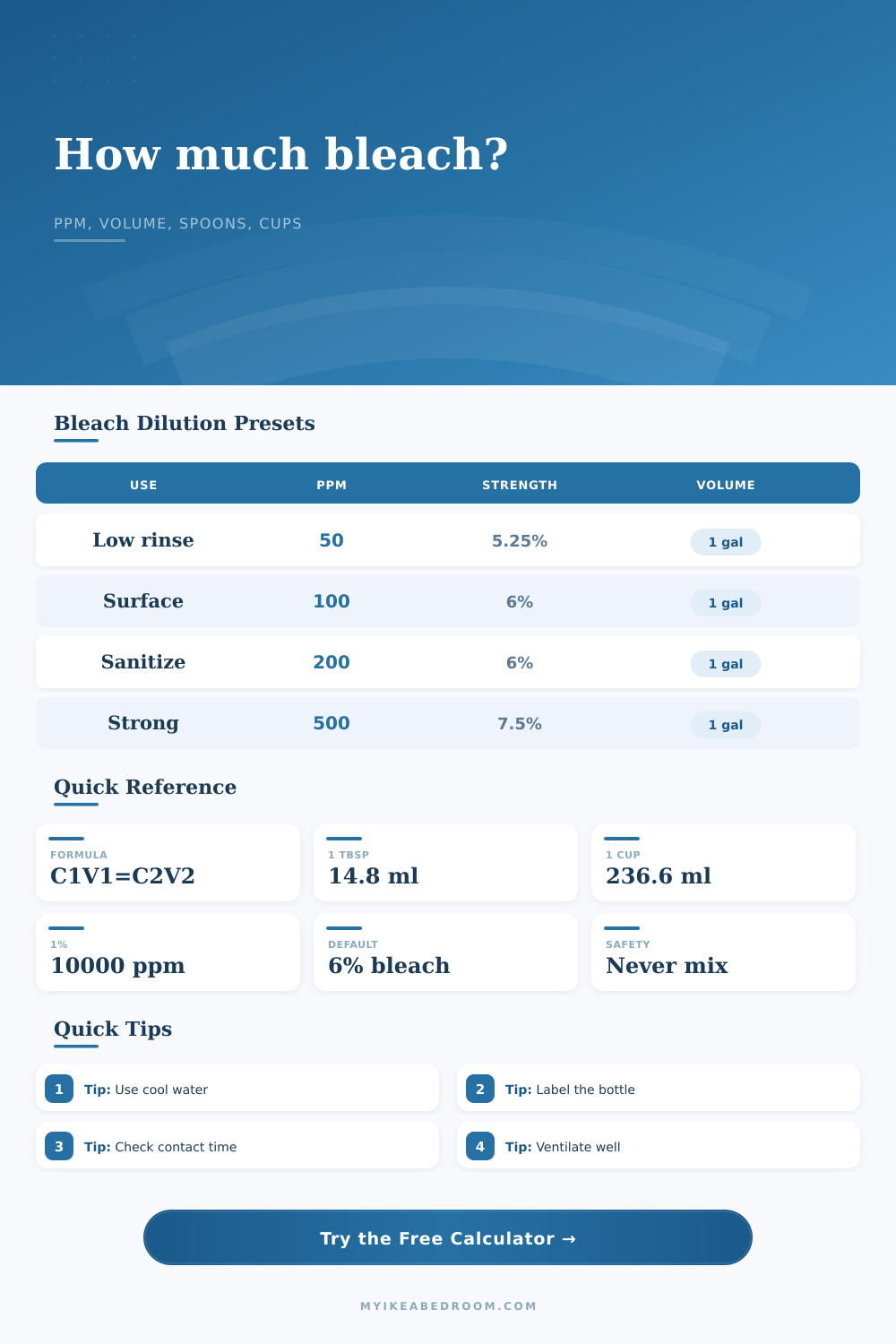
🧪Dilution presets
⚙Dilution inputs
C1V1=C2V2, so bleach volume V1 = target ppm x final volume / bleach ppm
Your bleach dilution result
📌Measurement quick cards
📊Common target ppm reference
| Planning target | Target ppm | Formula note | Contact-time note |
|---|---|---|---|
| Low chlorine rinse planning | 50 ppm | Small V1 from C1V1=C2V2 | Check the product label. |
| Light nonporous surface batch | 100 ppm | Double the 50 ppm bleach amount. | Keep surface wet as labeled. |
| General sanitizing batch | 200 ppm | Four times a 50 ppm batch. | Follow label contact time. |
| Moderate household solution | 500 ppm | Ten times a 50 ppm batch. | Do not shorten wet time. |
| High-strength planning batch | 1000 ppm | Target ppm divided by source ppm. | Ventilate and follow label. |
| Very strong planning batch | 5000 ppm | Use careful measuring and labeling. | Use only where label allows. |
🧮Bleach amount examples for 1 gallon
| Target ppm | 5.25% bleach | 6% bleach | 8.25% bleach |
|---|---|---|---|
| 50 ppm | 3.6 ml / 0.24 tbsp | 3.2 ml / 0.21 tbsp | 2.3 ml / 0.16 tbsp |
| 100 ppm | 7.2 ml / 0.49 tbsp | 6.3 ml / 0.43 tbsp | 4.6 ml / 0.31 tbsp |
| 200 ppm | 14.4 ml / 0.97 tbsp | 12.6 ml / 0.85 tbsp | 9.2 ml / 0.62 tbsp |
| 500 ppm | 36.1 ml / 2.44 tbsp | 31.5 ml / 2.13 tbsp | 22.9 ml / 1.55 tbsp |
| 1000 ppm | 72.1 ml / 4.88 tbsp | 63.1 ml / 4.27 tbsp | 45.9 ml / 3.10 tbsp |
| 5000 ppm | 360.5 ml / 1.52 cups | 315.5 ml / 1.33 cups | 229.4 ml / 0.97 cups |
🫗Volume conversion table
| Unit | Milliliters | Tablespoons | Use in this calculator |
|---|---|---|---|
| 1 teaspoon | 4.9289 ml | 0.333 tbsp | Very small bleach additions. |
| 1 tablespoon | 14.7868 ml | 1 tbsp | Common measuring spoon amount. |
| 1 fluid ounce | 29.5735 ml | 2 tbsp | Small cup or bottle batches. |
| 1 cup | 236.588 ml | 16 tbsp | Large bucket additions. |
| 1 quart | 946.353 ml | 64 tbsp | Sprayer or storage bottle size. |
| 1 gallon | 3785.412 ml | 256 tbsp | Bucket and mop-pail batches. |
📋Preset breakdown table
| Preset | Source strength | Target and volume | Approximate bleach amount |
|---|---|---|---|
| Low rinse | 5.25% | 50 ppm, 1 gallon | 3.6 ml, less than 1 teaspoon. |
| Light surface | 6% | 100 ppm, 1 gallon | 6.3 ml, about 1.3 teaspoons. |
| Kitchen tools | 6% | 200 ppm, 1 gallon | 12.6 ml, about 0.85 tablespoon. |
| Spray bottle | 7.5% | 500 ppm, 32 fl oz | 6.3 ml, about 1.3 teaspoons. |
| Quart bottle | 6% | 1000 ppm, 1 quart | 15.8 ml, about 1.07 tablespoons. |
| Counter batch | 7.5% | 1200 ppm, 2 liters | 32 ml, about 2.16 tablespoons. |
| Mop bucket | 6% | 2400 ppm, 2 gallons | 302.8 ml, about 1.28 cups. |
| Strong bucket | 8.25% | 5000 ppm, 1 gallon | 229.4 ml, about 0.97 cups. |
| Metric liter | 5.25% | 1000 ppm, 1 liter | 19 ml, about 1.29 tablespoons. |
| Metric bucket | 7.5% | 2000 ppm, 5 liters | 133.3 ml, about 0.56 cups. |
💡Measuring tips
⚠Safety warning
According to bottle, it’s 6 percent sodium hypochlorite, but you need something far weaker for cleaning your kitchen counter. Because they believe more is better most of us pour full-strength bleach all over everything. That typicaly leads to trouble.
Bleach doesn’t clean well when it’s the wrong strength. It damages the finish, it smells bad and it’s wasteful. Why? When diluted correctly, bleach are an effective germ fighter; any less is just soap. Any more is corrosive and dangerous. It’s the missing link that connects the full-strength stuff from jug to the diluted water that won’t burn your eyes or turn your hands into raisins.
How to Mix Bleach Safely
First, you enter the concentration on the back of your bottle; this changes depending off location and brand. Next, you select your desired concentration, measured in parts per million (ppm). That sounds complicated but all ppm do is count the number of chlorine molecules in every liter of water. For instance, a light duty wipe-down may only call for a hundred ppm whereas a heavy-duty mop bucket could requires two thousand.
The volume conversion happen automatically through the calculator. It informs you precisely how many milliliters of bleach to pour into whatever size container you’re using. The last part that confuse people is the volume field. Remember here that this field isn’t how much water you’re making; it’s how much solution in total you desire. So if you wish to make a gallon of spray, type in “one gallon.” From there, the calculator will figure out exactly how much bleach to add and amount of water needed for your chosen volume. It takes into account the little bit of space the bleach occupies itself. This detail has been forgotten by many other online instructions but pays off when you’re topping up your mop bucket or sanitizing an entire batch of kitchen tools.
This is chemistry. Bleach degrades over time. Light and heat accelerate its breakdown. When bleach are diluted, it lose strength quickly. That’s why the tool remind you to make up fresh solutions. When you mix, you’re on the countdown clock. Chemistry says that if you make up a gallon to use tomorrow on your floor, by evening what was once strong may only be half-strength. You should of made it fresh. Pros know this; they don’t prep a week’s worth of solution on Sunday, they mix small amounts at the moment of need.
For common tasks, there’s a quick sanity check provided by the reference tables on the page. For example, a five percent solution doesn’t take as much liquid than an eight percent one does. And you’ll see when going to higher concentrations (stronger source bleach) that you need less liquid to get going. Less liquid to measure means more precise, which is great, but also tricky if all you have is a measuring cup. You can switch between cups, tablespoons, and milliliters to match what you have in your measuring spoons. This removes the hassle of converting units so you can get on with the task.
But first, safety: never combine any of these chemicals. Mixing chlorine (bleach) with ammonia or vinegar will create poisonous gas that can instantly harm your lungs. Open up the space. Always wear gloves when using higher concentrations. And always follow the contact time. Contact time means how long the surface need to be wet in order to effectively kill the germs. If you dry it right away you defeat the purpose. Let it soak so the chemistry has time to do its job.
Respect bleach (It’s just a simple tool). It’s not how much you use. It’s how much is needed. Time, volume and concentration is related. Get it right and the math becomes a guide and less of a barrier. Then go in there and clean with confidence, no guessing. Mix a fresh solution and label your container. Getting those last few milliliters exactly right can make the difference between a stain or a sanitized surface.