Grass Seed Quantity Calculator
Estimate seed quantity from lawn area, seed rate, new lawn or overseed mode, grass type, germination percentage, slope and waste buffer, bag size, and metric kg per 100 m2 rate.
🌱Lawn seeding presets
Choose a starting lawn scenario, then adjust the area, seed rate, germination, slope or waste allowance, and bag size.
⚙Lawn area, seed rate, and seed quality
Grass seed quantity results
📌Grass type seed rate cards
📊Seed rate conversion table
| Rate in lb/1000 sq ft | Rate in kg/100 m2 | Use pattern | Example grass types |
|---|---|---|---|
| 0.5 lb | 0.24 kg/100 m2 | Very light overseed or small seeded warm-season grass | Centipede, Bermuda |
| 1 lb | 0.49 kg/100 m2 | Light warm-season seeding or thin overseed | Bermuda, zoysia |
| 2 lb | 0.98 kg/100 m2 | Warm-season new lawn or moderate cool-season overseed | Bermuda, zoysia, bluegrass |
| 4 lb | 1.95 kg/100 m2 | Typical overseed rate for many cool-season lawns | Tall fescue, fine fescue, ryegrass |
| 6 lb | 2.93 kg/100 m2 | Lower new-lawn rate for cool-season blends | Bluegrass, fine fescue |
| 8 lb | 3.91 kg/100 m2 | Common new-lawn rate for durable cool-season turf | Tall fescue, ryegrass blends |
| 10 lb | 4.88 kg/100 m2 | Heavy new-lawn rate for fast cover or rough seedbeds | Ryegrass, tall fescue, bahia |
📝New lawn versus overseed table
| Grass type | New lawn rate | Overseed rate | Planning note |
|---|---|---|---|
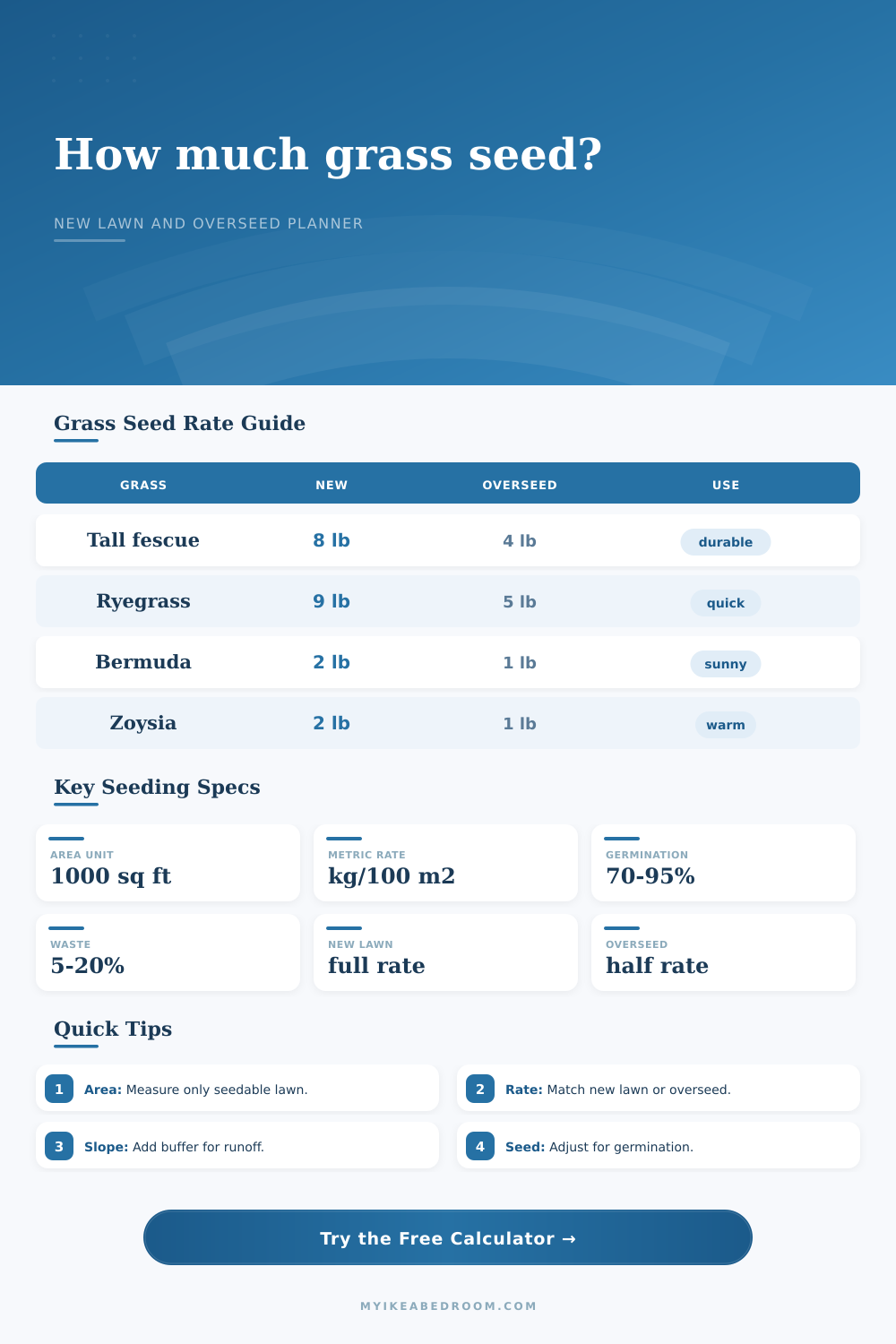
| Kentucky bluegrass | 6 lb/1000 sq ft | 2.5 lb/1000 sq ft | Smaller seed; keep soil contact high. |
| Perennial ryegrass | 9 lb/1000 sq ft | 4.5 lb/1000 sq ft | Fast germination, useful for quick cover. |
| Tall fescue | 8 lb/1000 sq ft | 4 lb/1000 sq ft | Durable default for many home lawns. |
| Fine fescue | 5 lb/1000 sq ft | 2.5 lb/1000 sq ft | Useful for shade and lower-input areas. |
| Bermuda grass | 2 lb/1000 sq ft | 1 lb/1000 sq ft | Warm-season seed with lighter rates. |
| Zoysia grass | 2 lb/1000 sq ft | 1 lb/1000 sq ft | Slow to establish; rate is only part of planning. |
| Bahia grass | 8 lb/1000 sq ft | 4 lb/1000 sq ft | Often used for sunny, open, lower-care areas. |
| Centipede grass | 0.75 lb/1000 sq ft | 0.35 lb/1000 sq ft | Very small seed; avoid over-application. |
🧮Preset quantity examples
| Lawn preset | Lawn area | Grass and purpose | Seed before bag rounding |
|---|---|---|---|
| Small Patch Repair | 120 sq ft / 11.1 m2 | Perennial ryegrass new lawn | About 1.5 lb with buffer |
| Townhouse Front | 450 sq ft / 41.8 m2 | Tall fescue new lawn | About 4.7 lb with buffer |
| Shaded Side Yard | 620 sq ft / 57.6 m2 | Fine fescue new lawn | About 4.2 lb with buffer |
| Family Backyard | 1,800 sq ft / 167.2 m2 | Tall fescue new lawn | About 18.6 lb with buffer |
| Overseed Refresh | 2,200 sq ft / 204.4 m2 | Kentucky bluegrass overseed | About 7.1 lb with buffer |
| High-Traffic Lawn | 1,400 sq ft / 130.1 m2 | Tall fescue overseed | About 7.5 lb with buffer |
| Sunny Bermuda | 900 sq ft / 83.6 m2 | Bermuda new lawn | About 2.4 lb with buffer |
| Zoysia Renovation | 750 sq ft / 69.7 m2 | Zoysia new lawn | About 2.0 lb with buffer |
| Bahia Road Strip | 1,250 sq ft / 116.1 m2 | Bahia new lawn on slope | About 14.4 lb with buffer |
| Metric Lawn Bed | 60 m2 / 646 sq ft | Perennial ryegrass overseed | About 3.8 kg with buffer |
💡Grass seed quantity tips
It only measures real grass area. Not everything in your yard is the lawn. Tree rings aren’t included as lawn. Patios isn’t included as lawn.
If people counts in paved/landscaped areas when calculating their lawn, then they are overbuying seed. They end up with leftover seed because they measured from fence-to-fence which include their driveway. The page’s calculator forces you to think about what is actualy getting seeded.
How to Know How Much Seed to Buy
Input a rectangle’s length and width OR if your yard isn’t a perfect rectangle, enter a custom total.
How much seed do I need? The answer vary a lot depending on what kind of project it is. If it’s new soil, which is bare and hostile to seeds, you’ll want to apply heavy coat. If you’re overseeding an existing lawn (filling holes instead of blanketing empty ground) you will use far fewer seed; that difference alone will reduce your purchase by half.
Most folks don’t think about seed quality till they’re already in trouble. What does it mean? That number on the bag indicates what percentage of the seed should germinate. Eighty five percent? Fifteen percent of those seeds is no good. You’ll have less-than-you-think seed so you’ll need to purchase some more seed. This calculator take care of that for you automatically. Knowing how it works, though, helps you identify poor value when shopping.
Lower germination rates are a clue (as are higher weed content). Buying premium seed may cost you more per bag but if more of the seed survive, you may end up needing to purchase fewer bags in total.
Then there’s waste. Rain washes it into the gutter; wind blows seed away; birds eat it. On sloped areas, seed slide downhill. Realism, rather than pessimism, says we need a buffer against both of these thing: slope and waste. Gravity lowers the success rate if your lawn sits on a hillside. You can make up for this loss using the tool, adding a percentage based off how much seed fails to remain in place.
A safe figure for flat areas would be 10 percent, but for those with slopes you’d do better than 20 percent. Otherwise, you’ll have some thin spots where terrain got tough.
The reason why the calculator tells you to buy whole bags (there’s no buying a fraction of a bag) has nothing to do with your lawn shape or geometry; it has to do with retail convenience, i.e., standardizing bag sizes. If you require 5.5 pounds of seed, sorry, can’t sell that to you. You can only buy whole bags. And the calculator will round up, telling you how many full bags to add to the cart. So you don’t have to go back to the nursery to pick some more up when you’re halfway through mowing the place.
It’ll also help you plan your mow-outs: A couple of lighter passes at right angles to each other are preferable to a single extra-heavy pass that will tend to clump seeds, creating weak root systems and inviting disease. Even distribution is best accomplished with two light passes. By using multiple passes, you divide the total amount of seed into smaller portions so you can track how much goes in the spreader each time.
On the page is a rate chart that gives varying rates based on type of grass. Cool season grasses (Tall Fescue) requires much more seed than warm season ones (Bermuda). Why? Biology: Seed size and number. There are many tiny Bermuda grass seeds per pound; one pound goes a long way. Because fescue has larger but fewer seeds per pound, you need more weight to cover the same area.
This isn’t something you have to memorize. All you have to know is what grass you have, and if you’re fixing it, or starting from scratch. It’s math, the rest is arithmetic.
Remember: we want a healthy lawn that’s thick, not a bag of un-needed seed sitting in the garage. Use the correct measurements, account for reality, and believe your math. You should of believed me: your lawn won’t be full of holes. It’ll be green.