Lawn Fertilizer Quantity Calculator
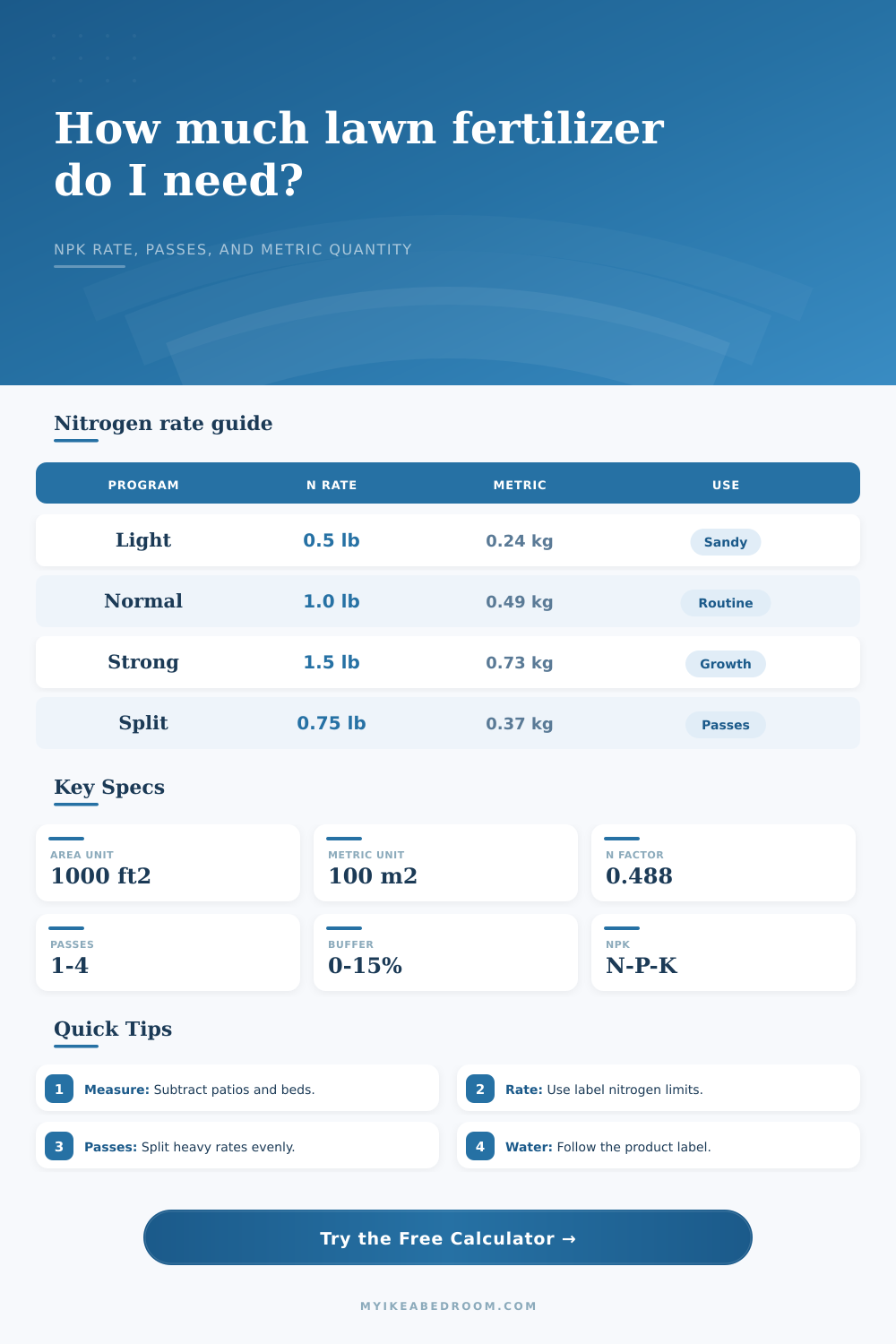
Estimate product weight from lawn area, target nitrogen rate, fertilizer NPK percent, spreader passes, bag size, and metric kg per 100 m².
Detailed Breakdown
| Target nitrogen rate | Metric equivalent | Typical lawn use | Calculator note |
|---|---|---|---|
| 0.25 lb N / 1000 sq ft | 0.12 kg N / 100 m² | Very light spoon-feed rate for small turf adjustments. | Useful when splitting a program into several gentle applications. |
| 0.50 lb N / 1000 sq ft | 0.24 kg N / 100 m² | Light application for sandy soil, shaded turf, or new sod support. | Often pairs well with two spreader passes for thin product amounts. |
| 0.75 lb N / 1000 sq ft | 0.37 kg N / 100 m² | Moderate feed for managed cool-season or warm-season lawns. | A balanced target when the fertilizer label allows the total nitrogen load. |
| 1.00 lb N / 1000 sq ft | 0.49 kg N / 100 m² | Common full-rate lawn application for active turf growth. | The product amount changes sharply when the nitrogen percentage changes. |
| 1.50 lb N / 1000 sq ft | 0.73 kg N / 100 m² | Heavy total nitrogen amount, usually better split into passes or dates. | Check product label limits before using a high target in one application. |
| Fertilizer analysis | Product for 1 lb N | Product for 0.5 lb N | What the math means |
|---|---|---|---|
| 10-10-10 | 10.00 lb / 1000 sq ft | 5.00 lb / 1000 sq ft | Lower nitrogen percent needs more product weight to reach the same nitrogen target. |
| 16-4-8 | 6.25 lb / 1000 sq ft | 3.13 lb / 1000 sq ft | A middle-strength lawn analysis with nitrogen, phosphate, and potash included. |
| 24-0-10 | 4.17 lb / 1000 sq ft | 2.08 lb / 1000 sq ft | Higher nitrogen percent lowers product weight while still delivering the target N. |
| 29-0-5 | 3.45 lb / 1000 sq ft | 1.72 lb / 1000 sq ft | Strong nitrogen analysis often needs careful spreader calibration. |
| 32-0-4 | 3.13 lb / 1000 sq ft | 1.56 lb / 1000 sq ft | Very concentrated product creates a small product quantity for the same target. |
| Lawn area | Metric area | At 1 lb N with 24% N | Two-pass spreader amount |
|---|---|---|---|
| 1,000 sq ft | 92.9 m² | 4.17 lb product | 2.08 lb product per pass |
| 2,500 sq ft | 232.3 m² | 10.42 lb product | 5.21 lb product per pass |
| 5,000 sq ft | 464.5 m² | 20.83 lb product | 10.42 lb product per pass |
| 7,500 sq ft | 696.8 m² | 31.25 lb product | 15.63 lb product per pass |
| 10,000 sq ft | 929.0 m² | 41.67 lb product | 20.83 lb product per pass |
| Spreader plan | Pass count | How to divide product | When it helps |
|---|---|---|---|
| Single pass | 1 | Apply the full calculated product amount once. | Works for low product rates on simple rectangular lawns. |
| Cross pattern | 2 | Apply half the total in each direction. | Helps reduce stripes and overlap marks on most lawns. |
| Light split | 3 | Apply one third of the product per pass. | Useful when the per-pass comfort check is above the selected limit. |
| Fine calibration | 4 | Apply one quarter of the product per pass. | Helpful for small lawns, high nitrogen products, and narrow spreader settings. |
The hardware store aisle is filled with bags of fertilizer, all looking very much alike. Promises of bright green color fill the label; then there’s the fine print, the critical stuff. The numbers listed in the upper right (N-P-K ratio) aren’t just hype. That equation explains if I am nourishing my lawn or drowning it.
Guessing, most home gardeners do. Is wasteful and can burns up turf. A chemical, after all.
How to Use the Fertilizer Calculator Correctly
The calculator at the top does the math for you, if you enter your desired amount of nitrogen and how big an area you’re treating. You avoid having to do the division (percentages!) yourself, and convert square footage into bag weights.
First is the actual area of your lawn. Many people includes their total property, including patio and driveway, in their measurements. That will increase your required amount of product right away. Subtracting these non-grass areas (which don’t take up fertilizer) are essential.
The best thing about this tool is that you can create your own area or just enter measurement for each dimension. But remember, you get a more precise measurement if you only measure the turf part. A small step, but it helps prevent over-applying anything BEFORE you grab the spreader.
The nitrogen target is the engine of the equation. It’s the nutrient that promotes both color and growth, but too much nitrogen can burns the grass. How much to apply depends on your goal, hence the reference table on the page that shows typical rates for various purposes. Half a pound per thousand square feet may be all that a sandy soil want; maybe more like a full pound for green-up in early spring for strong turf. What you choose should of match your soil conditions and type of grass… Not merely what’s convenient.
How much physical product will deliver that target dose of nitrogen? That’s what the N-P-K numbers on the bag tell you. You will need to spread much more weight of a 10-10-10 blend to get the same amount of nitrogen as a 24-0-10 mix.
Here’s where folks err: They think all fertilizers spread equally by volume. But they don’t. Depending on the concentration, a smaller amount of product can weighs the same. When you calibrate your spreader, that matters. The calculator gets rid of those pesky decimal conversions and tells you exactly the pounds to apply based off dividing the target nitrogen by the nitrogen percent.
Another practical variable is the spreader pass number. You don’t want to risk applying everything at once. That results in missed spots, streaking and possible runoff. Instead, spread applications over multiple passes which gives you even coverage. With this tool, you select a pass number and whether your equipment can handle the amount applied with each pass. If not, the tool flags that, alerting you that you need to either decrease the buffer or increase the number of passes. It is a handy safety check against scorched turf and other clumping problems.
Because most of the new standards are measured in kilograms per hundred square-meters, it includes metric conversion; if you’re not into kilograms, it’s an easy place to lose track of units. Displaying both together allows you to check yourself against your gut feeling.
The buffer option takes into account human error. We all overlap our grass by a bit at the property line, and I do have that little flower bed edged. This gives you some wiggle room so that you don’t buy another whole bag just to top off the edges. Ten percent is naturaly a good average suburban lawn number.
All that adds up to this: Fertilization is a balancing act. If you give too little, your grass will be pale and weak. Give too much, and you’ll waste the fertilizer and also encourage disease in the lawn. You want to give just what the lawn needs, not one bit more or less. Master the math and trust your calculations.
You will go from hoping you got it right to knowing you did. This confidence transforms chores into skills, so you can keep your lawn healthy without the stress of wondering if you’re doing it wrong.