Drip Irrigation Emitter Quantity Calculator
Estimate drip emitter count from plant count and row spacing, then check total flow, liters/hour, runtime gallons, and pressure zone capacity.
🌱Garden and bed presets
⚙Drip zone inputs
The calculator compares a plant-count layout with an emitter-spacing layout and uses the larger quantity before adding your spare emitter buffer.
Your drip emitter estimate
🧮Formula used
plant emitters = plant count × emitters per plant
spacing emitters = row count × (floor(row length inches / emitter spacing inches) + 1)
zone flow GPH = recommended emitters × adjusted GPH per emitter
📊Common emitter flow cards
📐Emitter spacing reference
| Plant or bed type | Typical emitter spacing | Emitters per plant | Planning note |
|---|---|---|---|
| Leafy greens and herbs | 6-12 in (15-30 cm) | 1 per small plant | Use closer spacing for dense rows. |
| Tomatoes and peppers | 12-18 in (30-46 cm) | 1-2 per plant | Place emitters near the root zone. |
| Berries and vines | 12-24 in (30-61 cm) | 2 per plant | Keep the wetted strip continuous. |
| Shrubs and perennials | 18-36 in (46-91 cm) | 2-4 per plant | Use multiple emitters around larger roots. |
💧Flow capacity table
| Emitter flow | 50 emitters | 100 emitters | Approx max on 5 GPM zone |
|---|---|---|---|
| 0.5 GPH (1.9 L/hour) | 25 GPH / 95 L/hour | 50 GPH / 189 L/hour | 600 emitters |
| 1.0 GPH (3.8 L/hour) | 50 GPH / 189 L/hour | 100 GPH / 379 L/hour | 300 emitters |
| 2.0 GPH (7.6 L/hour) | 100 GPH / 379 L/hour | 200 GPH / 757 L/hour | 150 emitters |
| 4.0 GPH (15.1 L/hour) | 200 GPH / 757 L/hour | 400 GPH / 1,514 L/hour | 75 emitters |
🔧Pressure zone guide
| Pressure zone | Planning psi | Flow factor used | Best use |
|---|---|---|---|
| Low pressure | 10-15 psi | 0.85x rated GPH | Short beds or gravity-fed layouts. |
| Standard drip | 20-25 psi | 1.00x rated GPH | Most small garden drip zones. |
| High pressure | 30 psi | 1.10x rated GPH | Use regulation before drip tubing. |
| Regulated PC | 15-45 psi | 1.00x rated GPH | Pressure-compensating emitters. |
🌱Garden preset examples
| Preset | Plant and row basis | Emitter setup | Flow and runtime cue |
|---|---|---|---|
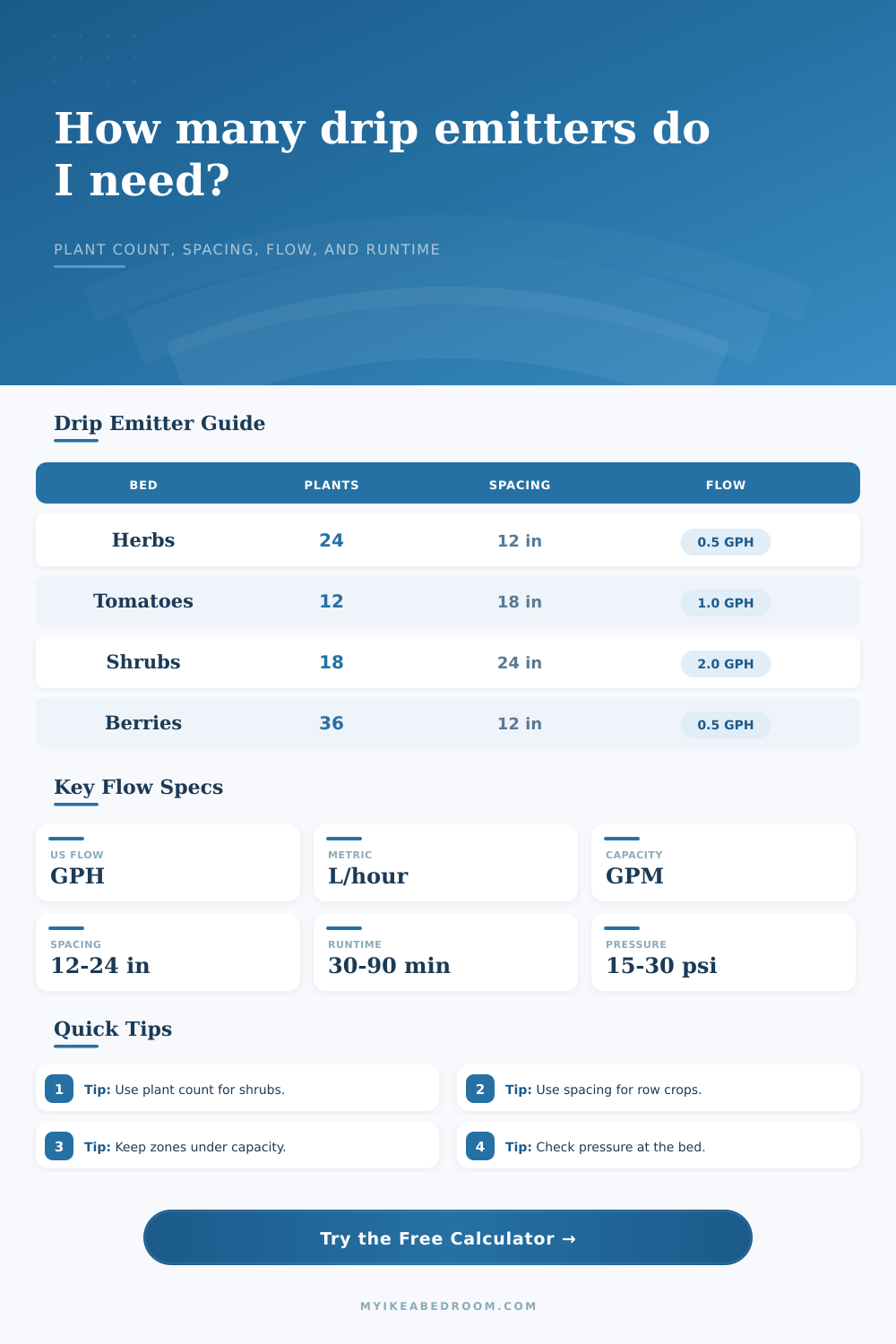
| Herb raised bed | 24 plants, 2 rows at 8 ft | 12 in spacing, 0.5 GPH | Light flow for shallow roots. |
| Tomato row | 12 plants, 1 row at 24 ft | 18 in spacing, 1.0 GPH | Longer runtime for deep watering. |
| Berry bed | 36 plants, 3 rows at 32 ft | 12 in spacing, 0.5 GPH | Continuous wetted strip. |
| Shrub border | 18 plants, 1 row at 54 ft | 24 in spacing, 2.0 GPH | Higher flow per plant cluster. |
💡Drip layout tips
Think you need a huge number of drip emitters for this or that garden bed? Panic sets in and so does confusion: How many should I order, and how do I know? Order too few and the tomatoes wilts; order too many and you’ll have spent money on things you don’t need.
That’s where the drip irrigation emitter quantity calculator come in, provided you grasp the meaning behind the inputs. Knowing that… And not just counting holes in a piece of tubing; is the difference between having a working system and simply one that looks like one. It’s about matching your soil with water volume, pressure, and time management.
How to Use the Drip Irrigation Calculator
Novices often assume all plants is equally thirsty. A rose bush isn’t a lettuce, right? And that’s where the option to input either row spacing or plant count comes into play with the tool. If you’re growing vegetable in regular garden rows, the spacing will help. How long of a piece of tubing and at what frequency do you want emitters on that line? For example. With trees or shrubs spaced individually, plant count matter more. How many water points do you want around each tree or shrub root ball?
The calculator calculates both ways and then goes with bigger of the two. Never again fear under-watering (because you used the wrong measuring method). It is a math safety net.
Drip systems also suffer from pressure issues. Too little: Your emitters will dribble, not really drip. Too much: They’ll spew as if they were tiny sprinklers, wasting water by evaporating it. Why does the tool’s pressure zone selector exist? The selected flow adjusts according to expected pressure. Standard emitters works best with most residential lines at about twenty to twenty-five psi (the pressure in most houses). If you’re on a weak pump or using a gravity-fed system, choose the low-pressure setting. This lowers the calculated flow to match what can actualy happen. It helps you avoid frustration of plants sitting in drier soil then intended because the water didn’t get through.
Flow capacity is where dreams meet plumbing. Based off your supply line, regulator, and filter, every zone has a maximum capacity. The calculator compares your entered capacity to your total zone flow. For example, if you attempt to run two hundred emitters off a line with only ten gallons per minute, it won’t work. Your pressure will drop. In the worst case, those emitters on the far side of the line won’t get any water. A general rule is to use less than eighty-five percent of capacity for each zone. That way there’s some wiggle room if something goes wrong (such as turning on a house faucet) or if sediment accumulates in the filter. The capacity check tell you before you put down any tubing.
The last component of the plan is runtime. Sure, it’s nice to know your system puts out X gallons per hour…but how many gallons do you want to apply during each watering cycle? That impacts plant health. So the tool takes your flow rate and the time you want to run it and spits out total volume. You can then determine whether that will be enough (thirty minutes?) or not (two hours?). If your soil is sandy, things drains quickly and require shorter (but more frequent) runs. If your soil is clay, it retains moisture and prefers longer, slower soakings. Knowing how many gallons are used per run, you’ll know just how much water reaches the ground. Adjust to match the nature of your soil and weather conditions. This eliminates guesswork.
Do not go without spare emitters. This is insurance. If you set your buffer at 10 percent (a good number), it will add that many more than your count. This compensates for gaps between the plants and your grid, clogged emitters, or missing end-caps. And it means you’ll have some spares on hand when one does get clogged, as inevitable will happen, usually about three days after planting time. You should of not scrimp on the spares. They’re cheap compared to cost of digging up a bed because you ran out of parts.
But with drip, it’s just a matter of decisions: Pick your plants; measure your area; program your timer. Run that info through the calculator up top and let it run the numbers for you. Convert it all to a list of parts. That’s where the art comes in: knowing why the numbers add up as they do. You must understand what the physics of water has to do with the biology of plants. Get the balance so the water simply vanishes beneath the surface. You cannot see it, but it works efficienty as the garden grows.