Compost Bin Size Calculator
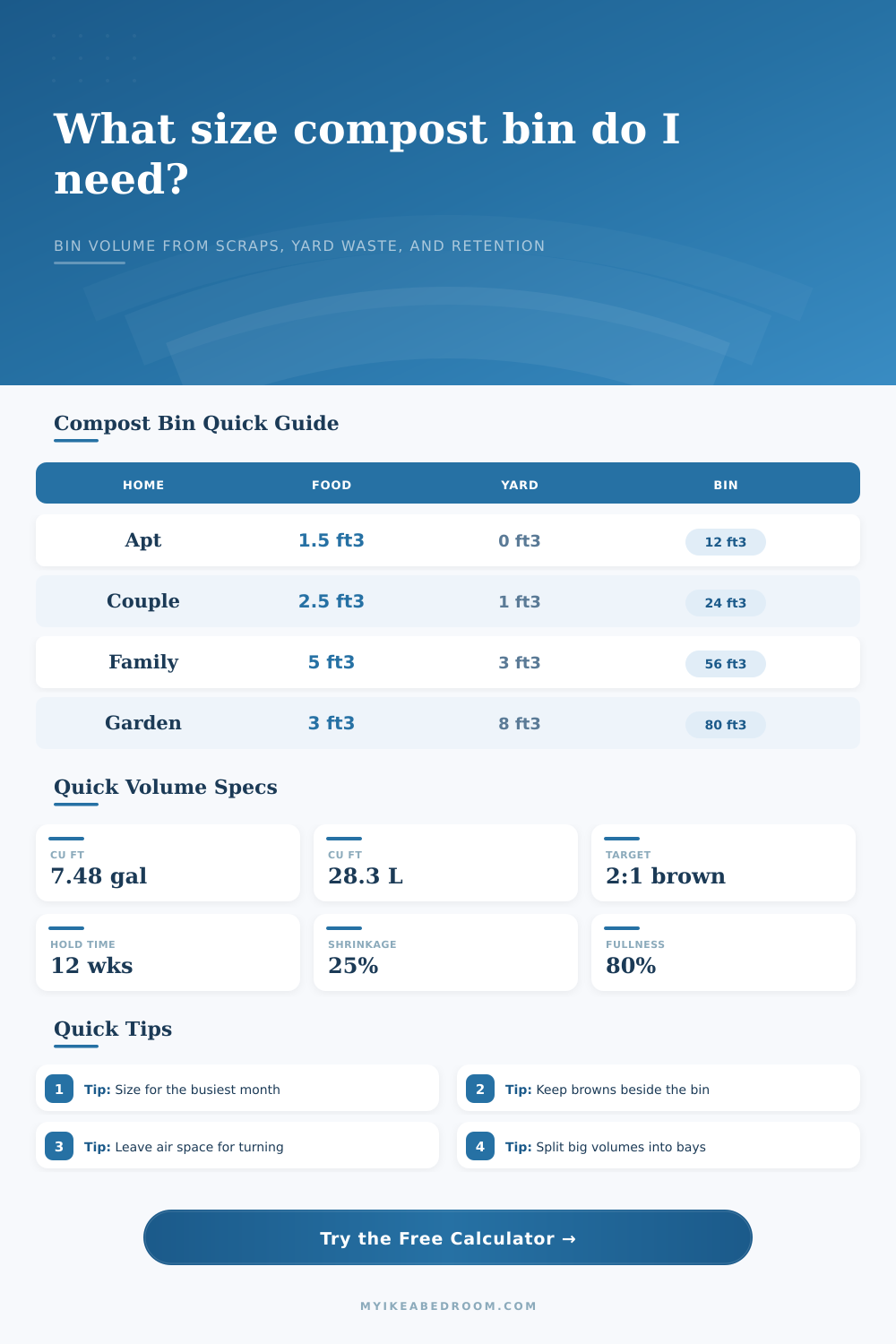
Estimate the bin volume you need from household food scraps, yard waste volume, retention weeks, shrinkage percentage, working fullness, and the green:brown ratio.
■Household and garden presets
■Compost volume inputs
Enter weekly material volume. The calculator stores everything as cubic feet, then converts bin volume to gallons and liters.
Compost volume breakdown
■Compost feedstock cards
■Reference tables
Green:brown ratio guide by loose volume
| Mix setting | Use when | For 5 cu ft greens | Calculator effect |
|---|---|---|---|
| 1:1.5 | Dry, leaf-heavy mix | 7.5 cu ft browns | Smallest balanced bin volume |
| 1:2 | Typical kitchen plus yard mix | 10 cu ft browns | Good default for sizing |
| 1:2.5 | Wet food scraps or fresh grass | 12.5 cu ft browns | Adds air and odor buffer |
| 1:3 | Very wet greens or slow turning | 15 cu ft browns | Largest brown-rich bin volume |
Bin volume conversions
| Cubic feet | Gallons | Liters | Common bin shape |
|---|---|---|---|
| 12 cu ft | 90 gal | 340 L | Small outdoor tumbler or compact bin |
| 27 cu ft | 202 gal | 764 L | 3 ft x 3 ft x 3 ft cube |
| 48 cu ft | 359 gal | 1359 L | 4 ft x 4 ft x 3 ft bay |
| 81 cu ft | 606 gal | 2293 L | 3-bay equivalent at 27 cu ft each |
Retention and shrinkage examples
| Weekly mix | Retention | Shrinkage | Active volume |
|---|---|---|---|
| 4 cu ft | 8 weeks | 20% | 25.6 cu ft before headroom |
| 6 cu ft | 12 weeks | 25% | 54 cu ft before headroom |
| 8 cu ft | 16 weeks | 30% | 89.6 cu ft before headroom |
| 10 cu ft | 20 weeks | 35% | 130 cu ft before headroom |
Common household and garden sizing checks
| Scenario | Weekly greens | Brown need | Typical active bin volume |
|---|---|---|---|
| Apartment scraps | 1.5 cu ft | 3 cu ft | 12-18 cu ft with short retention |
| Small family kitchen | 4 cu ft | 8 cu ft | 45-65 cu ft with yard trim |
| Leaf season storage | 2 cu ft | 4 cu ft | 60-90 cu ft when leaves stay on site |
| Three-bay garden | 8 cu ft | 16 cu ft | 120+ cu ft split across bays |
■Practical sizing tips
This is Compost 101. Most everyone begins composting with best intentions, and a way-too-small bin. They purchase whatever container passes for a drum, cram it full of kitchen scraps, then stand in horror at the sight of a deluged heap within three weeks’ time.
Why? Because volume is a trickster. Fresh leaves look like a lot, yet they collapse. Wet food waste looks like a bucketful, but it need space and structure to settle.
How to Choose the Right Compost Bin Size
Rather than guess at your needs based off household size alone, the calculator above consider such physical truths to estimate how many cubic feet (or liters or gallons) you really require. First of all, understand what you’re putting into the bin (the volume) versus how much space it can physically contain. When you put compostable stuff in, it doesn’t take up full volume, it shrinks! That’s because the microbes is eating away at your yard trimmings and food scraps, taking water from them and reducing their density. This causes the pile to compress a lot. If you don’t plan for the shrinkage when sizing your bin, you’ll end up with a system that’s constantly overflowing. This happens if you think only about volume of material you’re adding weekly and do not account for shrinkage. You need to adjust for anticipated shrinkage, typically on the order of 20-30%, and make sure bin will have sufficient physical capacity to hold the material as it decomposes over weeks or months.
The other part is to balance brown with green. Brown items (called carbon sources) include straw, shredded cardboard and dry leaves. Green items (nitrogen sources) include fresh grass clippings, and all those vegetable peels. It’s really more about the ratio, different than the absolute amount of waste. Too many greens? Not enough brown? Your heap will be smelly and slimy, and pack together so tightly that it won’t allow air into the middle. How do you know what the ratio should be? The calculator tells you how much additional brown stuff to add weekly to keep things cooking happily.
That is often the problem for city dwellers trying small-scale composting. They has a lot of kitchen scraps, but no place to store dry leaves.
The other variable affecting the math is retention time. How often do you turn the pile? Turn it daily and everything go through rapidly; you’ll need less volume of material overall. Or do you like it slow and don’t turn very often? You have a lot more material than you would of otherwise, so now you need a bigger container to accommodate that backlog. What’s your timeframe for letting stuff decompose in the active bin, before moving it into a curing stage? The inputs determine that. If you’re designing a multiple-bay system, such as one for new waste, an active-decomposition bin, and another holding finished compost; this is important.
There are some household presets that may help get you started, but usually it’s better to adjust as necessary. One person who lives alone in an apartment isn’t going to have the same needs as a family with lots of lawn and vegetables. The former is generating mainly small amounts of compact kitchen waste; the latter, seasonal surges of bulky garden trimmings and grass clippings.
Plan for your busiest week, not your average week. Don’t wait till harvest time or leaf season to reassess what you need (then you’ll just be overwhelmed). Plan ahead: no more emergency runs to hardware store, or the embarrassment of dumping half-rotten compost into bags.
There’s one other practical consideration: How much effort will this require? If you stuff everything in a big single bin, how are you going to get that thing turned? Without proper mixing, the heavy stuff on the bottom remain cold and without air. By dividing up the total volume into multiple bins (or even multiple bays within a single bin), you make it easier to turn them and manage air flow as well. Use the calculator to tell you how many bins you want, and then divide the suggested total volume by that amount to find out what each should look like. That way, you’re dealing with several manageable work spaces instead of one giant unmanageable heap.
So what’s the right size? In the end: Whatever size fits your space and your rhythm. Not “as big as possible,” but in the sweet spot of input/output/decomposition balance. Then the pile will decompose efficienty, smell earthy, and remain warm. The numbers line up, and you no longer need to worry about overflows, you get rich soil instead. Isn’t that the point?
Getting the bin size right is only the beginning of a working system. This system should work for you instead of against you.