Home Office Square Footage Deduction Calculator
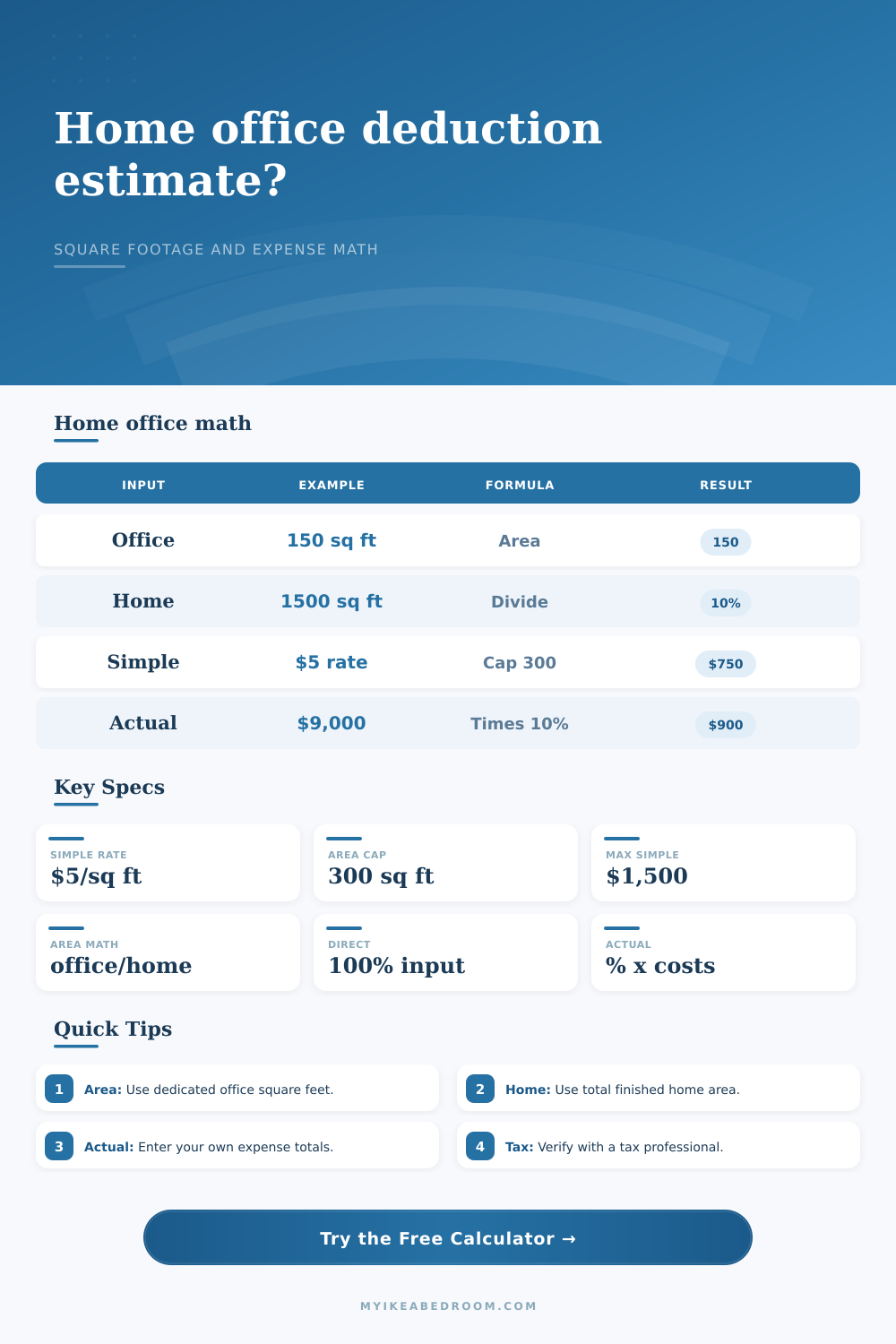
Estimate the dedicated office area percentage, the simplified method amount, and an actual method amount from the expense totals you enter. This calculator is informational and does not determine eligibility.
Pick a sample office setup, then replace the areas and annual expense totals with your own records.
| Dedicated office area | Area used by calculator | Rate | Simplified amount |
|---|---|---|---|
| 75 sq ft | 75 sq ft | $5 per sq ft | $375 |
| 120 sq ft | 120 sq ft | $5 per sq ft | $600 |
| 180 sq ft | 180 sq ft | $5 per sq ft | $900 |
| 300 sq ft | 300 sq ft | $5 per sq ft | $1,500 |
| 420 sq ft | 300 sq ft | $5 per sq ft | $1,500 |
| Office area | Total home area | Percentage formula | Business-use percent |
|---|---|---|---|
| 90 sq ft | 900 sq ft | 90 / 900 | 10.00% |
| 120 sq ft | 1,200 sq ft | 120 / 1,200 | 10.00% |
| 150 sq ft | 1,500 sq ft | 150 / 1,500 | 10.00% |
| 180 sq ft | 2,000 sq ft | 180 / 2,000 | 9.00% |
| 240 sq ft | 1,600 sq ft | 240 / 1,600 | 15.00% |
| Expense type | Calculator treatment | Example input | Example at 10% |
|---|---|---|---|
| Direct office expenses | Added at 100% as entered | $250 | $250 |
| Rent or mortgage interest | Multiplied by area percentage | $7,200 | $720 |
| Utilities | Multiplied by area percentage | $1,800 | $180 |
| Insurance | Multiplied by area percentage | $900 | $90 |
| Repairs and other indirect | Multiplied by area percentage | $950 | $95 |
| Preset | Office / home area | Simplified math | Actual math note |
|---|---|---|---|
| Small desk nook | 45 / 900 sq ft | 45 x $5 | 5% of indirect expenses plus direct expenses. |
| Spare room office | 150 / 1,500 sq ft | 150 x $5 | 10% of indirect expenses plus direct expenses. |
| Finished basement | 240 / 2,400 sq ft | 240 x $5 | 10% of indirect expenses plus direct expenses. |
| Large office cap | 420 / 2,100 sq ft | 300 x $5 | 20% of indirect expenses plus direct expenses. |
| Metric flat office | 12 / 110 m2 | Converted sq ft x $5 | Converted area creates the percentage. |
Use the same area basis: The percentage calculation is dedicated office area divided by total home area, so both entries should use the same unit system.
Keep direct and indirect separate: The calculator adds direct office expenses at 100% and multiplies indirect home expenses by the office percentage.
Read the two method outputs neutrally: The results show simplified and actual method estimates side by side without ranking either method.
Verify before filing: Home office tax rules depend on current IRS guidance and your facts; review records with a qualified tax professional.
Your home office deduction hinges less on the size of the room then on how well you justify its square footage. For many folks, “deducting a portion of my house” conjures up an image of a dedicated walled-off room (complete with door) stocked with a desk and other office equipment. But IRS definition of an eligible workspace is far broader, it could be a renovated closet or even just the corner of a bedroom, provided you consistantly use it for business activities.
This deduction come in two forms, each with its own pros and cons. The caveat is that you has to choose one or the other; you don’t get to mix and match. Many folks struggle with this part.
Choosing Between the Two Home Office Methods
First, there’s the easy route: the simplified version. Here, you just take square footage of your office (up to 300 sq ft) and multiply it by $5. Simple as pie! It doesn’t require much record-keeping, either. Unfortunatley, the simplified version has a hard cap on it, if you’re paying a lot of overhead and/or your office is big, you may end up losing money with the simplified approach. The calculator above indicates when the cap kicks in; use that to help determine whether simple approach makes sense for you.
Now here’s where it gets messy with the real method. Get out your mortgage statement, your insurance policies, and your utility bills. Figure out what percent of your house is an office (based off square footage) and then use that same percent on indirect expenses. With this method, if you paint just the office walls, you can write it off entirely; that’s called direct expense. It’s more complicated than the other one but generally shows reality better. Chances are if you’re working out of a tiny apartment, and it takes up most of the space, you’ll get a larger deduction with the actual method. The table on the next page will help you understand how various cost are handled. Mortgage/rent interest will be split based off percentages while direct repairs won’t.
Why does this matter? Because otherwise you’d end up double-dipping (claiming the same thing twice) or forgetting about legitimate work-related space costs in your home. Your choice between methods depend on how you live. For renters, who face fewer indirect costs than homeowners (who have mortgages and property taxes), the simple method is more attractive. For homeowners whose office space isn’t huge and house isn’t tiny, real method may yield little advantage over the simple rate. Run them both through the calculator, and compare. The real method may just barely bump up the total, in which case, why bother tracking down receipts? Or it may greatly raise the number, in which case, the time invested would of been well-spent.
Also keep in mind: How will this deduction affect you overall? For instance, do you own a house? Does this mean that the basis of your house need adjusting (and therefore will affect any capital gain if/when you sell your house)? That’s something long term that many homeowners forget about. The calculator gives you an estimated number… But doesn’t take into account your unique financial past/present/future. It’s an information tool, not legal advice. Use it as a general number to get a feel for what the square footage will turn into dollar-wise and to ensure you didn’t mess up your math somewhere along the line.
You want to be able to back up your claims. If you choose easy five-buck per square foot rate (or whatever you’re choosing!), then stick with it. Don’t go crazy dividing up your utility bills, but also don’t let anything slip through the cracks. Choose something, stick to it throughout the year, and keep good records. Once you’ve got the numbers, the math is straightforward. Let the tool do calculations for you.
Now you can step back and think about the big picture. Your time isn’t worth maximizing every last penny, not at all costs. Claim what’s right for you honestly and accuratley. When your numbers reflect your reality, you can file with confidence. That’s where the true value lies when you prepare in advance.