Shower Curtain Size Calculator
Calculate shower curtain width, drop length, fullness, panel split, liner overlap, and centimeter equivalents for straight rods, stalls, wide tubs, and clawfoot wrap layouts.
Choose a starting point, then adjust the installed rod width, hanging drop, liner overlap, and fullness factor to match the real bathroom.
Use the actual installed rod or track width. Metric entries are converted to inches internally, and every result includes centimeters.
Shower curtain size result
| Preset | Rod or track width | Drop length | Fullness | Typical sizing note |
|---|---|---|---|---|
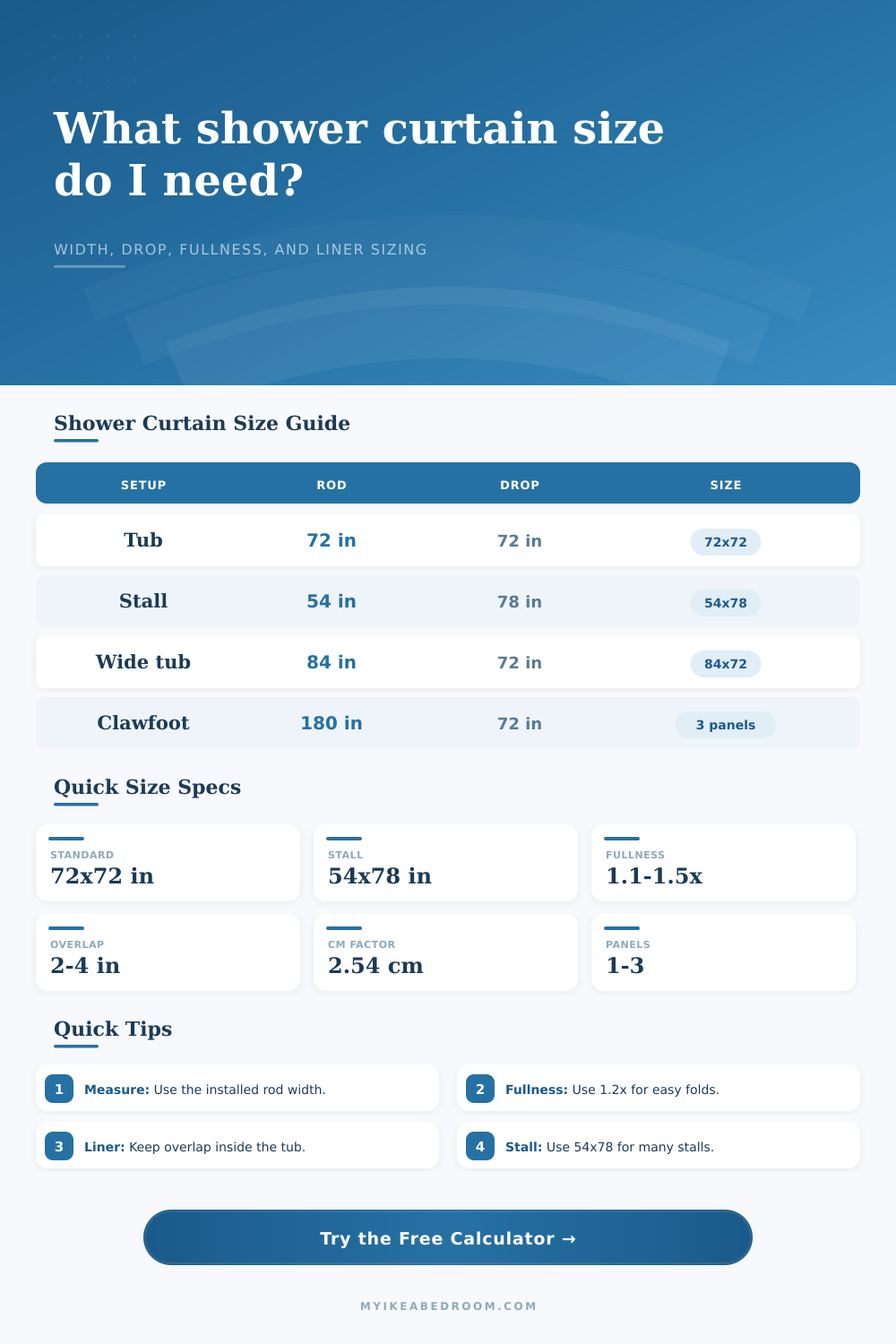
| Standard tub | 72 in / 183 cm straight rod | 72 in / 183 cm drop | 1.15x | Standard 72x72 curtain often works with light folds. |
| High rod tub | 72 in / 183 cm straight rod | 78 in / 198 cm drop | 1.15x | Use a longer drop when the rod is mounted higher than usual. |
| Stall shower | 54 in / 137 cm opening | 78 in / 198 cm drop | 1.10x | Common stall reference is 54x78 inches. |
| Narrow stall | 48 in / 122 cm opening | 72 in / 183 cm drop | 1.15x | Choose a curtain that is wider than the opening plus overlap. |
| Wide tub | 84 in / 213 cm rod | 72 in / 183 cm drop | 1.20x | Often needs an 84 in curtain or two narrower panels. |
| Curved rod | 72 in / 183 cm span | 72 in / 183 cm drop | 1.20x | Add side return so the curtain reaches the wall ends. |
| Clawfoot half wrap | 120 in / 305 cm track | 72 in / 183 cm drop | 1.25x | Split into two panels for easier entry and overlap. |
| Clawfoot full wrap | 180 in / 457 cm oval track | 72 in / 183 cm drop | 1.30x | Use multiple panels and check liner overlap around the full tub. |
| Fullness factor | Best use | Width formula | Fold appearance |
|---|---|---|---|
| 1.10x | Stalls, tight spaces, or simple liners | Rod coverage x 1.10 | Minimal folds with less fabric stack at one side. |
| 1.15x | Standard 72 in tub rods | Rod coverage x 1.15 | Light folds while keeping the curtain easy to slide. |
| 1.20x | Everyday tub-shower layouts | Rod coverage x 1.20 | Balanced folds for most straight or curved rods. |
| 1.25x | Wide rods and half-wrap tracks | Rod coverage x 1.25 | Softer folds with better side coverage. |
| 1.30x | Clawfoot wraps and fabric curtains | Rod coverage x 1.30 | Fuller drape around longer track runs. |
| 1.40x to 1.50x | Decorative fullness or extra privacy | Rod coverage x 1.40 to 1.50 | Deep folds, more stack width, and more fabric bulk. |
| Common size | Metric conversion | Often used for | Check before choosing |
|---|---|---|---|
| 36x72 in | 91x183 cm | Very narrow stall or side panel | Usually too narrow for a standard tub rod. |
| 54x78 in | 137x198 cm | Stall shower curtain | Confirm the taller 78 in drop clears the curb or floor. |
| 72x72 in | 183x183 cm | Standard tub-shower curtain | Works best when the rod is near 60 to 72 in wide with light fullness. |
| 72x78 in | 183x198 cm | Higher rod or taller shower opening | Use when the measured drop is close to 78 in. |
| 72x84 in | 183x213 cm | Tall ceiling track or high mount | Check that extra length will not puddle at the floor. |
| 84x72 in | 213x183 cm | Wider straight tub rod | Good when a 72 in curtain is too flat for the rod width. |
| 108x72 in | 274x183 cm | Wide track or two-panel coverage | Split panels may slide more easily than one wide curtain. |
| 144x72 in | 366x183 cm | Clawfoot or wrap layout | Check entry gap and liner overlap before finalizing. |
| Measurement | How to measure | Calculator use | Practical check |
|---|---|---|---|
| Rod width | Measure the installed rod or track path from end to end. | Base width before fullness is applied. | Curved rods may need the actual travel path, not wall-to-wall distance. |
| Side return | Add the total extra distance needed at the ends. | Added to rod width before the fullness factor. | Use more return for clawfoot wrap or rods that stand away from the wall. |
| Drop length | Measure from hook, ring, or clip to the planned bottom edge. | Main curtain length result before clearance adjustment. | Measure after rings are chosen because hook drop changes the curtain height. |
| Bottom clearance | Positive value stops the curtain above the floor or tub edge. | Subtracted from drop length in the length result. | Use negative tuck only when the curtain or liner should sit inside the tub. |
| Liner overlap | Add extra liner width at side edges or panel meeting points. | Rod width plus liner overlap gives a liner minimum. | Two to four inches is a common planning allowance for side coverage. |
| Panel split | Divide finished curtain width by the number of panels. | Shows the target width for each panel. | Two panels can be easier to open on a wide or wraparound track. |
Why? Because fabric bunches in center and there’s an opening on one side where water falls out onto floor. And the curtain sticks to your legs as you reach to close it. It happens all the time, and most often, it has nothing to do with the curtain at all.
What is it about? It is about proportions of the fabric to the rod. Buy yourself a beautifull linen drape. But if the proportions aren’t right, it won’t work. Fullness are at the root of nearly every problem. In clothing design, fullness mean the amount of fabric needed to fill out a certain width. Think of a high fullness dress, which has excess fabric that give it flowing folds. It is the same with a shower curtain, but most customers overlook this.
How to Measure for the Right Shower Curtain
A curtain that matches the width of your rod will appear tight and flat. To form gentle folds and then move easily across the tub, you need additional width. After plugging in your desired drape style and rod width into the calculator, it do all the math for you. A typical rod is 72″ wide; add about 20% for the fullness and voila, an 86″ wide curtain is what’s called for. The additional 16″ makes the difference between a curtain that swishes or one that is simply like a stiff piece of plastic.
For most straight tub configurations, this is roughly the right length. Another issue is stall showers. These tend to be narrow (compared to a tub), but sometimes their curbs is also quite different in height. Sometimes the shower stalls are taller (which means more ceiling height). The shower wall may end three inches above floor, which allows steam to escape. Or, it may end at floor, where it can get wet and grow mildew. The customizable aspect of the tool on this page fits those differences of height.
Does your stall door open onto a fifty-four-inch-wide area? No need for curtain as wide as a tub. What you want is a narrower curtain with greater height.
The drop is realy important, since you’re measuring from the hook… Not the rod. So if your decorative ring hangs down an inch, the actual curtain will drop by an inch, meaning bottom edge will be an inch farther off the tub rim. It is a small detail but it can make a difference in keeping the bottom part dry.
Clawfoot tubs are outliers. To wrap your fabric around all those freestanding clawfoot tub, you’ll need a track system that wraps around multiple sides. Accessing it from opposite sides call for a track system that wraps all the way around the tub. Your rod width isn’t simply the space between two walls anymore; it’s now total circumference of the tub including any returns to seal the edges. So if you’re looking at a tub that isn’t just a straight line but has round corners like an oval, then according to the reference table on the page your width go up (the width in a straight line becomes the width of an oval). Instead of one panel, you could be looking at three. Multiple panels makes it easier to open and close since you won’t have to drag a huge sheet around a corner.
The liner is workhorse of the tub, so don’t forget it! Unless it overlaps by a couple of inches on both sides (the norm), water won’t stay in the tub. And sizing the liner with the width of your rod doesn’t gives it enough wiggle room. A gust of wind that opens or closes the door, or even just moves things around, will expose the liner. That added protection is inexpensive peace of mind about having a wet bathroom floor.
Finally, is it exact? No. But it’s about knowing the room. What’s length of the drop? What’s width of the rod? How much drape do you want? Let the numbers guide you on the size to purchase. You should of wanted something that makes the room look great. You want your feet to stay dry. Only with the math can you have both.