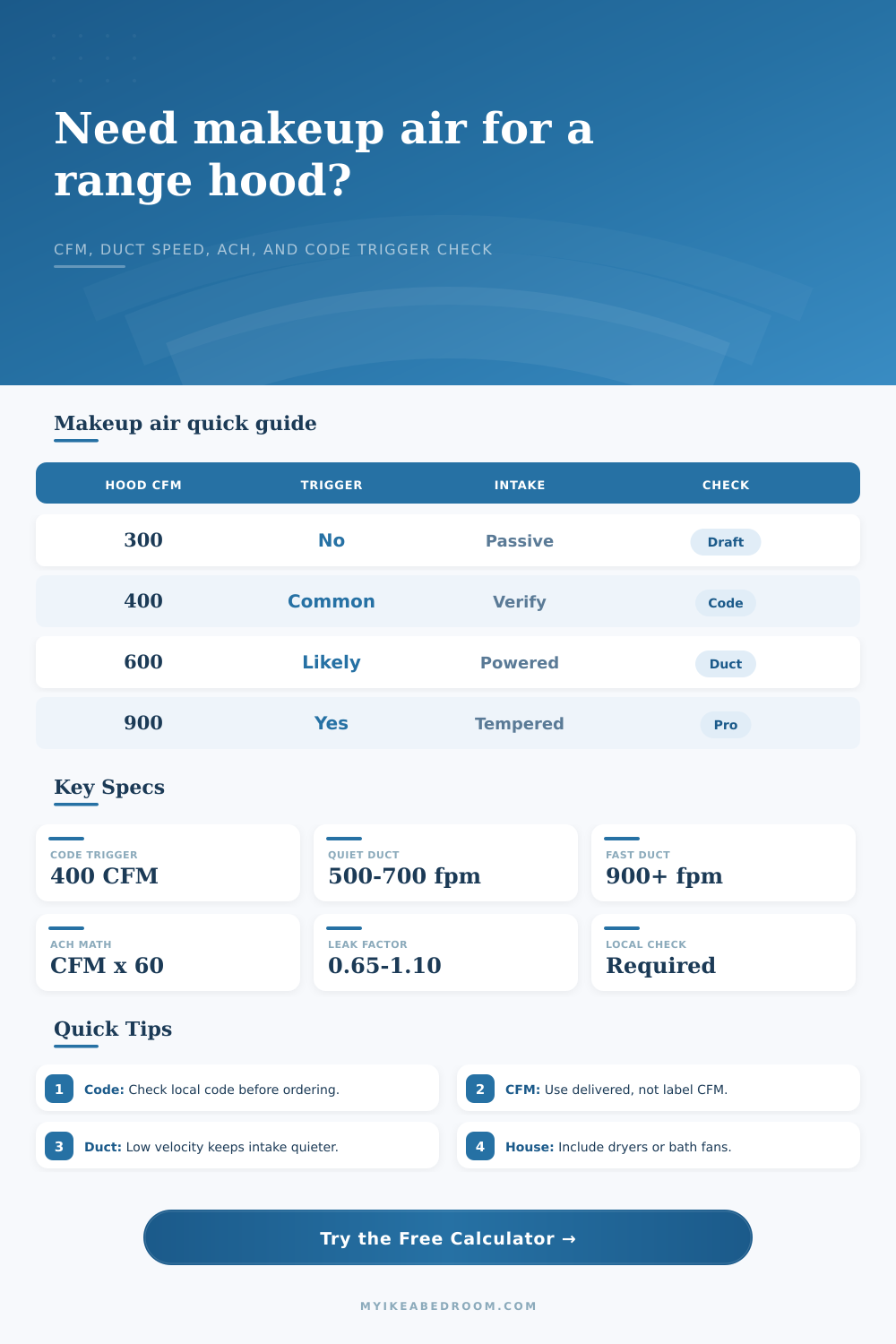
Kitchen Makeup Air Calculator
Estimate replacement air for a range hood using hood CFM, the common 400 CFM code trigger, room volume ACH, duct velocity, concurrent exhaust, and a leakage or pressure factor.
Choose a hood and house scenario close to your kitchen, then adjust CFM, room size, duct diameter, and leakage assumptions for the actual plan.
| Hood rating | Common trigger status | Typical makeup air approach | Planning note |
|---|---|---|---|
| Under 300 CFM | Usually below the 400 CFM trigger | Leakage and transfer air may be enough | Still check if the home is very tight or has draft-sensitive combustion appliances. |
| 300 to 399 CFM | Near the common trigger | Passive path or transfer grille review | Delivered CFM and local amendments can decide whether extra hardware is needed. |
| 400 to 599 CFM | At or above common trigger | Interlocked damper or powered intake often reviewed | Size replacement air close to the adjusted exhaust load. |
| 600 to 899 CFM | Likely makeup air review | Powered and possibly tempered makeup air | Duct velocity and comfort become important, especially in cold or hot climates. |
| 900 CFM or more | High exhaust load | Designed makeup air system | Coordinate hood, intake, backdraft dampers, combustion safety, and pressure testing. |
| Duct diameter | Area | 400 CFM velocity | 600 CFM velocity |
|---|---|---|---|
| 6 in round | 0.196 ft² | 2,037 fpm | 3,056 fpm |
| 8 in round | 0.349 ft² | 1,146 fpm | 1,719 fpm |
| 10 in round | 0.545 ft² | 734 fpm | 1,100 fpm |
| 12 in round | 0.785 ft² | 509 fpm | 764 fpm |
| 14 in round | 1.069 ft² | 374 fpm | 561 fpm |
| Hood ACH result | What it suggests | Pressure concern | Calculator response |
|---|---|---|---|
| Under 10 ACH | Lower air turnover for the connected space | Usually easier to replace | Leakage credit may cover part of the exhaust load. |
| 10 to 20 ACH | Moderate range hood impact | Review tight homes and long hood runs | Replacement target follows delivered CFM and pressure factor. |
| 20 to 35 ACH | Strong exhaust compared with room volume | Draft and door-slam symptoms become more likely | Interlocked or powered makeup air is usually the practical path. |
| Over 35 ACH | Very high exhaust for the connected volume | High pressure risk without a designed path | Use professional design, larger ducting, and local-code verification. |
| Preset | Hood CFM | House factor | Likely result |
|---|---|---|---|
| Apartment 250 CFM | 250 CFM | Average | Usually below common trigger, verify local rules. |
| Under-cabinet 300 CFM | 300 CFM | Average | Often handled by transfer air if pressure tests okay. |
| 400 CFM wall hood | 400 CFM | Tight | At the common review threshold. |
| 600 CFM island hood | 600 CFM | Tight | Powered interlocked makeup air is commonly reviewed. |
| 900 CFM pro-style hood | 900 CFM | Very tight | Designed and possibly tempered makeup air is likely. |
Use the right CFM: Hood labels can be higher than delivered airflow after duct losses. Use measured CFM when available.
Check the 400 CFM trigger: Many codes use 400 CFM range hood capacity as a makeup air review point, but local amendments control the final answer.
Watch duct velocity: A small makeup air duct can technically move the CFM while creating drafts, noise, or balancing trouble.
Include pressure risks: Dryer exhaust, fireplaces, atmospherically vented appliances, and sealed homes can change the makeup air requirement.
A strong range hood also generates negative pressure within your home. Gas flames lower and doors slam closed. This is the hood removing air at a higher rate then you are replacing it with. Appliances feel robbed of oxygen, while air comfort in dining room drops. Negative pressure become a very real problem that impacts airflow and safety.
How does the calculator work? To find out how much replacement air you need to supply with a fan, consider both the leakiness of your house and amount of air being exhausted by your hood. The physics of air movement are important to know here so that you can understand what these numbers mean.
How to Fix Air Problems in Your Home
When air exits the room, it doesn’t magically go away. It has to come in elsewhere. Unless you intentionaly create a pathway for air to replace itself, it will come in via smallest cracks in the wall, or from the attic, or from the basement.
Then, a lot of folks goes to the label on the hood box to see what the airflow rating is. It might be marked nine-hundred CFM. So they think, ‘I’ve got to put nine-hundred CFM of makeup air.’ Not so fast. Ducts are not without resistance. Airflow through elbows is reduced by friction. There’s actualy usually less air than the max rating flowing through the grill. Our tool takes this into account and allow you to adjust for delivered airflow. Oversizing your intake based off the label means designing for something that doesn’t even exist. Your intake fan will run constantly making noise, while a smaller (quieter) fan could of done the job just fine.
Then there’s the state of the house itself. How will a new house with sealed seams and spray foam insulation compare to an old house with drafty windows? There’s a leakage factor in the calculator that takes that into account. A house with few passive leaks (a tight home) requires more deliberate replacement air. A moderate hood act just fine on a drafty home. Just pull the air in around the leaks already present.
What kind of home do you live in? If you find that clothes cling to dryer drum, or that doors slam shut, then you’re livig in a tighter home than you imagined.
The code review covers about 400 CFM. Code review kicks in at about four hundred CFM (though many jurisdictions use a higher number). It is not because of any change in physics; it is merely a place where building codes draws a line. Under that amount, passive ventilation is often assumed to be sufficient. Over that amount, code enforcers expects to see some kind of plan for the flow of replacement air. The chart on the page breaks down these bands nicely and explains how a three-hundred CFM wall hood in your older ranch is different than a six-hundred CFM island hood in your sealed apartment. One requires a powered intake with a damper, perhaps; the other may require nothing more than a vented register.
Noise occurs when flow goes through ducts. Noise comes from turbulence, which is caused by high speed. And high speed happen inside small pipes. If you are worried about making too much noise when cooking, you don’t want your makeup air intake to be loud. Keep the speed down by using a bigger duct diameter. The tool will tell you what the feet per minute is at the duct size you choose. If it’s a big number, maybe you should use a bigger pipe or use a diffuser. It’s easier to install a larger duct during the rough-in than to chase down noise issues later. Trying to address noise after the fact will be harder.
Think about concurrent loads: What else in your house might be pulling from the same air? Fireplaces, bathroom fans, dryers, whatever. When you have two (or more) of them operating at the same time, that adds up to double the exhaust load. The calculator allow you to add simultaneous loads. This adds a simple number but it shows how much load is being placed on the pressure balance of your home, and most pressure issues occurs during the peak, not the average. Designing for the worst-case scenario avoids any pressure issues.
Makeup air is the quiet system for the loud exhaust fan. You never notice it if you get it right. Your kitchen becomes a vacuum chamber if you don’t get it right. Find the balance with the tool. Check the velocity. Follow the code triggers. Remember: there’s got to be air coming into the house when air leaves the house. It needs to have a planned way to return. The door won’t slam shut again.