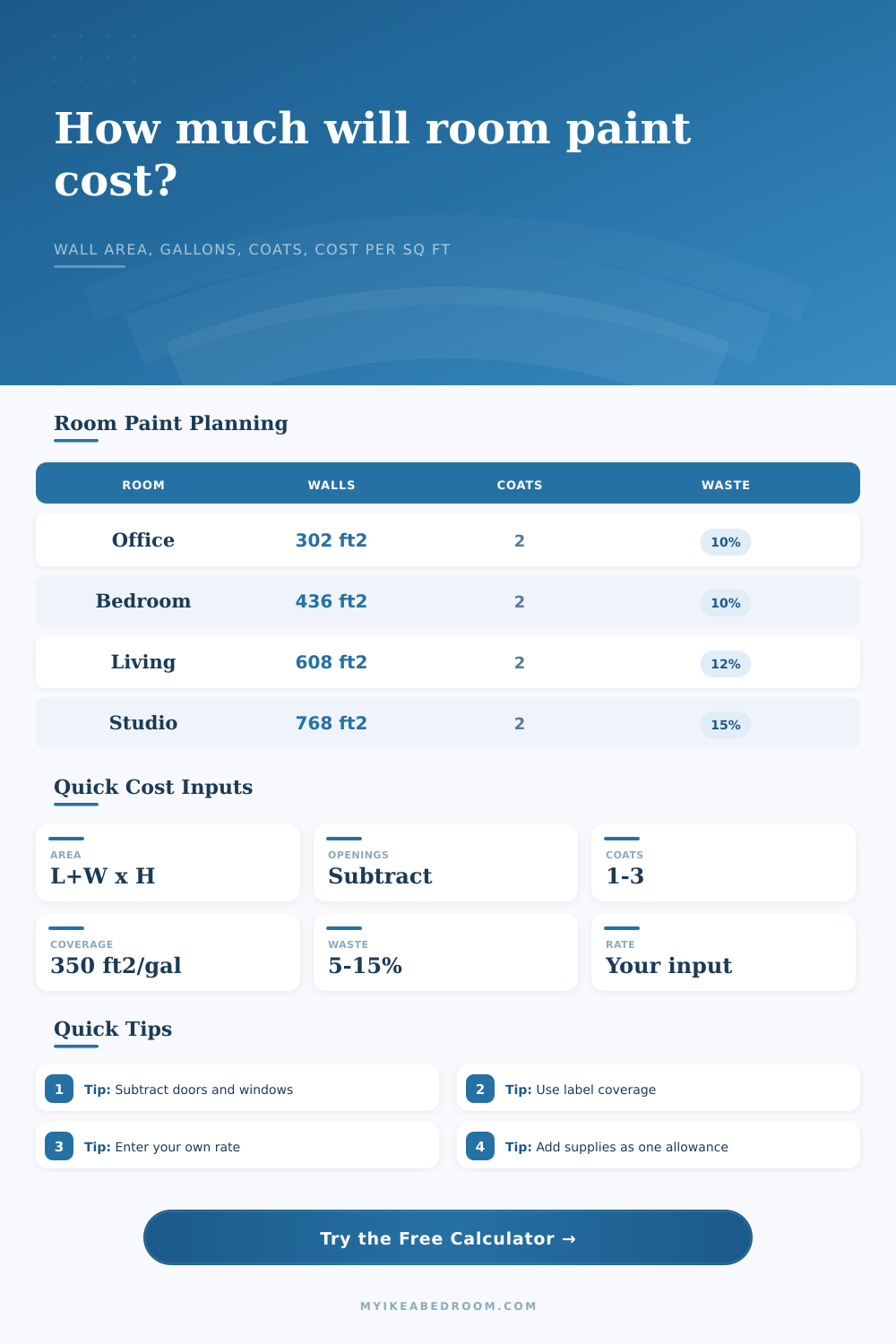
Paint Cost Per Room Calculator
Estimate room wall paint cost from length, width, height, openings, coats, coverage, waste, your entered unit rate, and your own supplies allowance.
🏠Room presets
⚙Room, paint, and cost inputs
Your room paint cost estimate
🧮Formula reference cards
📐Paint cost formula
gross wall area = perimeter x wall height
net wall area = gross wall area - door area - window area - extra openings
paint gallons = (net wall area x coats x (1 + waste %)) / coverage
total cost = planned gallons x entered unit rate + supplies allowance
📊Opening subtraction reference
| Opening type | Typical dimensions | Area to subtract | Calculator input note |
|---|---|---|---|
| Interior door | 3 ft x 7 ft | 21 sq ft | Use this for most bedroom or office doors. |
| Closet door pair | 5 ft x 7 ft | 35 sq ft | Enter as extra openings or raise average door area. |
| Small window | 2 ft x 3 ft | 6 sq ft | Useful for baths, halls, and compact rooms. |
| Medium window | 3 ft x 5 ft | 15 sq ft | The default average window area in this calculator. |
| Large window | 5 ft x 6 ft | 30 sq ft | Use for living rooms with larger glass areas. |
| Built-in section | Measured area | Custom sq ft | Add to extra openings if the wall section will not be painted. |
🎨Coverage and coats reference
| Surface condition | Planning coverage | Common coats | How to use it |
|---|---|---|---|
| Smooth sealed wall | 350 to 400 sq ft/gal | 1 to 2 | Use the higher coverage if the surface is even and close in color. |
| Standard repaint | 325 to 375 sq ft/gal | 2 | Good planning range for most occupied rooms. |
| Textured wall | 250 to 325 sq ft/gal | 2 | Lower coverage accounts for texture and roller loading. |
| Strong color change | 275 to 350 sq ft/gal | 2 to 3 | Increase coats if the previous color may show through. |
| Patchy repaired wall | 250 to 325 sq ft/gal | 2 to 3 | Use conservative coverage when repairs absorb differently. |
| Accent wall only | 300 to 400 sq ft/gal | 1 to 2 | Enter custom perimeter or reduce dimensions to the painted wall area. |
📦Gallons from net wall area
| Net wall area | 1 coat at 350 sq ft/gal | 2 coats at 350 sq ft/gal | 2 coats plus 10% waste |
|---|---|---|---|
| 150 sq ft | 0.43 gal | 0.86 gal | 0.94 gal |
| 250 sq ft | 0.71 gal | 1.43 gal | 1.57 gal |
| 350 sq ft | 1.00 gal | 2.00 gal | 2.20 gal |
| 450 sq ft | 1.29 gal | 2.57 gal | 2.83 gal |
| 600 sq ft | 1.71 gal | 3.43 gal | 3.77 gal |
| 800 sq ft | 2.29 gal | 4.57 gal | 5.03 gal |
🛋Common room preset reference
| Preset | Room dimensions | Openings subtracted | Planning note |
|---|---|---|---|
| Powder room | 5 ft x 6 ft x 8 ft | 1 door, no windows | Small area, but cutting-in can justify higher waste. |
| Home office | 10 ft x 10 ft x 8 ft | 1 door, 1 window | Square rooms usually produce predictable wall area. |
| Bedroom | 12 ft x 14 ft x 8 ft | 1 door, 2 windows | Good default for a standard repaint estimate. |
| Primary bedroom | 14 ft x 16 ft x 9 ft | 2 doors, 3 windows | Higher walls and more openings can offset each other. |
| Living room | 15 ft x 20 ft x 8 ft | 2 doors, large windows | Large openings make subtraction more important. |
| Studio room | 20 ft x 24 ft x 9 ft | 2 doors, 4 windows | Use custom perimeter if the space is not rectangular. |
💡Paint estimate tips
Guessing is how most people begin a painting job. They enter a room and imagine a new paint color, only to realize they have memorized the wrong number to take to paint store. This results in wasted paint and later return trips to pick up more. An accurate estimate saves you time, saves you money and help avoid the embarrassment of running out of paint while your contractor waits.
So how does it work? How do you know what you’re measuring? What’s the trick? Well, it’s important to realize that you’re painting vertical walls, not the floor space. That shifts math. You begin by inputting the size of your room into the calculator. It does the rest for you. But it’s helpful to understand the process so you can trust calculation.
How to Measure Paint for Your Walls
First figure out the room perimeter (the sum of all walls). Next multiply this by the wall height (the gross area). Now deduct window and door areas (this is where many estimate go wrong, people forget that each standard door take away 21 square feet of wall surface!). If you have more than one window or door, this saves a lot of money. In fact, it will often save a half-gallon of paint.
Even your coverage rate may be deceptive. Paint cans say they will cover three hundred to four hundred square feet per gallon. In perfect conditions. Actualy walls absorbs paint different than based off their previous colors and their texture. Dark-to-light color change? Use more product. Rough surface? Use more product. You can adjust the coverage number in the tool, and you should of do so.
Don’t count on what’s going to happen on label (the best case). Knock it down a bit for a buffer. Better to buy an extra quart than run out of paint and have to go back with another coat.
Waste is another hidden cost. There is drips, splashes, and irregular loads of roller paint. We account for this with an extra ten to fifteen percent waste factor. This sounds high if you’re painting a tiny space, such as a powder bath, but that’s the reality. A small room still require the same amount of work to cut in the corners. It isn’t about effort. It’s about surface area and how hard it is to apply.
There’s also the problem of supplies. Brushes, tape, trays, drop clothes can add up fast. There’s a line item for that in the calculator. Consider this fixed cost for the job. It doesn’t matter if you use pro gear or cheap stuff. That impact your total. By separating paint costs from supply costs, you’ll see how money is being spent. You might spend less but take longer, which is a fair trade off.
The output is a cost per square foot. That gives you something to use for comparison across projects, or even within a room. It averages out any differences in size and allows you to see what the refresh actualy costs. A small office might look cheap in total dollars, but expensive per square foot if the walls are complex. The reverse may hold true for a big room with simple walls. Knowing that keep people from overreacting to the dollar amount.
Inches and Ounces: Painting When we were painting, it was all about the big picture. Measuring was the last thing on our minds. We lost sight of details.
Measure carefully, allow those numbers to direct your shopping list. Measure waste, coats, and openings to stop the guessing. Begin the planning. And when that last brush stroke is complete, the budget holds up. Because you measured twice, you bought once.