Stone Veneer Corner Piece Quantity Calculator
Estimate outside corner linear feet, individual corner pieces, corner cartons, adjusted flat veneer area, and metric equivalents while accounting for return coverage and waste.
▶Veneer Project Presets
Choose a starting scenario, then edit the wall area, total outside corner length, average piece height, return width, carton coverage, and waste percentage.
⚙Corner And Flat Inputs
Your Stone Veneer Quantity Result
Calculation Breakdown
📊Core Formulas
📐Reference Tables
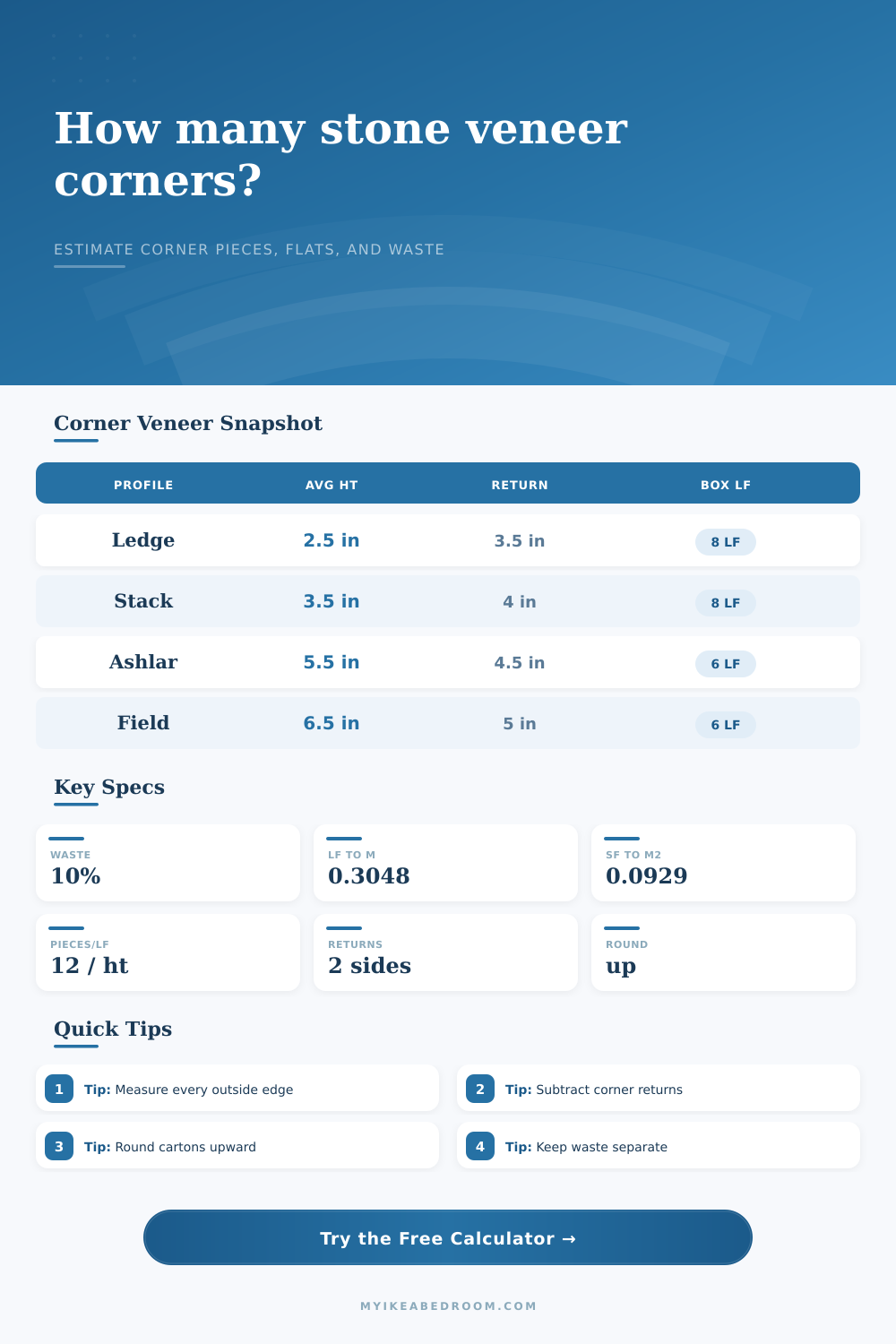
| Veneer profile | Avg piece height | Return per side | Typical flat coverage |
|---|---|---|---|
| Ledge stone strips | 2.5 in / 6.4 cm | 3.5 in / 8.9 cm | 10 sq ft / 0.93 m² |
| Stacked stone panels | 3.5 in / 8.9 cm | 4.0 in / 10.2 cm | 10 sq ft / 0.93 m² |
| Ashlar cut stone | 5.5 in / 14.0 cm | 4.5 in / 11.4 cm | 8 sq ft / 0.74 m² |
| Irregular fieldstone | 6.5 in / 16.5 cm | 5.0 in / 12.7 cm | 8 sq ft / 0.74 m² |
| Limestone ledge | 4.0 in / 10.2 cm | 4.0 in / 10.2 cm | 10 sq ft / 0.93 m² |
| Dry-stack ledgestone | 2.75 in / 7.0 cm | 3.25 in / 8.3 cm | 12 sq ft / 1.11 m² |
| Thin brick-look veneer | 2.25 in / 5.7 cm | 3.625 in / 9.2 cm | 7.3 sq ft / 0.68 m² |
| River rock veneer | 7.5 in / 19.1 cm | 5.5 in / 14.0 cm | 6 sq ft / 0.56 m² |
| Large-format stone | 8.0 in / 20.3 cm | 6.0 in / 15.2 cm | 6 sq ft / 0.56 m² |
| Average corner height | Pieces per LF | Pieces per meter | Best use |
|---|---|---|---|
| 2.25 in / 5.7 cm | 5.33 | 17.50 | Thin brick corners |
| 2.5 in / 6.4 cm | 4.80 | 15.75 | Ledge strip corners |
| 3.5 in / 8.9 cm | 3.43 | 11.25 | Stacked stone corners |
| 5.5 in / 14.0 cm | 2.18 | 7.15 | Ashlar mixed heights |
| 6.5 in / 16.5 cm | 1.85 | 6.06 | Fieldstone corners |
| 8.0 in / 20.3 cm | 1.50 | 4.92 | Large-format corners |
| Corner LF before waste | With 10% waste | 8 LF cartons | Metric equivalent |
|---|---|---|---|
| 8 LF | 8.8 LF | 2 cartons | 2.68 m adjusted |
| 12 LF | 13.2 LF | 2 cartons | 4.02 m adjusted |
| 24 LF | 26.4 LF | 4 cartons | 8.05 m adjusted |
| 36 LF | 39.6 LF | 5 cartons | 12.07 m adjusted |
| 48 LF | 52.8 LF | 7 cartons | 16.09 m adjusted |
| 60 LF | 66.0 LF | 9 cartons | 20.12 m adjusted |
| Flat vs corner step | Formula | What it prevents | Rounded item |
|---|---|---|---|
| Corner linear feet | Measured LF x waste | Short corner bundles | Corner cartons |
| Piece count | LF x 12 / height | Under-counted units | Pieces upward |
| Return adjustment | LF x 2 x return | Double-counted flats | Sq ft subtraction |
| Flat veneer area | Field area - returns | Too many flats | Flat cartons |
| Metric check | ft x 0.3048 | Unit mix-ups | m and m² |
| Final order count | Ceiling function | Partial cartons | Whole cartons |
ℹStone Veneer Measuring Tips
To estimate for a stone veneer installation, look at the flat wall space. Measure the width and length of accent wall or fireplace. Divide by the number of sq feet per box. Off to Home Depot we go.
Then you forget about those darn corners. Why do so many people find themselves running out at the last minute because they miscalculated? This is where the corners are located, and it’s not always easy to include them in the calculation.
How to Calculate Stone Veneer Needs
The calculator above do all the math for you. Just input your wall specs and choose your profile type. It saves you time figuring out how to estimate all that wacky return geometry.
But here’s the thing, corner pieces is structural parts of the build, not just decorations. A corner piece wraps the edge of your substrate and covers a certain width on both sides. How much space does it cover on either side of the edge? As much as this piece: When you install a corner piece, it covers a certain width on both sides of the edge, so that area cannot also be filled with flat stone pieces.
So when calculating how many corners you need, don’t double-count the covered area. You’ll end up running out of corner and buying too many flats if you do. The calculator takes away the return area so that when you order flats, you’re actualy ordering for the amount of exposed wall. Small calculation, big difference.
The whole amount varies depending on which profile you choose. Shorter profiles like ledge stone strips has less in each one. Typically these are only two and a half inches high or so. More individual pieces will be necessary to span a run of wall verticaly. Taller, more uniform ashlar stone requires fewer piece to reach the same linear foot. That’s what the table on the page references. It breaks down exactly how height affects the number of pieces per linear foot. Look at the samples in the box. Measure them if you’re not sure. Don’t take averages.
Waste is the silent budget killer. Both your adjusted flat area and your corner linear feet will have a waste percentage added to them in the calculator. Why? This is because installing stones around a corner create waste. You will need to sort them by texture and color to match the surrounding flat stone. You can’t just grab whichever corner piece you want. It needs to flow with the flat stone on each side. Because of this, you end up with offcuts which you won’t be able to use anywhere else. We add a ten percent waste allowance as standard. If your walls have complex angles or you’re using highly variable naturaly stone, you may want to bump this up.
Also consider your corner measurements. Measure all the outside edges, not just the ones you see. This includes chimney chases, window returns, and columns. One square column will have four outside edge. And if it’s eight feet tall then there are thirty-two linear feet of corner stone to cover. Many folks fail to multiply the amount of edges. This leaves them way short on material. The calculator says corner linear feet total outside. Walk around it, take your time and add up all the vertical edges before entering in a number.
Then there is the issue of metric vs. Imperial units for things bought abroad, like imports or foreign projects. It will automatically convert between them. If you measure in square feet, it’ll convert into square meters. Measured in linear feet? It’ll convert to meters. Whether you buy online from an importer or locally doesn’t really matter. There’s no calculation required in your head. Make sure whatever units you put in match what you measured.
Look at the number of cartons the calculator rounded up when you get your results. Each bundle of stone is separate. There is no such thing as buying half a carton. The reason is that the calculator rounds up so you have enough material and you don’t end up having an incomplete edge. If you’re ordering from the store and getting individual components instead of full cartons double check the number of pieces ordered. This will take the guesswork out off a complicated installation.
The key is to get the corner pieces correct and then the rest of the wall will fall into place. Patching it doesn’t give you the result that you want, you want your stone to look seamless. Get dimensions measured correctly. Remember to account for the overlap. Follow the numbers in placing your order. The frame of the corner defines the whole picture. Treat it just like everything else on the project.