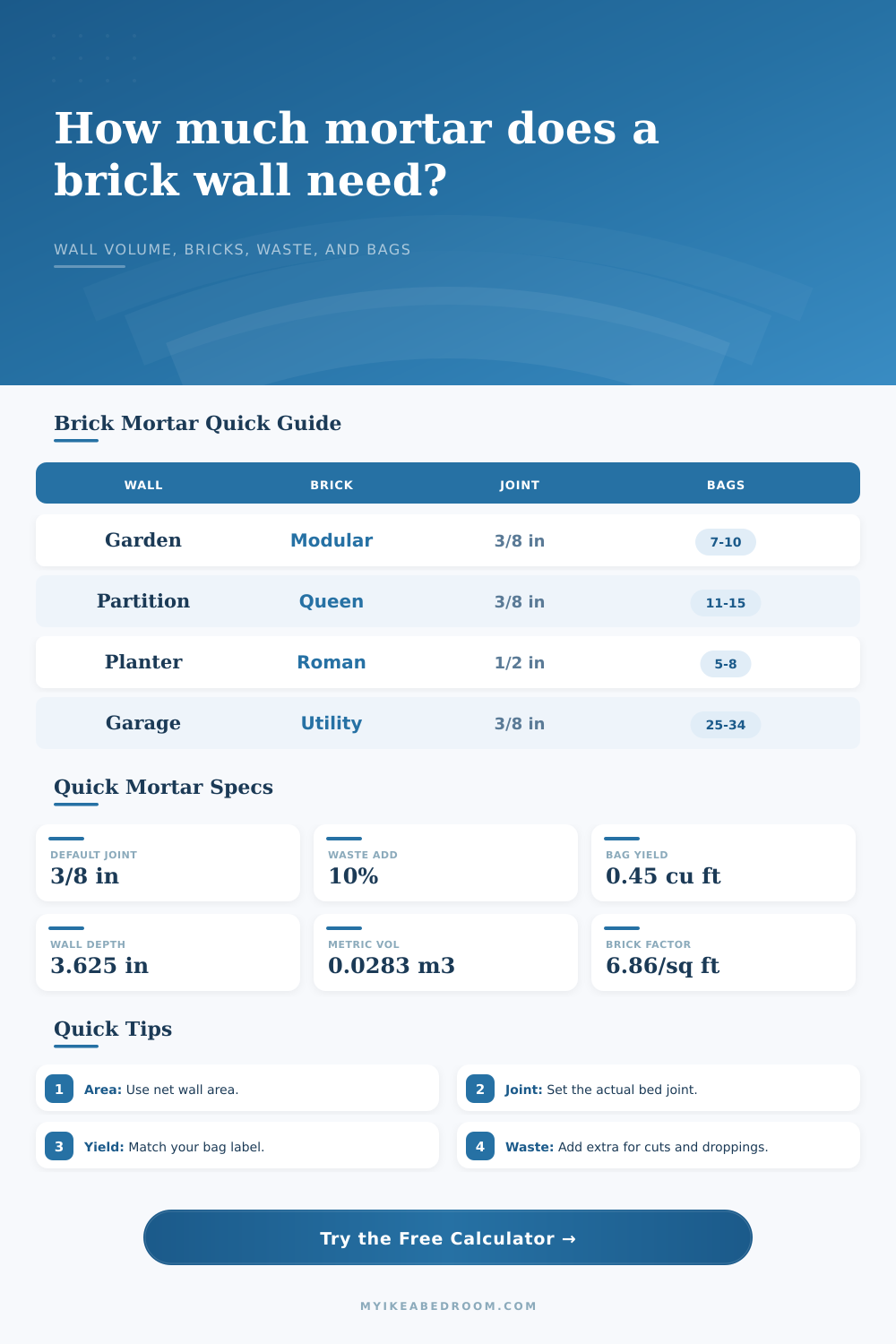
Mortar Quantity for Brick Calculator
Estimate wet mortar volume, brick volume, wall area, waste allowance, and bag count from wall dimensions, brick dimensions, joint thickness, and bag yield.
🧱Wall Presets
⚙Mortar Inputs
Mortar volume = wall volume - total brick volume, then add waste %. Bags = mortar volume / bag yield.
Mortar Quantity Results
Calculation Breakdown
📊Mortar Planning Constants
The calculator works internally in feet and inches, then shows metric equivalents for area and wet mortar volume.
📏Common Brick Dimension Reference
| Brick Type | Nominal Use | Actual Size | Approx Bricks / sq ft |
|---|---|---|---|
| Modular | General walls | 7.625 x 2.25 x 3.625 in | 6.86 |
| Queen | Face brick | 7.625 x 2.75 x 2.75 in | 5.76 |
| Utility | Larger units | 11.625 x 3.625 x 3.625 in | 3.00 |
| Roman | Long thin courses | 11.625 x 1.625 x 3.625 in | 6.00 |
| Thin brick | Veneer panels | 7.625 x 2.25 x 0.625 in | 6.86 |
🔧Joint Thickness and Brick Count Guide
| Brick Face | Joint | Face Module | Suggested Count |
|---|---|---|---|
| Modular | 1/4 in | 7.875 x 2.50 in | 7.31 / sq ft |
| Modular | 3/8 in | 8.000 x 2.625 in | 6.86 / sq ft |
| Queen | 3/8 in | 8.000 x 3.125 in | 5.76 / sq ft |
| Utility | 3/8 in | 12.000 x 4.000 in | 3.00 / sq ft |
| Roman | 3/8 in | 12.000 x 2.000 in | 6.00 / sq ft |
🛍Bag Yield Conversion Table
| Bag Yield | Metric Yield | Bags per cu ft | Bags per cu yd |
|---|---|---|---|
| 0.35 cu ft | 0.0099 m3 | 2.86 | 77.2 |
| 0.45 cu ft | 0.0127 m3 | 2.22 | 60.0 |
| 0.50 cu ft | 0.0142 m3 | 2.00 | 54.0 |
| 0.60 cu ft | 0.0170 m3 | 1.67 | 45.0 |
📝Common Wall Scenario Table
| Scenario | Wall Area | Typical Brick | Planning Note |
|---|---|---|---|
| Garden wall | 36 sq ft | Modular | Check cap and corner waste |
| Room divider | 80 sq ft | Modular | Subtract large openings |
| Planter face | 28 sq ft | Roman | Joint consistency matters |
| Garage wall | 192 sq ft | Utility | Confirm wall thickness |
✨Mortar Takeoff Tips
The point is that if you estimate your materials ahead of time, you avoid problem of getting halfway through a project only to discover you ran out of something! I mean, who knew how many bricks it took to build a wall? Or how much mortar was needed? It’s one thing to buy enough. But its another to understand the shape of the wall before laying a single brick.
That’s where math comes in and the calculator above runs it all for you. There is nothing like pulling out your scientific calculator with a bucket in hand. What are those numbers anyway?
How to Plan Your Brick Project
The premise couldn’t be more basic: take your total wall volume. Subtract the volume of the bricks within it. The resulting figure represent the volume that needs to be filled with mortar. Sounds easy enough.
But humans are awful at imagining three-dimensional nothingness. A single wythe wall can appear thin, but when you add up thousands of tiny joints, the total impact accumulate fast. This is why tool requests all three dimensions of the wall: its length, height and thickness. This last one’s frequently overlooked.
Most folks imagine a typical depth, but if you’re constructing a garage pier or garden wall, that number will change both the amount of bricks required and the amount of mortar needed completely. Nailing down this measurement is what transforms a blind guess into a pretty accurate estimate.
The other number mover, more so then you’d think (is thickness of the joint itself). You’re thinking: What’s the difference between a three-eighth-inch joint and a quarter-inch? A lot. Bigger joints holds more mortar per square foot and less brick per square foot.
The calculator lets you adjust this, but you have to decide what your masonry skills can handle. Too wide and job looks sloppy (and requires more mix). Too tight, and it’s difficult to maintain consistency (not to mention the challenge of laying those skinny babies).
There is a sweet spot for joint thickness; typically around three-eighths of an inch for standard modular brick. And again, table on the page makes all of this clear. It shows relationship between the size of the brick faces and the corresponding joints, which in turn determines the density of each. Don’t worry about remembering the ratio. Just understand that swapping the joint swap the material balance.
Then there’s the issue of waste. Waste is a silent budget killer. That is something every estimator understands and most DIY’ers don’t seem to care about. You’re going to drop some bricks. Sweep some mortar off scaffolding. You might make a mistake that forces you to tear out a course.
A waste percentage is added into the calculator, but take it for what it’s worth. It is just a buffer. If you’ve never done any masonry work, go on the high side. Having an extra bag left in garage is less expensive than having to run to store mid-pour.
And finally. The yield per bag is crucial. One bag isn’t the same as another. Some give you a half cubic foot; others less. Enter the wrong yield and the bag count will be incorrect. Read the label.
Are all modular bricks (standard) the same size compared to other types of bricks? Queen and Utility bricks has different volumes and surface areas than modular bricks. Each one also has a different volume. However, the calculator automatically accounts for this change in brick type.
If you select the correct brick from your plan, you don’t have to perform the volume calculation yourself. Simply choose the matching brick type. The result displays bag count and wet mortar volume. Why use wet volume? Because dry mixes expands or contract with compaction and water content.
Knowing the wet volume allows you to estimate the number of batches to make at a time. This lets you plan ahead when you’re mixing. When all the mortar’s gone from the bucket, the bricks need to be done. Don’t want the bricks done before the mortar. It’s only a bit of an edge, but that’s what separates an easy afternoon from a long weekend panic.
Go as far as you can with the tool, and then put some icing on your proverbial cake. The numbers are there. You do the planning.