Conduit Fill Calculator
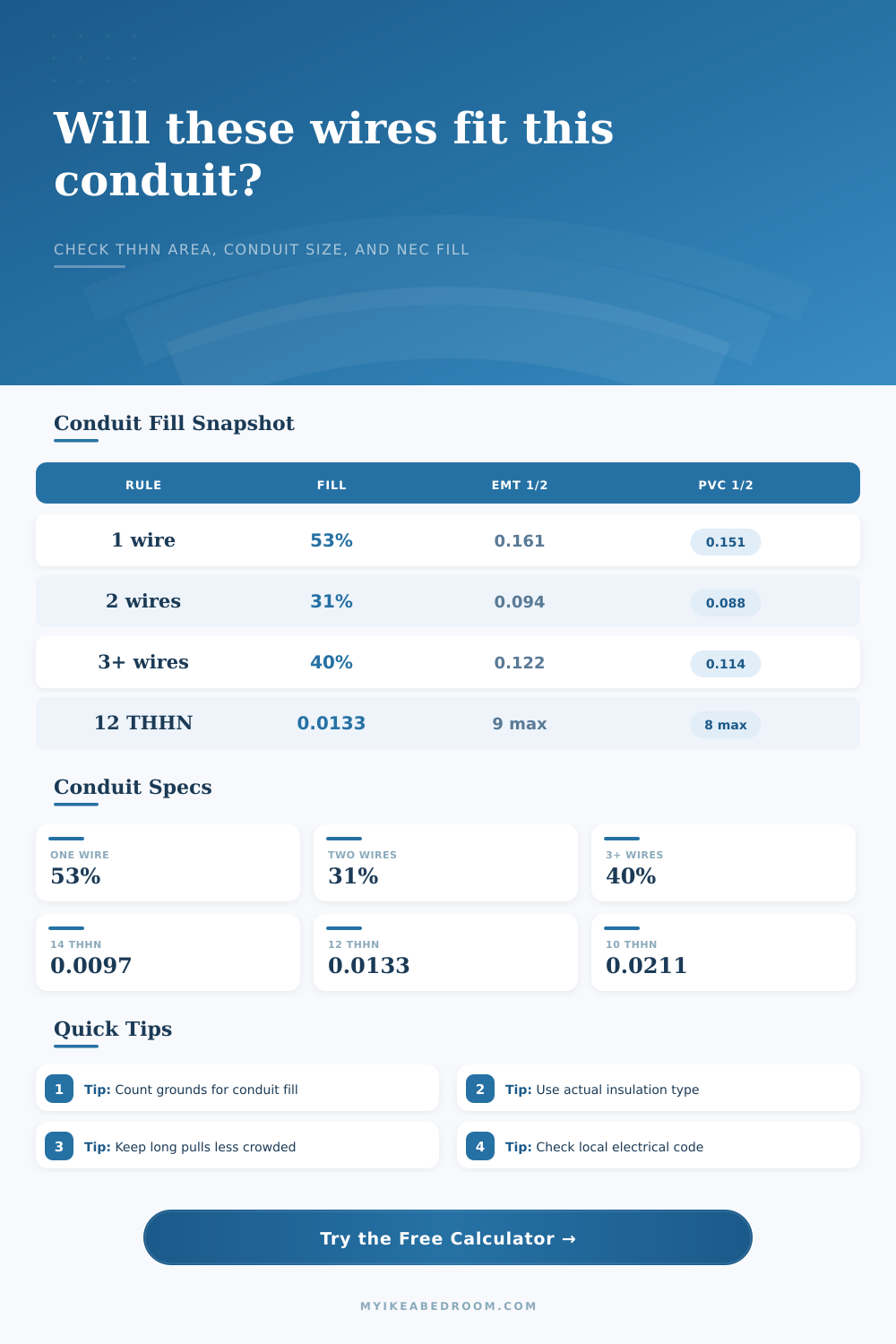
Check THHN conductor area against EMT or PVC Schedule 40 trade-size area using the NEC conduit-fill limits: 53% for one conductor, 31% for two conductors, and 40% for more than two conductors.
▶Conduit Presets
Load a common home wiring pull, then adjust conductor count, wire size, raceway type, and trade size to match the actual plan.
⚙Conduit And Wire Inputs
Your Conduit Fill Result
Calculation Breakdown
📊THHN Area Reference
📐Reference Tables
| NEC fill condition | Maximum fill | Formula used | Calculator trigger |
|---|---|---|---|
| One conductor | 53% | Conduit area x 0.53 | Total count equals 1 |
| Two conductors | 31% | Conduit area x 0.31 | Total count equals 2 |
| More than two conductors | 40% | Conduit area x 0.40 | Total count is 3 or more |
| Actual fill | Total wire area | Wire area x conductor count | All entered wires counted |
| Trade size | EMT total area | PVC Sch 40 total area | 40% area comparison |
|---|---|---|---|
| 1/2 in | 0.304 in² | 0.285 in² | 0.122 / 0.114 in² |
| 3/4 in | 0.533 in² | 0.508 in² | 0.213 / 0.203 in² |
| 1 in | 0.864 in² | 0.832 in² | 0.346 / 0.333 in² |
| 1-1/4 in | 1.496 in² | 1.453 in² | 0.598 / 0.581 in² |
| 1-1/2 in | 2.036 in² | 1.986 in² | 0.814 / 0.794 in² |
| 2 in | 3.356 in² | 3.291 in² | 1.342 / 1.316 in² |
| THHN size | Area in square inches | Area in mm² | Typical calculator use |
|---|---|---|---|
| 14 AWG | 0.0097 | 6.26 | Lighting branch fill |
| 12 AWG | 0.0133 | 8.58 | Receptacle branch fill |
| 10 AWG | 0.0211 | 13.61 | Appliance branch fill |
| 8 AWG | 0.0366 | 23.61 | Small feeder fill |
| 6 AWG | 0.0507 | 32.71 | Subpanel or EV fill |
| 4 AWG | 0.0824 | 53.16 | Larger feeder fill |
| Example pull | Conduit | Total wire area | Fill check |
|---|---|---|---|
| 3 #14 + 1 #14 ground | 1/2 EMT | 0.0388 in² | 12.8% actual fill |
| 3 #12 + 1 #12 ground | 1/2 EMT | 0.0532 in² | 17.5% actual fill |
| 4 #10 + 1 #10 ground | 3/4 PVC | 0.1055 in² | 20.8% actual fill |
| 4 #6 + 1 #10 ground | 1 EMT | 0.2239 in² | 25.9% actual fill |
ℹConduit Fill Tips
It’s kind of like trying to push a garden hose into a small diameter pipe: it’ll bend back on itself (kink) and not go any further. Wires is no different… Pack them in too tightly into a conduit and…you guessed it, they won’t go.
Sounds easy enough, right? Well, there are electrical codes that try to keep us from burning down buildings, insulation adds thickness, and friction build up over long runs. Fortunately, the math are done for you with the calculator above (after you choose conduit size and wire type). So you don’t have to guess anymore if your intended pull will fit within the raceway.
Why You Should Calculate Conduit Fill
The key to conduit fill is that it’s not just filling a tube with copper, but filling it with insulated cables that has volume, which take up some amount of space inside the conduit. And the amount of that available space they can occupy is strictly limited by National Electrical Code. With one conductor in a conduit, you may occupy up to 53 percent of its interior. Drop down to two conductors and that number drop to 31 percent. With three or more conductors, the maximum goes to 40 percent. All those numbers assume the remaining empty space in the conduit will let you pull wires through without overheating conductor or damaging their insulation. It’s a safety margin built into the conduit shape itself.
There’s also a second level of complication around choosing EMT versus PVC: EMT looks like PVC on the outside, yet has a different inside diameter (enough so as to affect the fill calculation completeley). Because EMT is thinner walled, for a given trade size, it has more interior space than equivalent-sized Schedule 40 PVC. Unless you recalculate after switching materials, you may end up over your limit. As the table of references on this page shows, a half-inch EMT carries more wire then does a half-inch PVC pipe. Until you know what is installed (or will be installed), don’t trust any of the results.
The most frequent error are failing to count every conductor. People may think if there are no spare wires then it doesn’t matter… but yes, it does! Each insulated strand take up space within the raceway. Three hot wire plus one neutral plus one ground equals five conductors. With the calculator, you can enter the main conductor number as one entry and the separate number of grounds/spares as another entry. That way you don’t clutter up your existing numbers with plans to upgrade later. Plan ahead for additional capacity today so you won’t be ripping out wall someday.
Even a legal fill can be impossible due to long runs or tight turns where the extra friction makes pulling almost impossible. The snake’s got the math down but your conduit has a bunch of elbows and snakes around in the attic. You’ve got no choice but to give yourself some wiggle room within the conduit itself. If the puller tells you “You’re maxed out,” then upsize the conduit. Not much more material cost, just lots less headaches and labor time on the pull.
The THHN wires is normal and take up different amounts of space depending on their size (gauge). For example, a 12 AWG wire takes up more space than a 14 AWG wire. So it takes up more in terms of number of inches in that conduit. This is what this calculator are referencing when determining whether or not your combo will fit. No need to remember the square inch amount per size wire. Simply trust that the calculator knows what to use based off your input, then counts them up accordingly. Then you know not only if you’ll pass, but how much room you have left for spares.
Respect your materials’ physical limitations. That’s what conduit fill planning is all about. Fitting some wires in a hole is only part of it, fill planning is about getting an install done safely, code compliant, and also maintained. If you don’t take the time to properly calculate fill, you’re setting yourself up for the headache of a failed inspection or a stuck wire. The numbers doesn’t lie, but you should of given them a bit of attention to detail. Get the inputs right and the numbers will guide you directly to a good pull.