Electrical Panel Load Calculator
Estimate a dwelling panel load from floor area, required small-appliance and laundry circuit allowances, fixed appliance demand, HVAC, EV charging, service voltage, and panel utilization.
▶Home Load Presets
Pick a common home profile, then edit the VA and panel entries to match real nameplates, the actual panel label, and your local electrical rules.
⚙Panel Load Inputs
Your Panel Load Result
Calculation Breakdown
📊Demand Snapshot Cards
📐Reference Tables
| Load item | Planning rule | Demand used | Result effect |
|---|---|---|---|
| General lighting and receptacles | Floor area x 3 VA per sq ft | Tiered dwelling demand | Forms base house load |
| Small-appliance circuits | 1500 VA per selected circuit | Included with base demand | Adds kitchen and dining allowance |
| Laundry circuits | 1500 VA per selected circuit | Included with base demand | Adds laundry allowance |
| Fixed appliances | Nameplate VA total | 100% or 75% setting | Adds qualifying appliance demand |
| HVAC load | Larger heating or cooling VA | 100% in this tool | Adds major climate load |
| EV or continuous load | Nameplate VA x 125% | Continuous factor | Adds large charger or similar load |
| Base load range | Demand factor | Formula step | Calculator row |
|---|---|---|---|
| First 3000 VA | 100% | Count full first tier | Base demand first tier |
| 3001 to 120000 VA | 35% | Remainder x 0.35 | Base demand second tier |
| Over 120000 VA | 25% | Upper remainder x 0.25 | Large-home reserve tier |
| Panel amps | VA / volts | Total demand divided by service voltage | Calculated amps card |
| Home preset | Area | Base circuits | Large loads | Likely panel check |
|---|---|---|---|---|
| Studio condo | 650 sq ft | 2 small appliance + 1 laundry | Low fixed load, no EV | Usually light on 100 A |
| Older 100 A home | 1550 sq ft | 2 small appliance + 1 laundry | AC and several fixed loads | Often needs closer review |
| Family home | 2200 sq ft | 3 small appliance + 1 laundry | Central HVAC and appliances | Often comfortable on 200 A |
| EV ready home | 2400 sq ft | 3 small appliance + 1 laundry | 9600 VA EV charger | Panel utilization can rise fast |
| All-electric home | 2800 sq ft | 4 small appliance + 1 laundry | Range, dryer, water heating, HVAC | Confirm with local load calc |
| Equipment | Common planning range | Where to enter it | Important note |
|---|---|---|---|
| Dishwasher or disposal | 700 to 1500 VA each | Fixed appliance total | Use the nameplate when available. |
| Electric water heater | 3500 to 5500 VA | Fixed appliance total | May be a major fixed load. |
| Central air conditioner | 4000 to 9000 VA | Largest HVAC load | Use the larger heating or cooling load. |
| Heat pump or heat strips | 7000 to 20000 VA | Largest HVAC load | Auxiliary heat can dominate the result. |
| Level 2 EV charger | 7200 to 11520 VA | EV or continuous load | This calculator applies 125% to this input. |
ℹPanel Load Tips
There’s a gray metal door in the garage or basement, and there you are standing before it. Maybe there’s a sticker on it containing an old code that shows a combination of electrical current and voltag. Your plan involves a new kitchen appliance, or perhaps adding a workshop or a second car, and you’re wondering whether your house will be able to manage the increased power requirement. Electrical service anxiety sets in.
Your home’s electrical system has a panel, which manages electricity for your home, but most of us hardly ever think about it … except when we realize our panel isn’t giving us what we need. For those unfamiliar: Electricity is more than just lights and switches; every device you use draw current. That’s what we imagine it to be. What’s forgotten is that each light or outlet require a certain amount of power.
How to Check Your Home’s Electrical Power
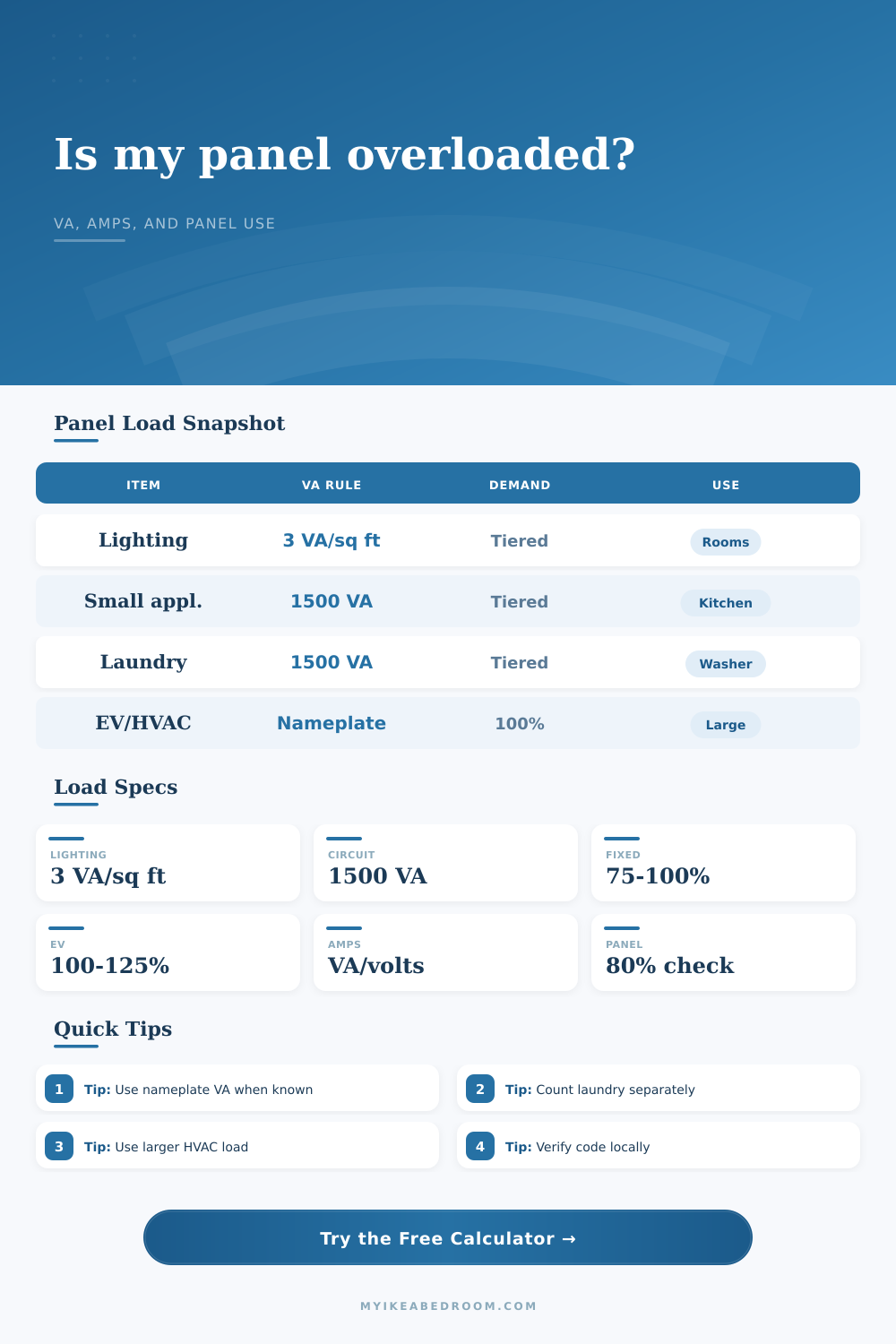
So all you have to do is input your square footage, appliance details, heating/cooling requirements, and EV charger status and the calculator does the rest. It begins with the simplest case, receptacles (outlets) and lighting. Those is assumed to be three volt-amperes per sq ft. It’s a conservative estimate based off code, it assumes average fixture / outlet density. In other words, it’s probably lower than what you need but a decent place to start.
That said, the tool also includes dedicated circuits for laundry and small appliances. Most codes requires these. Each gets an allowance of 1500 volt-amps. You are just following a rule.
Next is big loads. Water heaters and other fixed appliance (dishwashers, etc.) are thrown into the pot. Here you can use the demand factor. There is a 75 percent factor if you have four or more of these. Why? They are never all on full power at the same time. It is a small tweak but it will matter in the final count.
HVAC loads deserve special treatment. Enter the higher of your cooling or heating need. Don’t add them. People tend to do this when estimating their total load by assuming their heater and AC are running at the same time in a worst-case scenario. That’s not true; the dominant system’s peak demand drive the load.
We pay special attention to continuous loads. When it comes to an electric vehicle charger, this isn’t just another appliance. It’s an appliance runing for hours and hours. To create the necessary extra space called for by code, the tool take that input and applies a 125 percent factor to it. That way, if you’re plugging into the charger for hours, the breaker doesn’t trip.
As you start adding some of these things, you may find yourself noticing that your use percentage has crept up. That’s your usage percentage. How much of your panel’s capacity are you using? If you’re hovering around 80 percent then you’re in the safe zone. If you’ve got it pushed to 95 percent, then you’re flirting with trouble. The remaining capacity figure lets you know exactly how much room you have for future upgrades.
This one can be tricky on older houses. Thirty years ago, 100 amps was fine. Today it’s barely enough for all our comfort systems and electronics. So you may find yourself staring at a panel upgrade. This is a big project. This project requires permits and pulls new service line. This is not a DIY weekend project. Use the calculator to see if it makes sense to invest.
See if you’re merely underpowered or just loading it up wrong. Occasionally, you’ll move some of your circuits around. Other times, you need more juice coming in.
And so, to compare, here’s the reference table from the page:
You can see at a glance how various home profiles line up. That small footprint of a studio condo is nothing different than a large family home complete with EV charger. And the input changes the output dramatically. See how the addition of a heat pump mini split alters the balance? See how heavy tools in a garage workshop must be treated with respect.
The numbers aren’t abstract data. These are actual breakers and copper wire that gets hot when pushed beyond their limits. Enter the information slowly. If there are nameplates on your equipment, use their ratings. Don’t guess, that’s how mistakes happen. Overestimate rather than underestimate. Before purchasing equipment, you need to know what you’re walking into.
The calculator gives you a snapshot of your current electrical reality. It doesn’t remove the need for a licensed electrician. It won’t pull permits. It will show you what your electrical situation looks like. It will also help you talk to your contractor about your home. Point to the usage percentage and ask whether it’s healthy. Talk about the demand factors and learn why they are necessary.
Ultimately though, this comes down to control. When you know what’s going into your house, you can plan for expansion. That means no more tripping the main breaker on a hot day as a surprise. It also lets you know whether or not you can squeeze in that new EV charger. Until you know what’s flowing through the panel, it’s nothing but a box. But once you know the numbers, the mystery vanishes. No more guesses. Just management. And that’s what matters most when you’re dealing with high voltage inside your own walls.