Circuit Breaker Size Calculator
Estimate breaker size from watts and volts, apply the 125% continuous-load rule, round to common standard sizes, and compare the result with simple wire ampacity references.
1Load presets
Choose a real home load preset, then adjust the values for the actual equipment nameplate and circuit plan.
2Circuit inputs
3Wire ampacity reference
Reference values below are simplified 60°C conductor examples for common home planning. They do not replace code tables, correction factors, or equipment instructions.
4Reference tables
| Standard breaker | 80% continuous guide | Typical single-phase watts at 120 V | Typical single-phase watts at 240 V |
|---|---|---|---|
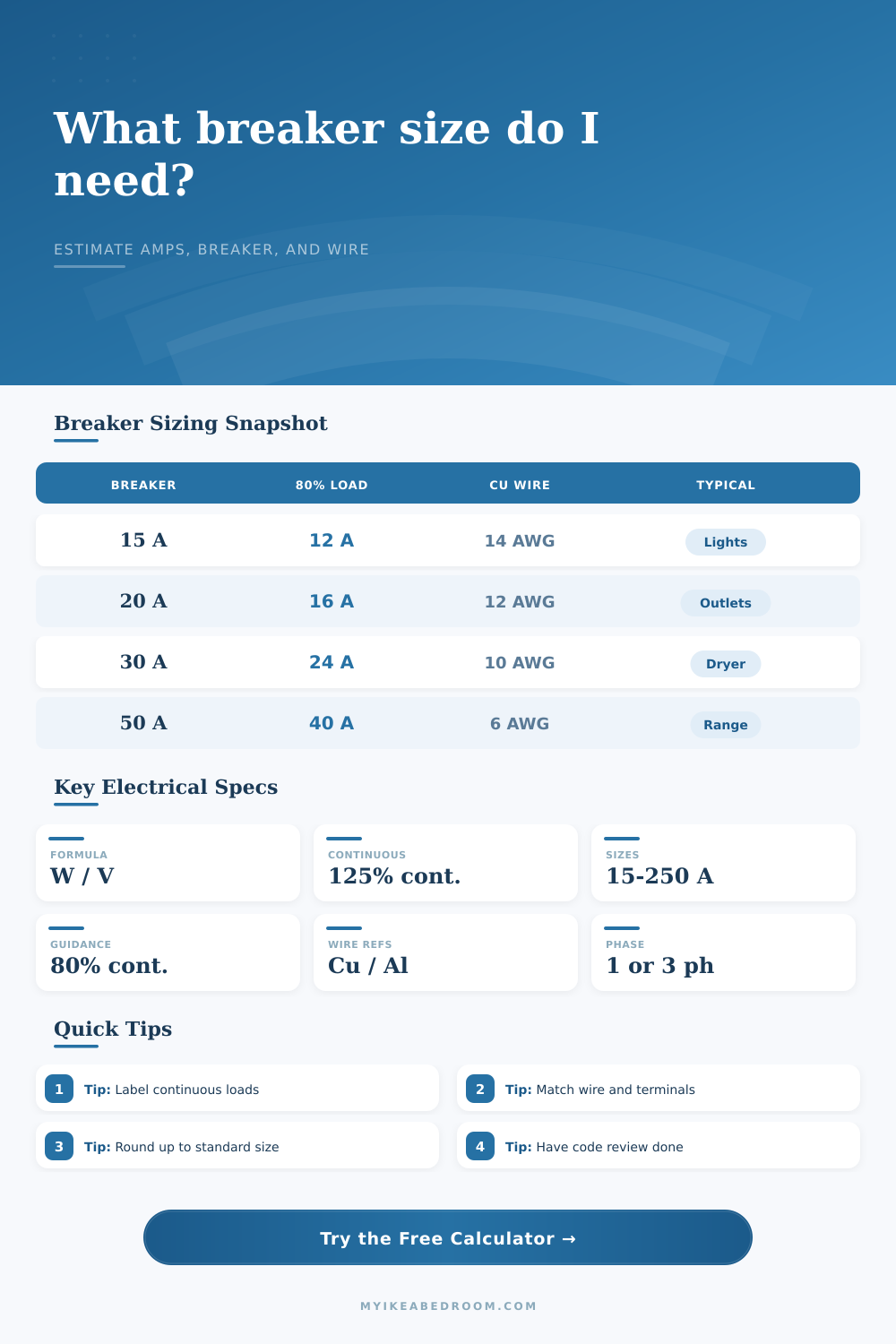
| 15 A | 12 A | 1,440 W | 2,880 W |
| 20 A | 16 A | 1,920 W | 3,840 W |
| 30 A | 24 A | 2,880 W | 5,760 W |
| 40 A | 32 A | 3,840 W | 7,680 W |
| 50 A | 40 A | 4,800 W | 9,600 W |
| 60 A | 48 A | 5,760 W | 11,520 W |
| AWG or kcmil | Copper 60°C | Aluminum 60°C | Planning note |
|---|---|---|---|
| 14 AWG | 15 A | Not typical | Lighting branch circuits |
| 12 AWG | 20 A | 15 A reference | General receptacles |
| 10 AWG | 30 A | 25 A reference | Small appliance loads |
| 8 AWG | 40 A | 30 A reference | Large home loads |
| 6 AWG | 55 A | 40 A reference | Equipment circuits |
| 4 AWG | 70 A | 55 A reference | Feeder planning |
| Load preset | Watts and volts | Continuous portion | Likely breaker range |
|---|---|---|---|
| Bedroom lighting | 600 W at 120 V | 100% | 15 A minimum common size |
| Portable heater | 1500 W at 120 V | 100% | 20 A when continuous |
| Microwave outlet | 1800 W at 120 V | 0% | 15 to 20 A by nameplate |
| Water heater | 4500 W at 240 V | 100% | 25 to 30 A range |
| EV outlet | 9600 W at 240 V | 100% | 50 A for 40 A continuous |
| 3-phase shop load | 12000 W at 208 V | 70% | 45 to 50 A range |
5Practical sizing tips
Okay so you’re remodeling something and suddenly the breaker trips. Why? Because the tool you were using require more amps than what the circuit will allow. There is a reason why breakers should of been sized properly. It’s not just theory; it’s safety.
So you take a look at the wattage rating, divide by voltage, and there’s your amp. Now you’ll round up to the next closest breaker size. The problem is solved, right? That approach ignores thermal reality of the wiring inside your walls. That doesn’t account for effects of heat on copper wire in your walls. Current has a limit. Pushing too much current into 14-gauge wire will cause insulation to degrade. There won’t be a trip, there will be heat. And heat leads to fire.
Why Wire and Breaker Size Matters
We want the breaker to match weakest link in our system. In most cases, that’s the wire.
But what about continuous loads? If you turn something on for three hours or more, it’s a continuous load. But if you turn it on and off every few minutes for ten minutes total, it’s not a continuous load. Continuous loads are considered more dangerous; they create steady heat where spikes don’t, so the code call for sizing the breaker with 125% of the load if it will be running for at least three hours continuously. That additional capacity is a safety buffer.
The calculator above do that math for you. It automatically assumes you’ll want 125% so you don’t have to think about the fraction. It then rounds up to the nearest standard size. This means you won’t need to install a custom breaker, which no one carries.
This section covers wire gauge and breaker size. Why does this matter? For example, you’ll typically find 15-amp breaker used for lighting circuits (which is rated for use with 14-gauge copper wire). Never replace that 15-amp breaker with a 20-amp one, even if you suspect there may be frequent nuisance trips. That’s no longer providing safety protection. In the event of a short, the wire would melt without tripping the breaker. Remember: It’s the wire that determines the breaker, and not vice versa.
You can refer to the table on the page for some examples: 12-gauge wire can handle 20 amps; 10-gauge wire can handle 30 amps. These figures is based off lots of research and testing over many years using different types of insulating material at various temperatures.
Homeowners often forget the 80% rule when it comes to constant loads and regular breakers. Continuous loads must be kept below 80% of the amp rating of the breaker. For example, a 20-amp breaker is rated for 16 amps of continuous load. Why? Because a breaker is a thermal device. It trips by heating up. The longer you run a circuit at max output, the more likely that breaker will overheat and fail prematurely. Keeping continuous loads under 80% keeps the breaker within safe operating temperature. For electrical panels, this is important for their lifespan.
Also note that most household outlets are single-phase, but many large appliances like electric ranges or dryers uses 240 volts. Single-phase is most common throughout the house. Many large appliance (e.g., electric range) require 240 volts. That impacts how you calculate the amperage. If you have a high-voltage circuit (240 vs. 120), then you’ll get fewer amps for the same amount of power. Fewer amps means smaller wire and smaller breaker. High-voltage circuits is good for heavy machinery; but they can be lethal if wired incorrectly. Always read the voltage required off the piece of equipment‘s nameplate. If it says 240 volts but you assume 120 volts instead, you just doubled your amperage estimate. That creates some pretty major size mistakes.
The tool isn’t a permit; it’s an aid for planning. It explains how voltage, power and protection relate. It indicates whether what you plan is reasonable or not. But local codes differ. Attic heat degrades wire capacity. Heat builds when cables are bundled. A qualified electrician check these and other variables before any wire installation.
The calculator is meant as a conversation starter with your contractor. It demonstrates that you’ve done your homework. You’ll be able to ask the right questions.
You want a system that stays cool under pressure. Only then will the sizing work, the walls remain cool and the lights stay on.