Extension Cord Gauge Calculator
Choose a practical 16, 14, 12, or 10 AWG extension cord from amp load, one-way cord length, supply voltage, allowed voltage drop, copper resistance, and continuous-load factor.
▶Tool And Load Presets
Pick a common home or workshop load, then adjust the amp load, cord length, and voltage-drop target to match the label on your equipment.
⚙Cord And Load Inputs
Your Cord Gauge Result
Calculation Breakdown
📊AWG Resistance And Capacity
📐Reference Tables
| Gauge | Copper Resistance | Common Cord Capacity | Continuous Check |
|---|---|---|---|
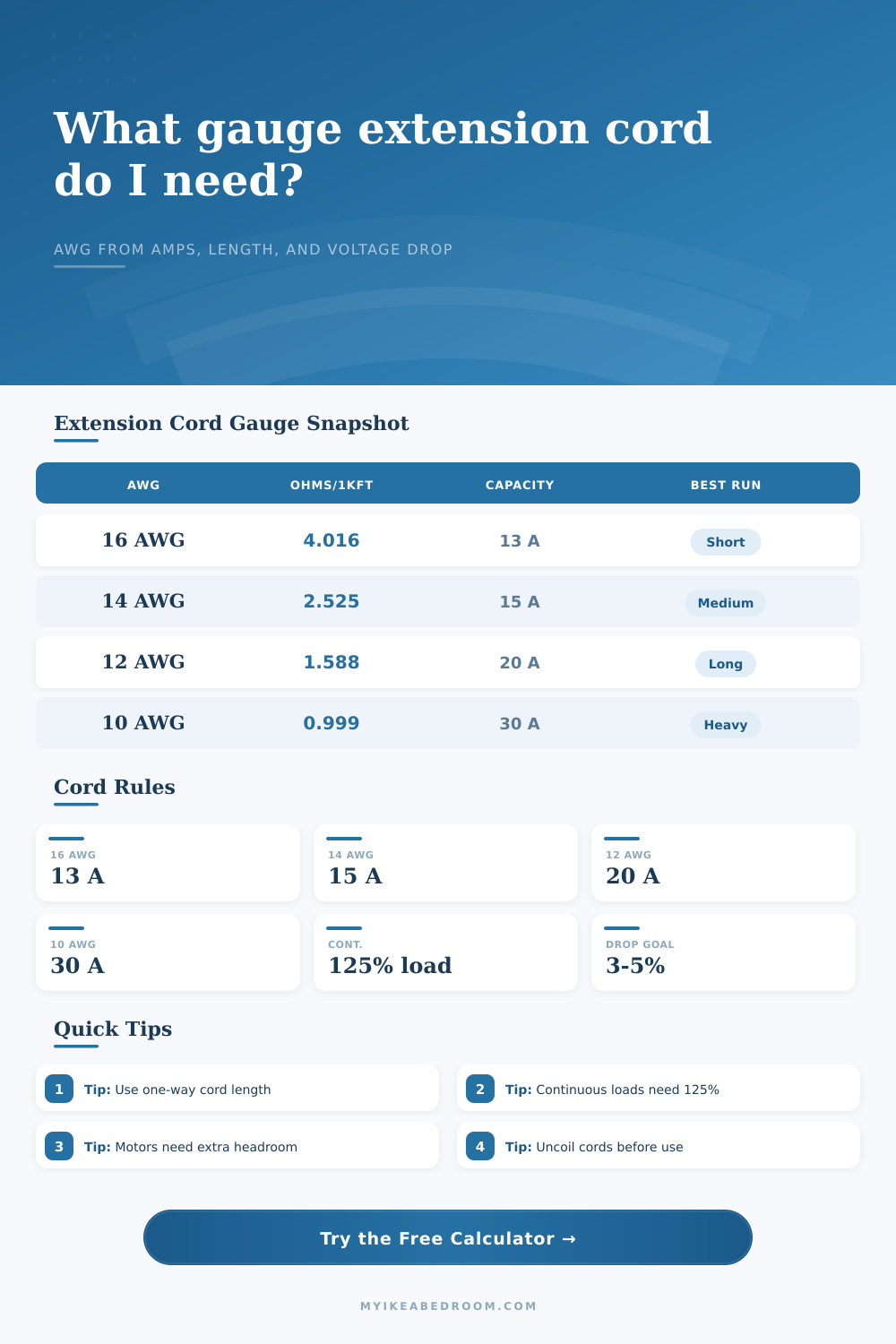
| 16 AWG | 4.016 ohms per 1000 ft | 13 amps | 10.4 A at 80% |
| 14 AWG | 2.525 ohms per 1000 ft | 15 amps | 12.0 A at 80% |
| 12 AWG | 1.588 ohms per 1000 ft | 20 amps | 16.0 A at 80% |
| 10 AWG | 0.999 ohms per 1000 ft | 30 amps | 24.0 A at 80% |
| Rule | Formula | Why It Matters | Calculator Use |
|---|---|---|---|
| Amp load | Watts / volts | Sets conductor current | Input or derived |
| Round trip | 2 x cord length | Current travels out and back | Voltage drop |
| Voltage drop | A x ohms | Lower voltage reaches load | Drop card |
| Continuous load | A x 1.25 | Extra ampacity margin | Capacity check |
| Example Load | Amps | Length | Likely Gauge | Notes |
|---|---|---|---|---|
| Small chargers and desk lamp | 2 A | 25 ft | 16 AWG | Low amp load and short run |
| TV, console, and speakers | 5 A | 50 ft | 16 or 14 AWG | Voltage-drop target decides |
| Vacuum or shop vac | 10 A | 50 ft | 14 or 12 AWG | Motors prefer less drop |
| 12.5 A heater for 3+ hours | 12.5 A | 25 ft | 12 AWG | Continuous factor rules out lighter cords |
| 15 A saw or compressor | 15 A | 100 ft | 10 AWG | Heavy load plus long run |
ℹCord Gauge Tips
Ever pull the trigger of A saw or flip switch on your shop vacuum and watch it chug? The machine doesn’t fire up, so you immediately think something’s wrong with your gear. Something’s fried, right? Wrong. It’s more likely that you’re using an extension cord that is too small. This cord is too small for its length, so it can’t provide enough power to get your tools humming.
Why does voltage drop matter in the shop? Because if you understand it, you’ll know when a job will go fast. Or drag on more different than expected. You put in how far away it will be and what size tool you want to use and the calculator figures out the rest. You no longer have to guess about resistance coefficients. It takes all electrical theory and applies it to a wire gauge that actualy gets your tools running.
Why Your Power Tools Need a Bigger Extension Cord
Electricity encounters resistance as it travels through copper. There’s some sort of resistance. As the electricity move down the wire, it lose some of its potential and becomes heat. Less voltage gets to the tool on the opposite end. The bigger the wire, the smaller the resistance.
But we don’t use a big wire. We use a small one and that’s where American Wire Gauge system goes backwards. The bigger the number, the thinner the wire. So 16 gauge is pretty thin and used for things like phone chargers. Ten gauge are big and used for serious stuff.
When using an extension cord, most of us grab whatever is convenient from garage. This is a bad idea if load is heavy. A thin wire stretched out over distance asks too much of the cord. The voltage reaching the tool will be to low to create enough torque within the motor. To make up for it, the motor will draw excessive current, heating the wire even more. It’s a vicious cycle that burns energy and has potential to harm your investment.
This calculator considers this dynamic by considering two important variables: 1) that the wire can physically accommodate current without getting hot, and 2) how much voltage drop there will be so tool gets enough power.
Heat builds up over time on wiring used for continuous loads. Working lights, space heaters, anything that’s on three or more hours create a warm cord that will stay warm until turned off. To compensate for this effect, electrical codes dictate that we derate the capacity of our wire accordingly. For continuous loads, the calculator multiply the amperage by a factor of one-point-twenty-five. So a 12 amp space heater is considered a 15 amp load in terms of sizing. That additional margin isn’t just bureaucratic red-tape. It’s the difference between a cool cord and fire-hazard. Take this into consideration when you’re making plans for anything that will be running for a long time.
The other primary factor causing mistakes is, well, length. We tend to underestimate how far electricity has to travel. It’s going to have to travel the length of the cord to the tool and back up again to the outlet. That’s a double the length of your actual run because it’s a round trip. So in reality, a 50-foot cord is actually a 100-foot cord from an electrical perspective. Your real-world, one-way length will be the number you put into the calculator which will account for that doubling itself. This eliminates the mistake of assuming that just because something is short, it’s not worth worrying about when it actualy covers a pretty large distance.
Motors are especially sensitive to voltage drop. Motors uses a magnetic field to generate movement. The slightest loss of voltage will quickly overheat a motor and cause it to fall out of sync. Notice this occurring in your air compressor or maybe you have a sump pump? They work great when cold but quit after warming up for several minutes. Switching to a heavier gauge wire (going from 14 to 12 gauge) will brings the motor back to full working order. And the payoff is instant, it’s reliable.
Lastly, don’t run your extension cord when it’s coiled. The coil retains heat, which doesn’t allow the wire to let it out. It causes hot spots that destroy the insulation. You should of uncoiled it first. Before plugging in a tool drawing a lot of juice, always uncoil your cord completely. Unplug it immediately if either the cord or the plug gets warm to the touch. You’ve taken the wire beyond its capacity. Running the correct gauge eliminates all this. It allows the electricity you’re paying for to get to where it needs to go.