Pipe Thermal Expansion Calculator
Estimate straight-run pipe growth from material coefficient, pipe length, and temperature change using deltaL = alpha * L * deltaT, with inch and millimeter results plus loop allowance references.
🔧Pipe and material presets
📏Expansion inputs
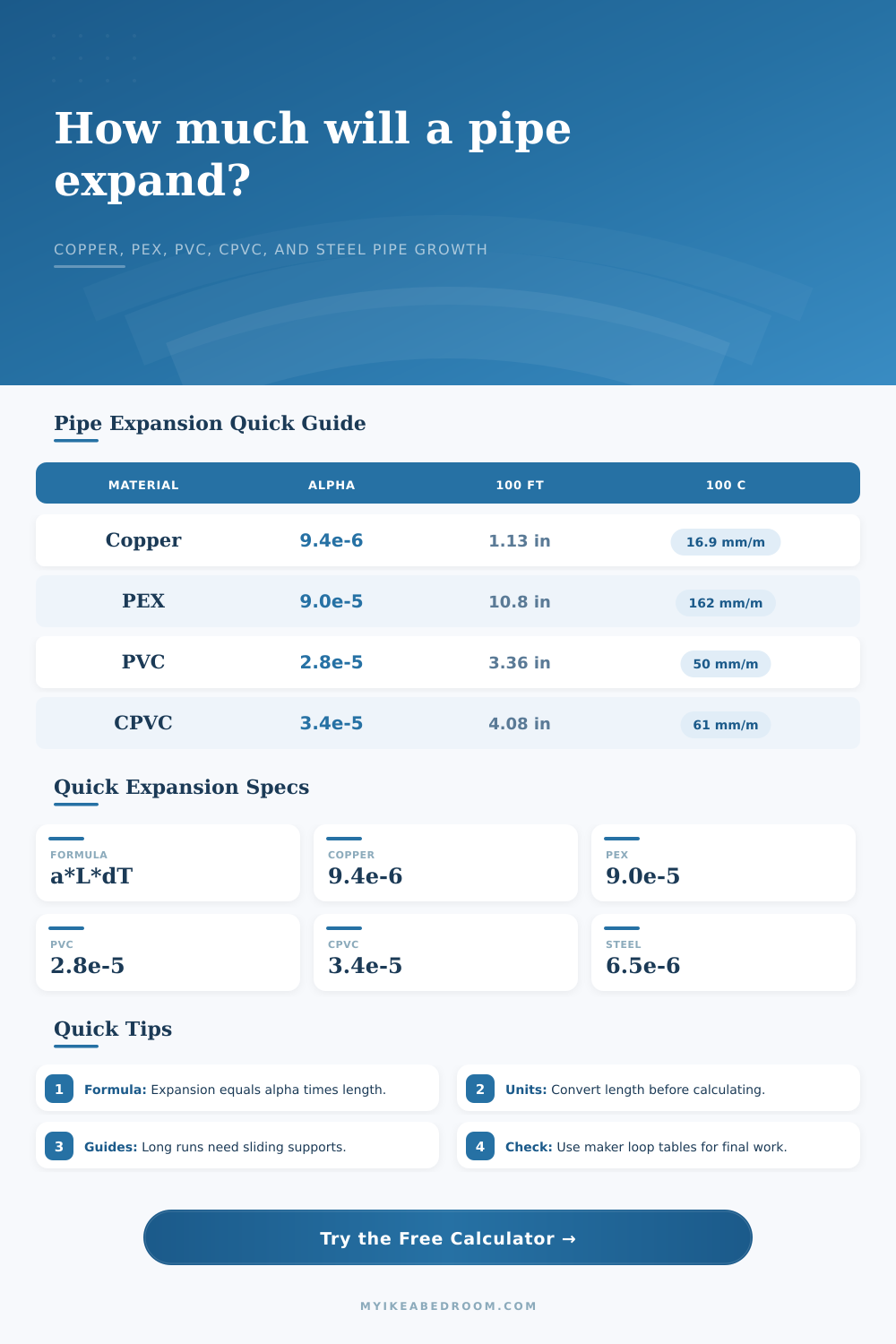
deltaL = alpha * L * deltaT
imperial: inches = alpha in/in/°F × length inches × temperature change °F
metric: mm = alpha mm/mm/°C × length mm × temperature change °C
Your pipe expansion result
Enter pipe details and calculate to review movement allowance.
🧪Material coefficient grid
📊Expansion coefficient table
| Pipe material | Alpha in/in/°F | Alpha mm/mm/°C | Example movement |
|---|---|---|---|
| Copper Type L or M | 0.0000094 | 0.0000169 | 1.13 in per 100 ft per 100°F |
| PEX-A tubing | 0.0000900 | 0.0001620 | 10.80 in per 100 ft per 100°F |
| PEX-B tubing | 0.0000800 | 0.0001440 | 9.60 in per 100 ft per 100°F |
| PVC Schedule 40 | 0.0000280 | 0.0000504 | 3.36 in per 100 ft per 100°F |
| PVC Schedule 80 | 0.0000260 | 0.0000468 | 3.12 in per 100 ft per 100°F |
| CPVC CTS | 0.0000340 | 0.0000612 | 4.08 in per 100 ft per 100°F |
| Carbon steel | 0.0000065 | 0.0000117 | 0.78 in per 100 ft per 100°F |
| Stainless steel | 0.0000096 | 0.0000173 | 1.15 in per 100 ft per 100°F |
📐Loop allowance reference
| Allowance type | Reference factor | Use for | Planning note |
|---|---|---|---|
| Sliding end or sleeve | 1.10x expansion | Movement into open clearance | Keep pipe free to move axially |
| Offset or bend allowance | 1.25x expansion | Small changes in direction | Avoid clamping both sides rigidly |
| Expansion U-loop | 1.50x expansion | Long straight plastic or metal runs | Size loop from pipe maker data |
| Flexible loop allowance | 2.00x expansion | Conservative planning checks | Use when routing is uncertain |
📋Preset scenario comparison
| Scenario | Material and run | Temperature change | Approx expansion |
|---|---|---|---|
| Copper hot branch | Copper, 45 ft | 70°F | 0.36 in / 9 mm |
| PEX hot trunk | PEX-A, 80 ft | 80°F | 6.91 in / 176 mm |
| PVC drain stack | PVC, 30 ft | 55°F | 0.55 in / 14 mm |
| CPVC supply run | CPVC, 65 ft | 75°F | 1.99 in / 51 mm |
| Steel hydronic main | Steel, 100 ft | 120°F | 0.94 in / 24 mm |
💡Thermal movement tips
Or how about that loop of PEX you put in your sub floor? Because you had all this room to spare before that wall right? So you just went straight from the manifold down to the other side of the house, until the furnace came on and the water warmed up and that pipe shove into the framing with some real force. Why did that happen?
It didn’t magically grow (It’s Physics). All material expand when they get hot and contract when they cool. But that’s not the problem; the problem is not giving them somewhere to go.
Why Pipes Expand and How to Handle It
That leaves you just putting in your temperature change and your length into the calculator, and the calculator figure out the rest. You do not have to guess any conversions or coefficients. The basic formula is: The change in length is equal to alpha times the original length times the change in temperature. You take the material’s expansion coefficient, multiply that by length of pipe, then multiply that by the temperature change.
Easy-peasy, right? But that first variable, the coefficient; is where folks goes wrong. A low coefficient means something expands very little even with a large run. For example, copper’s not too bad here; even at long lengths, it won’t grow by much.
But plastic pipes. Such as PVC and PEX (has far higher coefficients). For an equal temperature difference, they’ll stretch and contract far more farther than the metal. And that’s what many folks screw up on since we think of plastic as being rigid, just like steel (though I know it feels solid in our hands). But plastic’s elastic. It’s expansive.
The straight line distance is not what you want to measure. You want to measure the developed length between anchors. Each inch expand, and if the pipe snakes around corners then each inch of that curve counts.
The other key variable is temperature change. It’s not the difference between freezing and boiling that you calculate. It’s the difference between the installed ambient temperature and the operating temperature. For example, you don’t calculate from freezing to boiling, but from fifty-degree basement where you laid pipe to the one-hundred-and-forty degrees it reaches when you run it. Your difference would be ninety degrees.
That’s a pretty good jump and a little error in assuming how much it starts out will mess up your whole allowance calculation. You can even get it to visualize how much clearance you’ll need. It doesn’t just give you measurements in inches, like “this thing is going to expand four feet,” but multiplies that number by a specific factor based off what you plan to do with the other end. Do you plan to use a full U-bend or a sliding sleeve? Those require different allowances.
The tool’s reference table spells that out: sliding might only need 10% added clearance whereas a more conservative flexible loop would require twice as much theoretical expansion. Why? Rigid anchors at each end of a long length of flexible plastic create enormous amounts of stress. And that stress doesn’t vanish; it goes somewhere. It usually go into your manifold, your fittings, or the walls themselves.
A subtler but significant part of this equation is support spacing. The guides should supports and allow axial movement without sagging. If they are too tight, they become anchors. This forces one long run into multiple shorter runs that must also be computed separately. Too loose and you’ll risk vibration or buckling. All the calculator figure assume a proper sliding support system, but do check on how well those clamps is installed anyway. Gripping the pipe too firmly with a clamp defeats all your careful expansion planning.
Expansion isn’t your only problem, contraction is too. As the system cools it contracts. You can design for expansion without designing for contraction. This lack of planning for contraction will pull on the joints and stress other connections in ways you never expected. Think of the whole cycle, not just from hot to cold but cold to hot. It goes both ways.
We’ve had some contractors that will just blow this stuff off based off experience, “I did it like this before.” Yes, experience is good. But materials has changed. Hydronic heating/radiant floors are polymer-based now, which expands with every degree of heat. There is also less furnitures used now than in older systems.
Let the material breathe; respect its movement. Give it room. Measure twice, calculate once, then let the material do its thing. It’s a small step, but keeps the system intact for decades.
That subfloor PEX loop is waiting to move. Make sure it has room to do so.