Pipe Volume Calculator
Estimate liquid volume inside straight pipe runs using cylinder volume, nominal pipe inside-diameter references, gallons, liters, volume per foot, and water weight.
🔧Pipe presets
📏Pipe inputs
Choose a nominal ID reference or enter a measured inside diameter. The calculator uses cylinder volume: pi × radius² × length.
Pipe volume results
📊Nominal pipe ID reference
📘Volume per foot table
| Nominal pipe | Reference ID | Gallons per foot | Liters per meter |
|---|---|---|---|
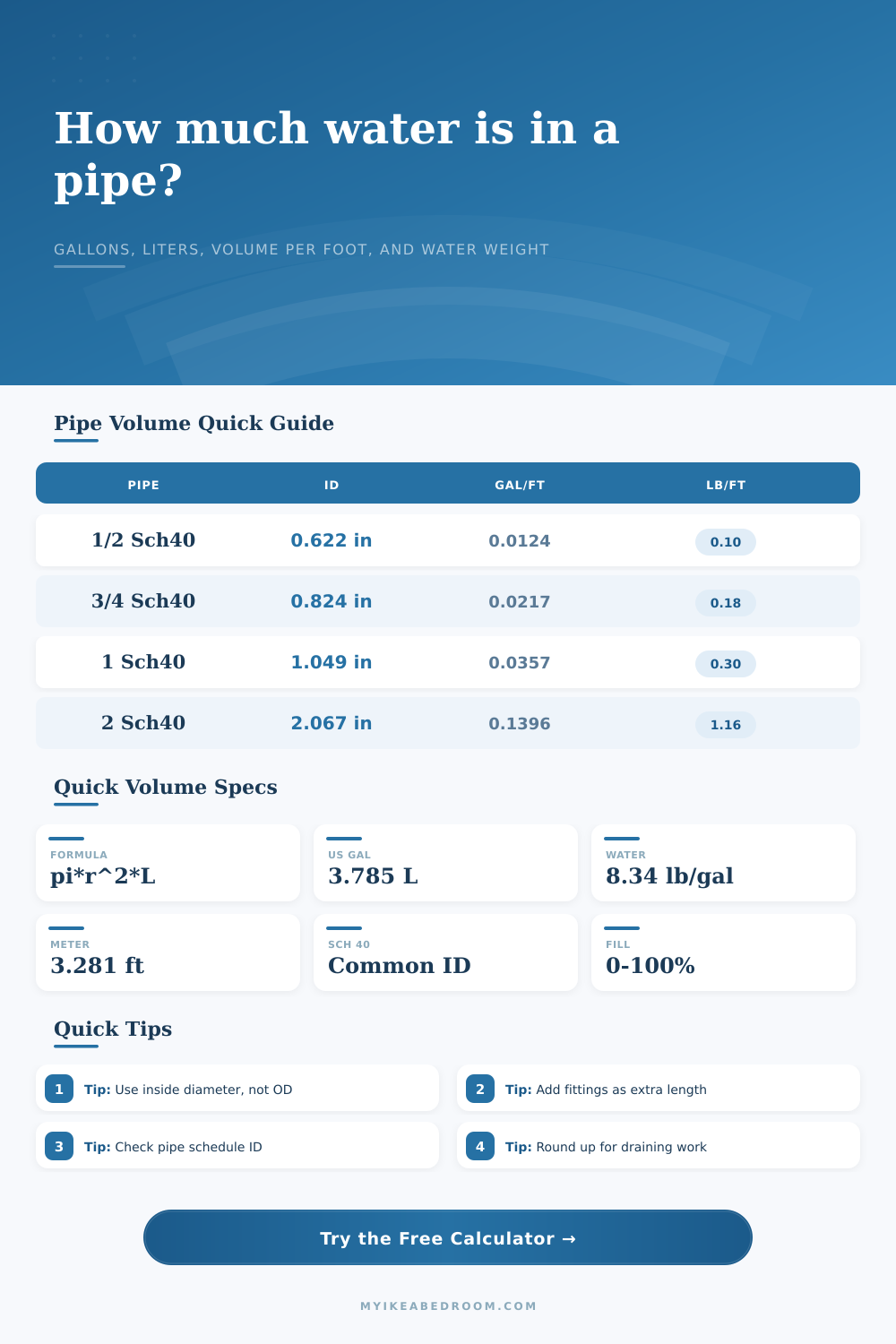
| 1/2 in Schedule 40 | 0.622 in | 0.0124 gal/ft | 0.154 L/m |
| 3/4 in Schedule 40 | 0.824 in | 0.0217 gal/ft | 0.269 L/m |
| 1 in Schedule 40 | 1.049 in | 0.0357 gal/ft | 0.443 L/m |
| 1-1/4 in Schedule 40 | 1.380 in | 0.0617 gal/ft | 0.767 L/m |
| 1-1/2 in Schedule 40 | 1.610 in | 0.0840 gal/ft | 1.043 L/m |
| 2 in Schedule 40 | 2.067 in | 0.1396 gal/ft | 1.734 L/m |
📐Pipe standard comparison
| Nominal size | Sch 40 ID | Sch 80 ID | Copper L / PEX notes |
|---|---|---|---|
| 1/2 in | 0.622 in | 0.546 in | Copper L 0.545 in, PEX 0.475 in |
| 3/4 in | 0.824 in | 0.742 in | Copper L 0.785 in, PEX 0.671 in |
| 1 in | 1.049 in | 0.957 in | Copper L 1.025 in, PEX 0.862 in |
| 1-1/4 in | 1.380 in | 1.278 in | Copper L 1.265 in, PEX 1.054 in |
| 1-1/2 in | 1.610 in | 1.500 in | Copper L 1.505 in, PEX 1.244 in |
| 2 in | 2.067 in | 1.939 in | Copper L 1.985 in, PEX 1.629 in |
🧮Common run examples
| Run type | Reference pipe | Length | Approx volume |
|---|---|---|---|
| Sink supply branch | 1/2 in copper L | 35 ft | 0.54 gal / 2.0 L |
| Laundry branch | 3/4 in Sch 40 | 45 ft | 1.02 gal / 3.8 L |
| Radiant loop | 1/2 in PEX | 250 ft | 2.40 gal / 9.1 L |
| Utility main | 2 in Sch 40 | 100 ft | 14.66 gal / 55.5 L |
💡Pipe volume tips
Unless there’s a reason to know how many gallons of water fit in the thing, you may have forgotten it’s an empty tube most of the time. For example, you might need to know this when sizing a pump or figuring out what happend with your water bill when filling a new loop for radiant heat in your house.
The inside diameter matters more then the outside diameter ever will, and you realy need to get it right because it isn’t some hypothetical number. It affects displacement, weight, and could cause a mess if you get it wrong.
Why You Must Measure the Inside of the Pipe
So how much does it hold? You put the cylinder’s measurements into the calculator above and it figures it out for you, but what exactly are you putting in it?
Most folks glance at the nominal size on the pipe’s label in the hardware store and think they’ve got it nailed down. Nope. Most people assumes the nominal size tells them the capacity. An inch of pipe isn’t realy an inch wide inside. That’s because there’s a wall there.
And the more pipe, the more the wall eats away at the diameter, making the issue worse with every length of pipe. The larger the number after “Schedule” (e.g., Schedule 80), the thicker the walls which reduces the bore or inner width of the pipe.
If you measure the outside by mistake, you’ll be way off; overestimating the volume by a large amount. That’s what most folks miss. Since the outside is easy to access, they figure it must be the thing they are supposed to be measuring. Volume is on inside.
If you know how many feet long something is, understand that real-world buildings has very little straight pipe. There are elbows, tees, and valves, all of which create dead space that will retain water as much as any other part of the system. When you’re figuring out total system water for treating with chemicals or draining, it’s smart to estimate an additional 5-10% for fittings. This seems like padding but is actualy realistic.
Half-inch supply line stretched along a long run to a sink may contain less than half a gallon, which sounds inconsequential until you want to drain it without creating an airlock, or calculate the weight of that water on a ceiling joist. Water weighs approximately eight and a third pounds per gallon. That’s a lot if you multiply it by hundreds of feet in a big house, and realize there are hundreds of pounds of liquid hanging over your head.
Secondly, it’s a question of materials. Steel pipe of any given nominal size will be a certain inside diameter; so will copper Type L or PEX tubing. Because PEX has thinner walls and is more flexible, it often have a larger bore (inner diameter) relative to its outside diameter compared to steel pipe. In other words, a comparable-length section of PEX may contain more water in the loop than an equal length of steel pipe which impacts both pump sizing and fill time.
To understand exactly how small variations in inner diameters can add up to gallons-per-foot, the page includes reference tables explaining all this clearly. You don’t need to memorize them but should at least be aware that they exist… And differ based off material type.
What’s this mean in terms of your own project? What do the results say?
For instance: if you’re winterizing, knowing the exact amount of water will help you figure out how many gallons of anti-freeze to add and circulate. If you’re balancing a hydronic heating system, then knowing exactly how many gallons per foot allows you to estimate the length of time required to purge air from the system. Filling something is one thing; taking control of a system that goes through cycles from wet to dry to wet again is another.
In short: Volume in pipes is a reflection of hidden capacity. It’s up to you to put that number into context. A basic sink branch? Or a gnarly utility main? Treating pipe as more than just a tube (a container that can be measured, not just a path) avoids costly errors. Add up the fitting, measure the inside, and factor in water weight. You should of saved money on your plumbing system, and your bank account will thank you for it.