Rainwater Tank Size Calculator
Estimate collected rainwater from roof area, rainfall, and runoff coefficient, then size storage from daily water demand, dry days, reserve, and liters.
☁Roof and garden presets
⚙Calculator inputs
Your rainwater tank estimate
📐Formula used
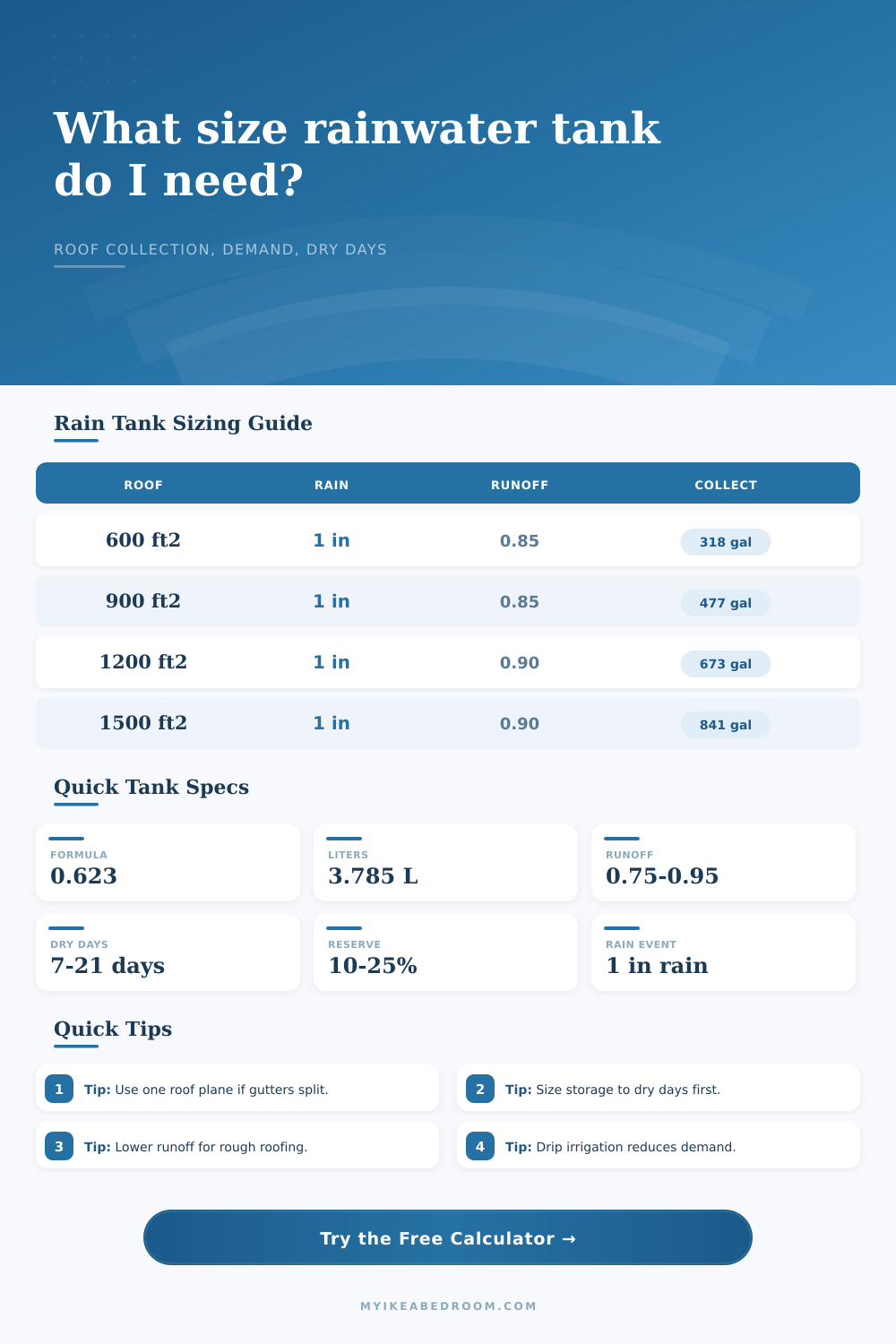
collection gallons = roof area sq ft * rainfall inches * 0.623 * runoff coefficient
demand gallons/day = garden water gallons/day + other non-potable demand
tank gallons = demand gallons/day * dry days * (1 + reserve percent)
🏠Runoff coefficient reference
💧Rainfall collection table
| Roof area | Rainfall | Runoff coefficient | Collected volume |
|---|---|---|---|
| 500 sq ft (46.5 m2) | 0.5 in (12.7 mm) | 0.85 | 132 gal (500 L) |
| 800 sq ft (74.3 m2) | 1.0 in (25.4 mm) | 0.90 | 449 gal (1,700 L) |
| 1,200 sq ft (111.5 m2) | 1.0 in (25.4 mm) | 0.90 | 673 gal (2,548 L) |
| 1,500 sq ft (139.4 m2) | 1.5 in (38.1 mm) | 0.85 | 1,191 gal (4,508 L) |
🌱Garden demand by watering depth
| Garden area | Weekly depth | Garden demand | 14 dry days storage |
|---|---|---|---|
| 100 sq ft (9.3 m2) | 0.5 in (12.7 mm) | 4.5 gal/day (17 L/day) | 62 gal (235 L) |
| 250 sq ft (23.2 m2) | 1.0 in (25.4 mm) | 22.3 gal/day (84 L/day) | 312 gal (1,181 L) |
| 500 sq ft (46.5 m2) | 1.0 in (25.4 mm) | 44.5 gal/day (169 L/day) | 623 gal (2,358 L) |
| 750 sq ft (69.7 m2) | 1.25 in (31.8 mm) | 83.4 gal/day (316 L/day) | 1,168 gal (4,421 L) |
🗓Dry days storage guide
| Daily demand | 7 dry days | 14 dry days | 21 dry days |
|---|---|---|---|
| 20 gal/day (76 L/day) | 140 gal (530 L) | 280 gal (1,060 L) | 420 gal (1,590 L) |
| 40 gal/day (151 L/day) | 280 gal (1,060 L) | 560 gal (2,120 L) | 840 gal (3,180 L) |
| 60 gal/day (227 L/day) | 420 gal (1,590 L) | 840 gal (3,180 L) | 1,260 gal (4,770 L) |
| 100 gal/day (379 L/day) | 700 gal (2,650 L) | 1,400 gal (5,300 L) | 2,100 gal (7,950 L) |
📋Common roof and garden scenarios
| Scenario | Roof and rainfall | Demand basis | Tank planning result |
|---|---|---|---|
| Small shed and planters | 180 sq ft, 1.0 in, 0.85 runoff | 80 sq ft at 0.6 in/week | 77 gal collected, 52 gal for 10 days |
| Garage roof and raised beds | 480 sq ft, 1.0 in, 0.90 runoff | 220 sq ft at 1.0 in/week | 269 gal collected, 317 gal for 14 days |
| House roof and vegetable patch | 1,100 sq ft, 1.2 in, 0.90 runoff | 450 sq ft at 1.0 in/week | 740 gal collected, 787 gal for 18 days |
| Large roof and mixed borders | 1,600 sq ft, 1.5 in, 0.85 runoff | 800 sq ft at 1.25 in/week | 1,271 gal collected, 1,752 gal for 21 days |
💡Planning tips
When beginning to think about rainwater harvesting, we begin with the roof. After all, it’s right there in front of us: free water. It has a big surface area. Storms is coming, and the tank will fill up. Wrong. Making your tank size solely based off its potential to collect is faulty thinking. It fails to consider whether or not your garden will need that water when it rains, which isn’t going to be most of the time (i.e., there are going to be many dry day).
That’s where the calculator above come into play. By entering information about your roof and rainfall data, it do the math for you, no guesswork with conversion numbers required.
How to Calculate the Right Tank Size
Demand (not necessarily supply) is typically the limiting factor. First determine how many gallons or liters you use each day. That is area irrigated times the depth of water needed per week. If you’re only growing a tiny patch of herbs, it won’t be much. A thirsty lawn or big veggie garden may goes through a lot of water in high summer. This figure for daily use will guide everything else. Guessing at a tank size without this reference point are a crapshoot.
Next, determine the number of days you can go without rainfall. That’s what the dry days input refers to. In most places, a few days won’t matter much. A few weeks? Drought territory. Enter that number into the calculator, multiply your daily demand by your chosen number of dry days, and you have how much you must store. Then add some buffer. It is not an additional amount but rather a factor for how easily you can pump it out and space for sediment to settle. If you skip this buffer you might suck up debris and/or burn out your pump.
The type of roofing material used make a difference in the bottom line. You don’t get all the rain that lands on the roof into the tank. Metal, because it’s smooth, tends to yield more runoff than say, asphalt shingles with their rough surface that absorb and hold onto more water. To account for this loss, there is something called runoff coefficient. If you have a smooth metal roof, you may end up getting 95 percent of the rain. If you have a shaded rough roof, perhaps only seventy five percent. If you fail to adjust for this, you’ll end up underestimating the frequency of needing to top off the supply.
Space constraints are physical limitation on what you can do. Maybe the math say a big tank will get you through a 40 day drought. But maybe you don’t have enough room for a bigger tank? In this scenario, the tool allows you to make tradeoffs. If you see that one inch of rain fill up your small tank, then it gives you guidance that you should consume that water fast. Standing water promotes mosquitoes and algae growth. A healthy tank is one which turns over often and is thus easier to handle.
Another option is First flush diverters. They throws out the first few gallons of rainwater. The first water off the roof will have bird poop, leaves and other roof grunge on it. By losing some of the water, your actual collection is slightly lower. It’s worth it to get cleaner water. If you’re using it on edibles you don’t want roof crud.
Rainwater harvesting works like a balance sheet. On one side, you have local rainfall + your roof area (income). On the other, you have your watering habits + your garden size (expenses). Your tank is your smoothing device; it accounts for the difference between them. If you have high income and low expenses, you need a small tank. If you have unreliable rain and high expenses, you need a large tank. It’s not about catching every drop. It’s about having enough water stored up so you’re good during dry spells. Work out what you need, then use the size of your roof to figure out how to fill in the rest.