Tankless Water Heater Flow Rate Calculator
Total the fixtures that may run at the same time, calculate temperature rise from setpoint minus incoming water temperature, estimate BTU/h demand, and compare it with derated heater flow in GPM and L/min.
📋Simultaneous-use presets
⚙Flow and temperature inputs
Temperature fields convert between Fahrenheit and Celsius. Flow choices are stored in GPM and displayed with matching L/min equivalents.
Tankless flow result
⚙Live sizing checks
📊Tankless sizing reference tables
| Fixture | Low-flow planning | Common planning | High-flow planning |
|---|---|---|---|
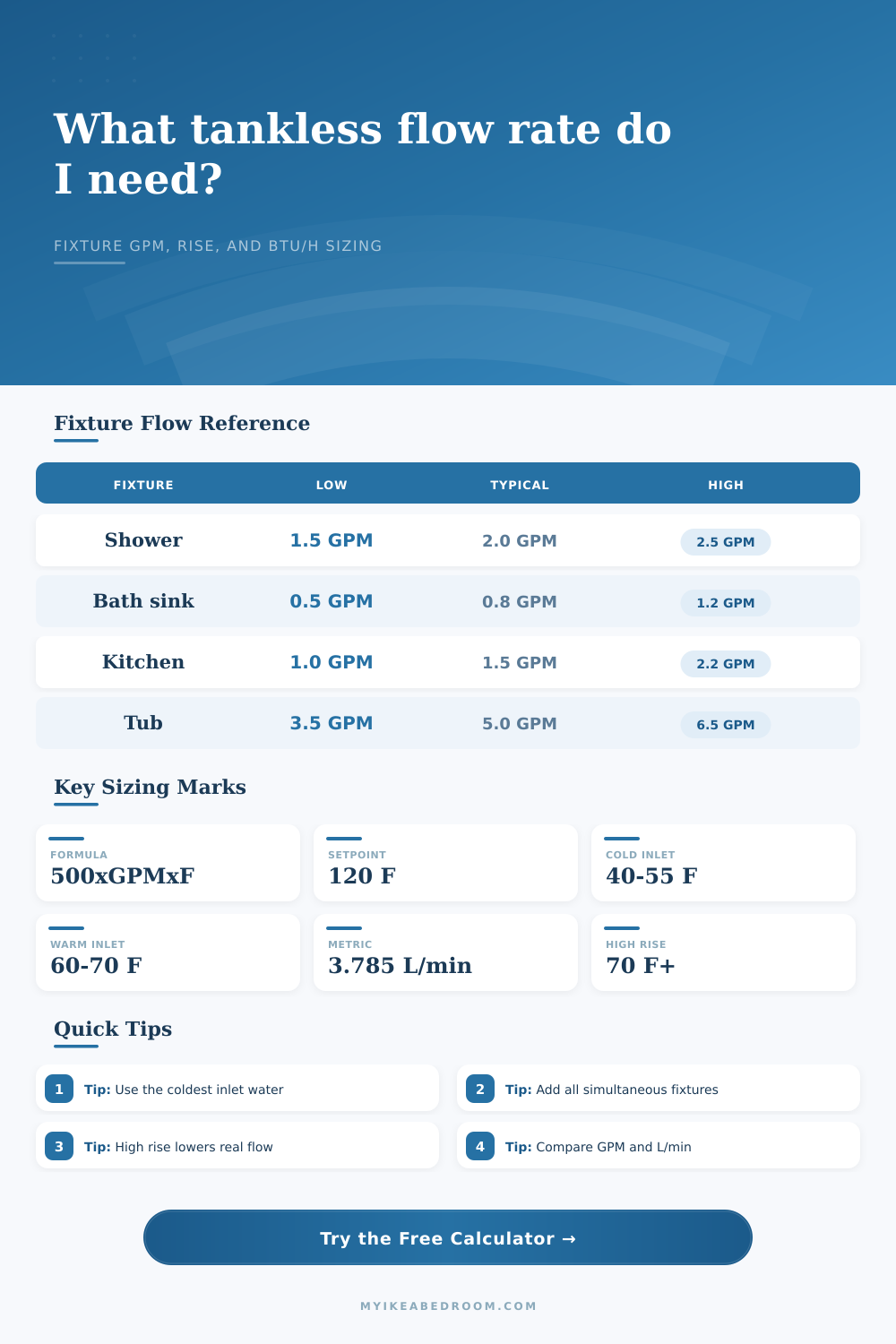
| Shower head | 1.5 GPM / 5.7 L/min | 2.0 GPM / 7.6 L/min | 2.5 GPM / 9.5 L/min |
| Bathroom faucet | 0.5 GPM / 1.9 L/min | 0.8 GPM / 3.0 L/min | 1.2 GPM / 4.5 L/min |
| Kitchen faucet | 1.0 GPM / 3.8 L/min | 1.5 GPM / 5.7 L/min | 2.2 GPM / 8.3 L/min |
| Dishwasher fill | 0.6 GPM / 2.3 L/min | 0.8 GPM / 3.0 L/min | 1.2 GPM / 4.5 L/min |
| Laundry warm fill | 0.8 GPM / 3.0 L/min | 1.2 GPM / 4.5 L/min | 1.8 GPM / 6.8 L/min |
| Tub filler | 3.5 GPM / 13.2 L/min | 5.0 GPM / 18.9 L/min | 6.5 GPM / 24.6 L/min |
| Total hot flow | 45°F rise | 60°F rise | 75°F rise |
|---|---|---|---|
| 2.0 GPM / 7.6 L/min | 45,000 BTU/h | 60,000 BTU/h | 75,000 BTU/h |
| 3.0 GPM / 11.4 L/min | 67,500 BTU/h | 90,000 BTU/h | 112,500 BTU/h |
| 4.5 GPM / 17.0 L/min | 101,250 BTU/h | 135,000 BTU/h | 168,750 BTU/h |
| 6.0 GPM / 22.7 L/min | 135,000 BTU/h | 180,000 BTU/h | 225,000 BTU/h |
| 7.5 GPM / 28.4 L/min | 168,750 BTU/h | 225,000 BTU/h | 281,250 BTU/h |
| Actual rise | Base flow ratio | High-rise factor | Effective flow note |
|---|---|---|---|
| 35°F / 19.4°C | 45 / 35 = 129% | 100% | More flow than 45°F rating |
| 45°F / 25.0°C | 45 / 45 = 100% | 100% | Matches rated flow point |
| 60°F / 33.3°C | 45 / 60 = 75% | 95% | High-rise reserve begins |
| 75°F / 41.7°C | 45 / 75 = 60% | 90% | Cold-water sizing case |
| 90°F / 50.0°C | 45 / 90 = 50% | 85% | Very demanding inlet condition |
| Use pattern | Fixture mix | Total flow | Planning note |
|---|---|---|---|
| Compact apartment | 1 shower only | 1.5 to 2.0 GPM | Often point-of-use or small whole-home range |
| One bath morning | 1 shower + 1 sink | 2.5 to 3.0 GPM | Good baseline for a small home |
| Two bath overlap | 2 showers + 1 sink | 4.8 to 5.6 GPM | Check winter inlet temperature carefully |
| Kitchen overlap | Shower + kitchen | 3.0 to 4.0 GPM | Common morning and evening demand pattern |
| Tub filling | Tub only or tub + sink | 4.0 to 6.5 GPM | High flow can exceed comfort capacity |
💡Sizing tips
So don’t just go by the BTU rating when selecting a tankless water heater, consider the flow rate as well. The BTU rating show how much heat the device can produce, but it doesn’t show if that is enough for your daily needs. It’s possible for you to put in a high-powered unit and still end up with cold water if another person shower in the vicinity.
But it isn’t power alone that’s limiting you here. The limit are really flow rate. This page calculates the math for you. But knowing why helps avoid expensive errors.
Why You Should Check Flow Rate, Not Just BTU
The basic problem is a rise in temperature. Typically they is rated by how much they will raise the temp, commonly forty-five degrees Fahrenheit. So if you want to go from fifty degree water into your tank and up to one hundred twenty you will have to add a seventy degree bump to the water. Many does that backwards. They look at that big flow rate and think it will work when the morning temps is really cold in winter. Nope. And the bigger the temp hike you need the smaller amount of water it can move because heaters don’t get bigger. Physics doesn’t bargain.
To obtain realistic figures, you must also have some idea about your worst-case scenario. In other words, what is your lowest incoming water temperature? Typically, this occur during early spring and/or late winter months. When using this tool, you can enter that cold baseline into the calculator. That way, it’s going to give you realistic results instead of ideal results. For example, if your climate has cool ground throughout the entire year, you’ll never realize highest performance of your heater. You are fighting thermal mass, which is the cooler water entering your pipes.
The second hidden trap is simultaneous use. Most units will handle a single shower head at one and a half gallons per minute. But toss in a washing machine, a running kitchen faucet, and a second shower, and suddenly you’re looking at five or six gallons of demand each minute. The calculator’s presets show you where those overlaps occur. Size for the worst-case scenario, because you’re not just sizing for one fixture; you’re sizing for the moment when everyone want hot water all at once. It’s a small thing and yet it matters. Average-size a unit, and it won’t meet your peaks.
Sometimes you’re not sure how much flow fixtures use. The reference tables is handy for a fast glance at normal fixture flows. A shower head might be a super-efficient one-point-five gpm model or a high-pressure rain head that requires a two and a half gallon per minute flow rate, or more! Pull-out sprayer kitchen faucets can use as much as two point two gallons, especially if someone is cleaning up after dinner. This is not just a hypothetical number; it is the real-world limit of what your heater has to deal with and what your plumbing system can deliver.
The instant you exceed the heater’s derated capacity, water temperatures start dropping. And you’ll notice. The thing that they adjust for is derating. So if a heater is rated for a 45 degree rise on six point five gallons then it could be rated for say three or four gallons on a seventy-five degree rise. That’s what the drop off in the calculator means. It will take the manufacturer’s base rating and scale it back to your own inlet temperature.
So you won’t be dissapointed like you can sometimes be where you got your new heater and found out you couldn’t have a shower and bath fill simultaneously. You would of rather find that out before the plumber left the driveway.
Another difference is that while you can put as much fuel as you want into a gas unit, an electric unit are limited by how many amps a circuit can provide. So it calculates how much power (in BTUs) it require and translates those to kilowatts, which lets you know what kind of electrical draw that equates to. In old houses where they may have very little panel space this can be important. You could want a particular flow rate, only to find out that your electrical isn’t prepared for that amount of current draw.
Physics and desire come together in sizing a tankless system. How much do you want? That’s the how long will it last question. And then there is the hottest we can make it. The inputs ask that of you. What’s the busiest hour, what’s the coldest water. That way the system does its job when it needs to.
Don’t get distracted by the large BTU number. It is all about the flow that makes you comfortabley.