Window Replacement Payback Calculator
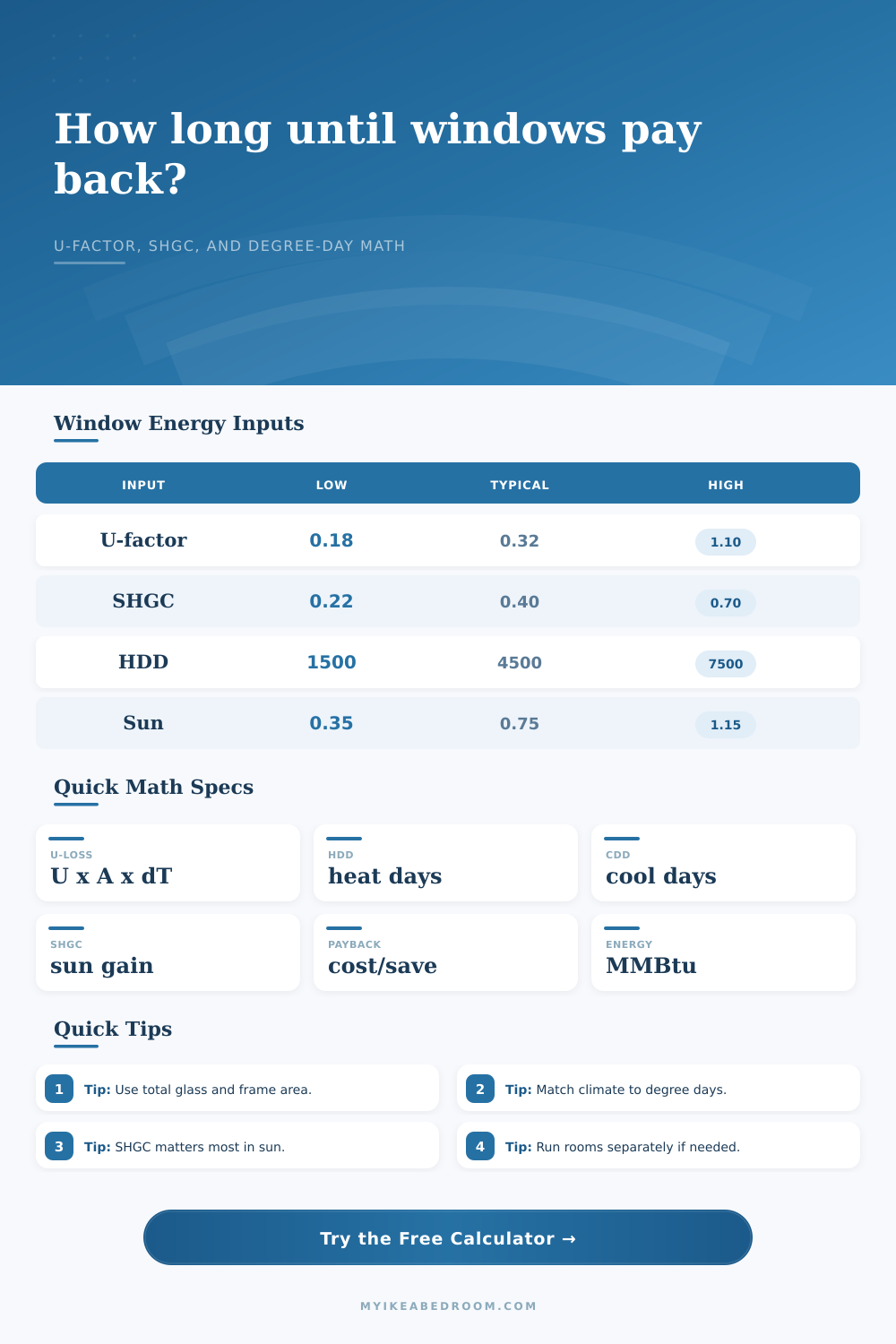
Estimate heat loss from U-factor, solar gain from SHGC, degree-day energy savings, annual savings, and simple payback from your own project amount.
🪟Window Payback Presets
📏Energy And Payback Inputs
Window Payback Results
🔢Formula Snapshot
⚙Energy Math Reference
🌡Climate Degree Profile Table
| Profile | Heating Degree Days | Cooling Degree Days | Sun Factor |
|---|---|---|---|
| Mixed average | 4,000 HDD | 1,200 CDD | 0.75 medium exposure |
| Cold cloudy | 6,500 HDD | 650 CDD | 0.55 lower sun |
| Cold sunny | 5,800 HDD | 800 CDD | 0.95 clear winter sun |
| Hot humid | 1,000 HDD | 3,000 CDD | 0.90 cooling exposure |
| Hot dry | 1,800 HDD | 2,700 CDD | 1.15 intense sun |
| Marine mild | 2,800 HDD | 350 CDD | 0.60 moderated sun |
🪟U-Factor And SHGC Reference
| Window Case | Typical U-Factor | Typical SHGC | Calculator Note |
|---|---|---|---|
| Single pane clear | 0.90 to 1.20 | 0.65 to 0.80 | High conductive loss, high solar gain |
| Older double pane | 0.45 to 0.65 | 0.45 to 0.65 | Moderate loss and solar gain |
| Low U insulated glass | 0.22 to 0.35 | 0.25 to 0.45 | Lower U-factor reduces conduction |
| Low solar gain glass | 0.24 to 0.36 | 0.20 to 0.30 | SHGC change affects cooling and winter sun |
☀SHGC And Sun Factor Table
| Exposure | Sun Factor | Cooling Impact | Heating Offset |
|---|---|---|---|
| Deep shade or north exposure | 0.30 to 0.45 | Small SHGC cooling change | Small winter solar offset |
| Mixed orientation | 0.60 to 0.80 | Moderate SHGC cooling change | Moderate winter solar offset |
| Sunny south or west glass | 0.90 to 1.10 | Large SHGC cooling change | Winter sun can matter |
| Hot dry high-sun exposure | 1.10 to 1.20 | Very large cooling change | Cooling often dominates |
📝Preset Assumption Table
| Preset | Area | U Change | SHGC Change |
|---|---|---|---|
| Single pane bedroom | 96 sq ft | 0.95 to 0.30 | 0.70 to 0.38 |
| Old double pane | 140 sq ft | 0.55 to 0.28 | 0.55 to 0.36 |
| Sunny south wall | 180 sq ft | 0.62 to 0.30 | 0.62 to 0.32 |
| Hot climate room | 155 sq ft | 0.58 to 0.31 | 0.64 to 0.24 |
| Whole home starter | 360 sq ft | 0.70 to 0.29 | 0.62 to 0.34 |
💡Calculation Tips
When most homeowners consider replacing windows they see it as an upgrade for comfort, not a financial transaction. They get a quieter street, less draft, and new views. The energy savings are supposed to come along with all that stuff, but the math doesn’t usually work out based off what brochures say.
To find out if you will ever recieve back the money you spent on new windows, ignore what the marketing specs say and look into how your own climate works. Buying a window isn’t about buying a window; it is about buying performance relative to where you live.
When Will New Windows Pay Back Your Money?
Windows are fundamentally a double-edged sword: they let heat escape in the winter and let heat enter in the summer. The calculator above will balance those competing forces for you.
To get started, think about the U-factor which indicates the window’s ability to resist heat transfer. Lower is better; this has a huge impact on your energy bills if you inhabit a cold spot where heating costs is a big part of your bill. However, unless you also consider the Solar Heat Gain Coefficient, known as the SHGC, you may be swapping one issue for another.
The SHGC represents amount of solar radiation passing through window. If you have high solar gain in a hot southern climate, even a highly insulated space become a greenhouse. This can drive up your cooling expenses, regardless of whether you’ve got a great U-factor.
So that’s the part everyone skips over. We think: We should insulate. Insulate! But we ignore sunlight until someone like me points it out.
The tool compensates for this through degree days. Degree days are measurements of how many days it has been below or above some comfortable starting point. In a hot, dry climate with intense sun, you’ll need a low SHGC to keep the air from baking, and the tool accounts for this by using cooling degree days. In a cold, cloudy climate, you need a low U-factor because the sun won’t be working to your advantage.
The tool takes all this information in and combines it with a single number describing the cost of energy. This number is a bit of a fudge. It takes the actual cost of electricity and natural gas and simplifies them down into one combined number, which is why it is a rough estimate. Chances are the true ratio of your electric bill and gas bill are not going to exactly match that estimate, but the general trend it shows you tend to be right. What it does show you is the overall trend.
So take it less as a promise of dollars, and more as a direction indicator: Is the payback time more like two decades? Then this is less an economic decision (and more a matter of how much your house is worth to you).
In practice, factors such as shading from overhanging trees; the way thermostats are set; and even leaks around the window frame makes a big difference. The page includes a table of rough figures for how much different windows saves, so you can see if your situation is an outlier. Obviously, single panes in an older house need replacing… But upgrading from say, a good double pane to some luxuruis triple-pane may never add up solely on their energy performance. As you upgrade toward better windows, the incremental benefit decrease.
The final verdict: Do you care about the bottom line more or do you hate sitting in that glare/cold draft? Replace the windows because it’s making you nuts. The money is a nice bonus. It makes the bill sting a bit less.
The calculator takes out all the feel-good stuff and shows you some real numbers. How many winters will it take for my energy savings to pay for what I paid the window guy? Now that you know exactly what you’re paying for, you can choose your goal. You might want steady savings, a nicer looking home, or immediate comfort. And you’ll know how long it’ll take.