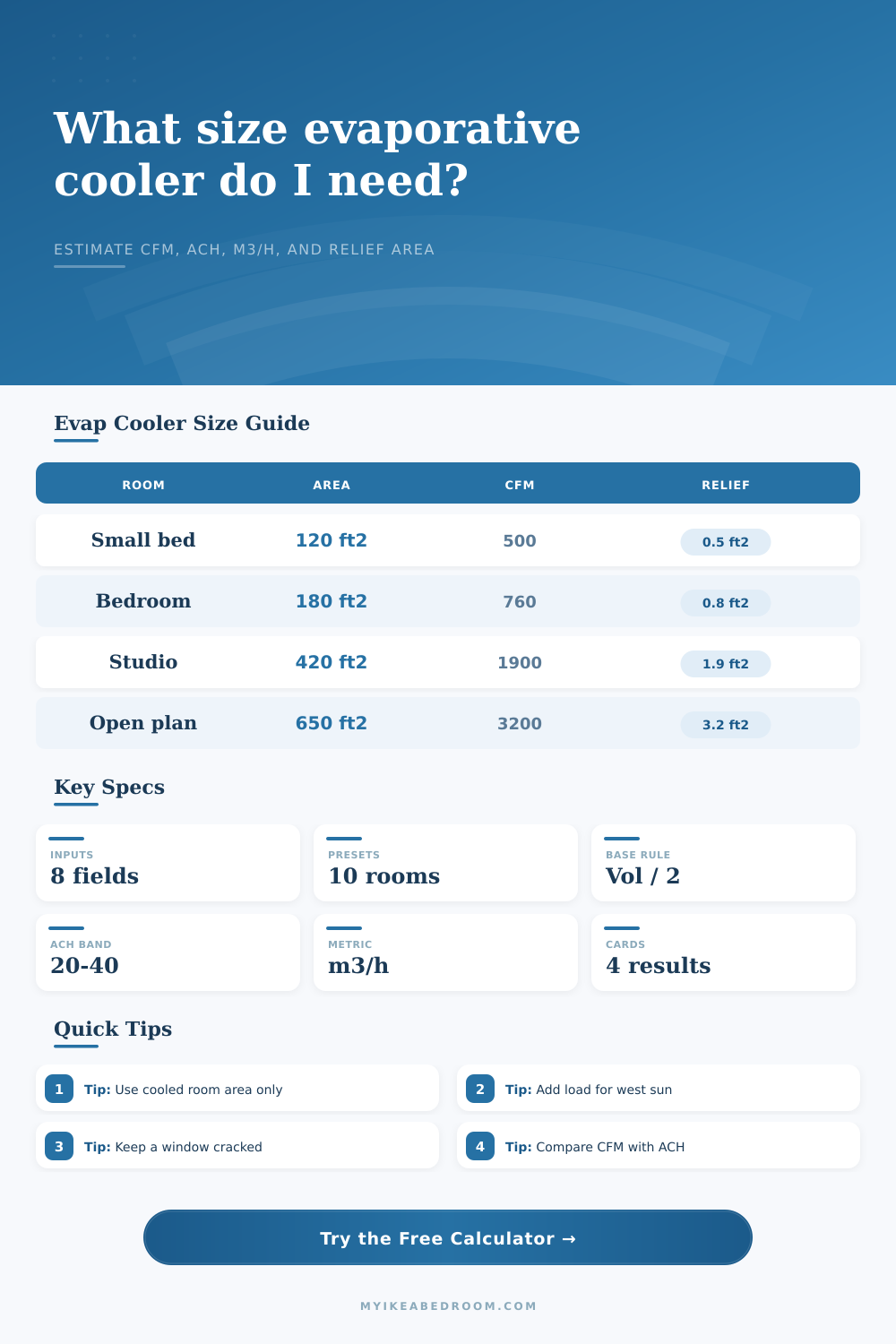
Evaporative Cooler Size Calculator
Estimate room cooler airflow from floor area, ceiling height, dryness, sun load, target air changes, sizing buffer, and the relief opening needed for steady evaporative airflow.
| Step | Formula | Result | Unit |
|---|---|---|---|
| Volume | area x height | 0 | cu ft |
| Base CFM | volume / 2 | 0 | CFM |
| Adjusted | base x factors | 0 | CFM |
| Final | max path + buffer | 0 | CFM |
| Step | Formula | Result | Unit |
|---|---|---|---|
| ACH CFM | volume x ACH / 60 | 0 | CFM |
| Actual ACH | CFM x 60 / volume | 0 | ACH |
| Relief | CFM / relief rate | 0 | sq ft |
| Metric | CFM x 1.699 | 0 | m³/h |
| Space | Area | 8 ft volume | Base CFM |
|---|---|---|---|
| Small bedroom | 120 sq ft | 960 cu ft | 480 CFM |
| Bedroom | 180 sq ft | 1440 cu ft | 720 CFM |
| Primary room | 280 sq ft | 2240 cu ft | 1120 CFM |
| Studio zone | 420 sq ft | 3360 cu ft | 1680 CFM |
| Open living | 650 sq ft | 5200 cu ft | 2600 CFM |
| Condition | Factor | Why it changes | Use case |
|---|---|---|---|
| Mild dry spell | 0.90x | Lower heat gain | Shaded rooms |
| Typical dry summer | 1.00x | Baseline sizing | Most rooms |
| Hot dry climate | 1.12x | More heat removal | Sunny bedrooms |
| High desert | 1.25x | Stronger cooling call | Top floors |
| Open high heat | 1.35x | Large shared load | Open plans |
| Target | CFM formula | Feel | Good for |
|---|---|---|---|
| 20 ACH | volume x 20 / 60 | Gentle | Quiet rooms |
| 25 ACH | volume x 25 / 60 | Soft steady | Bedrooms |
| 30 ACH | volume x 30 / 60 | Typical | Base rule |
| 35 ACH | volume x 35 / 60 | Stronger | Sunny rooms |
| 40 ACH | volume x 40 / 60 | High airflow | Hot spaces |
| Airflow | 1000 rule | Square inches | Metric area |
|---|---|---|---|
| 500 CFM | 0.50 sq ft | 72 sq in | 0.05 m² |
| 1000 CFM | 1.00 sq ft | 144 sq in | 0.09 m² |
| 2000 CFM | 2.00 sq ft | 288 sq in | 0.19 m² |
| 3000 CFM | 3.00 sq ft | 432 sq in | 0.28 m² |
| 4000 CFM | 4.00 sq ft | 576 sq in | 0.37 m² |
That’s why we start with the classic failure mode of an evaporative cooler, the draft that relieves at first turns into a wet blanket on your skin. It typically boils down to one variable you’re not thinking about: how does hot, damp air get out? You calculate based off the square footage of the room, but ignore where the air will go when it exits. When there is no path, the cooler encounter a wall of moisture rather than always circulating fresh air.
You’ve got to balance the relief opening area, climate dryness, sun load, and volume. The math starts getting complicated realy quickly. Fortunately the calculator (above) plugs in your local conditions and room dimensions then takes care of all the heavy lifting for you. No more guessing what coefficient is important for your particular setup.
How to Pick the Right Evaporative Cooler Size
People assume that floor area is what matters, but it’s not. Evaporative coolers cools air, not floors, and ceiling height makes all the difference in the world. For example, while a standard eight-foot-ceilinged bedroom may have the same amount of floor space as a loft with ten-foot ceilings, the loft can hold far more air. We don’t need to move the square footage on the floor plan. We want to move the entire cubic volume of the room.
To account for this in the tool, I calculate volume first and then divide it by two using a base rule of thumb. This is a practical industry standard that divides that volume by two which roughly translates to thirty air changes per hour. That sounds like a lot but that is the pace required to keep the air feeling dry and crisp rather than stagnant and muggy.
Interestingly enough, the sizing decision depend heavily on the climate. For example, a unit sized for an office in a cool coastal city may not have to work nearly as hard than one installed in a high desert location with bone dry air and relentless sun beating down on it all day. The calculator adjusts your baseline airflow up or down to account for the climate.
Having extreme west facing windows or intense afternoon sun will greatly increase the heat load. That’s not just battling the ambient temperature, that’s battling the thermal mass of glass and your walls. This results in a unit that might look good on paper but feels underpowered on a hot day. The sun load multiplier is there specifically to bridge the gap between how it should perform and how it really performs.
This is where most DIY’ers fall short. They get the correct size cooler then put it into a sealed space. An evaporative cooling are NOT a recirculation system. It pulls in outside air and has to expel the old air. If you don’t have sufficient window relief area (enough opening), the pressure within the room will build up and reduce airflow. The calculator specifies exactly how much relief area you should of have around your windows in square footage for your desired airflow. That opening needs to be unobstructed by screen(s) if possible or at least be made big enough to overcome the resistance. Treat it like an exhaust valve on your room. Too little, and the cooler will choke.
The other thing that makes this useful is as a sanity check, what’s my comfort level? That’s where air changes per hour come into play. For general living space, thirty is the sweet spot. Use twenty if you’re actualy going to sleep in there (since you’ll want it draft free and quiet). Forty if it’s a hot studio apartment with lots of cooking/electronics where you want to make sure it’s still breathable. The tool will show you those numbers and let you compare your air flow calculation to them, to see whether you’re over or undershooting. It’s not about nailing down the exact number but more about knowing the balance between cooling capacity, comfort, and noise.
The sizing’s a mix of intuition and science. I ran the numbers correctly, and then we had this huge west-facing wall of glass so it was still hot. Run the numbers and use them as a starting point but don’t treat them as the absolute truth. If your space poses special issues (extreme sun exposure, high ceilings) give yourself a little extra padding. Remember, we’re looking for more than cooling air; we’re working towards a system where fresh, dry air constantly replace the warm, stale stuff. Get the balance dialed in and suddenly that draft isn’t a sticky struggle, but rather a refreshing breath of air.