Portable Air Conditioner BTU Calculator
Estimate portable AC nameplate BTU/h from room area, ceiling height, sun exposure, occupants, appliance heat, opening loss, duct loss, and real-output derating.
📌Room Cooling Presets
📏Portable AC Sizing Inputs
Your Portable AC BTU Estimate
🧮Core Conversion Cards
🌡Area Baseline Reference
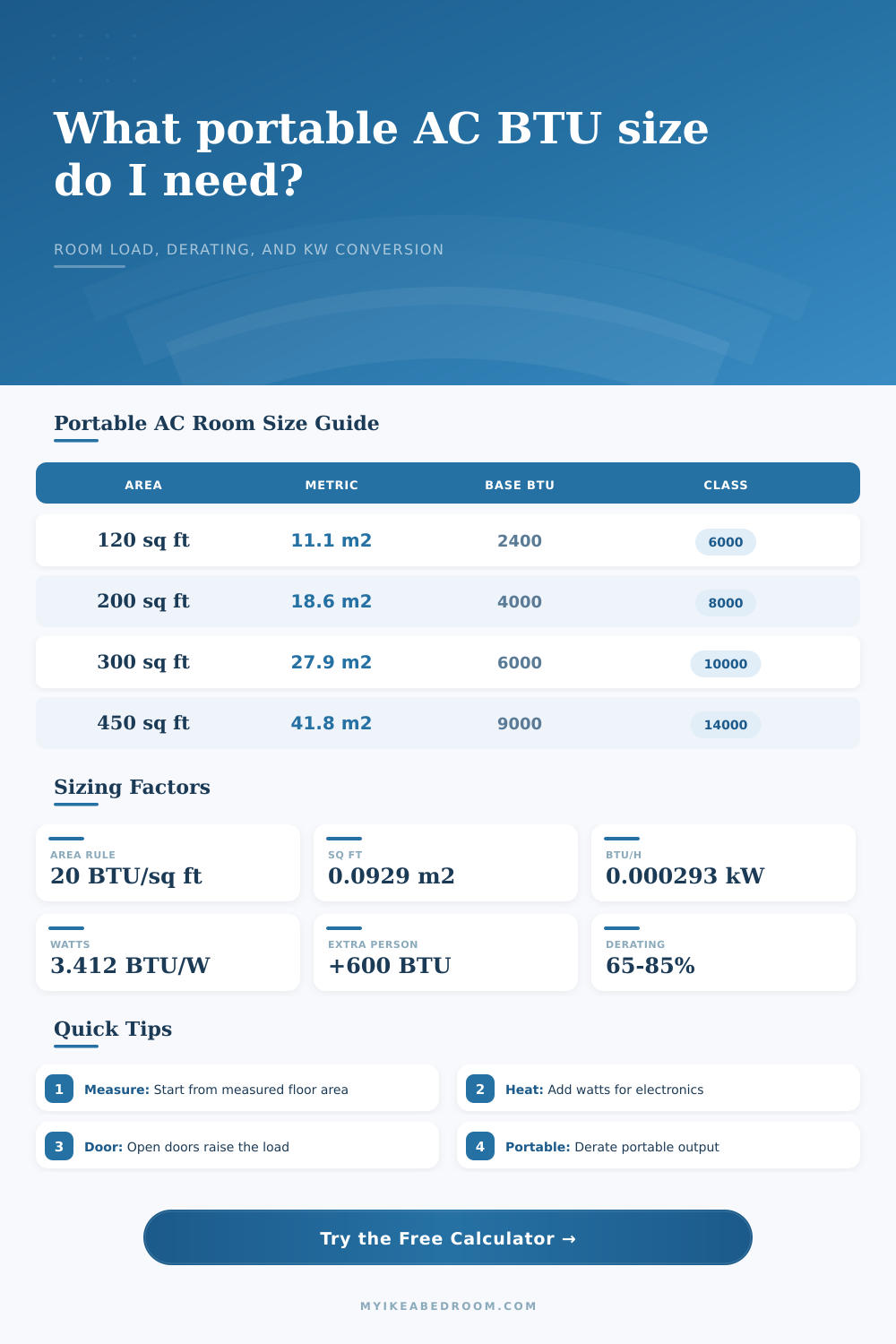
Floor area starts the estimate before ceiling, sun, people, appliance, opening, and portable AC derating adjustments.
| Measured room area | Metric area | Area baseline at 20 BTU/h per sq ft | Likely portable class before extra loads | Calculator note |
|---|---|---|---|---|
| 100 sq ft | 9.3 m² | 2000 BTU/h | 6000 BTU/h class | Small bedrooms still round up because portable units lose output through hoses and makeup air. |
| 150 sq ft | 13.9 m² | 3000 BTU/h | 6000 to 8000 BTU/h class | Often enough for a closed sleeping room with shade and low electronics. |
| 225 sq ft | 20.9 m² | 4500 BTU/h | 8000 to 10000 BTU/h class | Sun, high ceilings, and single-hose derating usually push the nameplate higher. |
| 320 sq ft | 29.7 m² | 6400 BTU/h | 12000 to 14000 BTU/h class | Open doorways or living-room electronics can dominate the final adjustment. |
| 450 sq ft | 41.8 m² | 9000 BTU/h | 14000 to 16000 BTU/h class | Large portable AC setups need careful exhaust routing and a low-loss room boundary. |
☀Adjustment Factor Table
These factors explain how the calculator moves from floor area to a room-specific cooling load.
| Adjustment | Calculator value | Applied to | What it represents | When it matters most |
|---|---|---|---|---|
| Ceiling height factor | Height divided by 8 ft | Area baseline | More air volume needs more heat removal. | Lofts, top-floor rooms, and bedrooms above 9 ft. |
| Heavy shade | 0.90 multiplier | Area and height load | Less solar gain through windows and walls. | North-facing rooms, shaded bedrooms, and basement rooms. |
| Afternoon sun | 1.10 multiplier | Area and height load | Solar gain adds heat after the room is already warm. | West-facing rooms and large exposed windows. |
| Extra occupants | 600 BTU/h each after two | Direct added load | People add sensible and latent heat to the room. | Shared offices, living rooms, and hobby spaces. |
| Appliance watts | Watts multiplied by 3.412 | Direct added load | Indoor electrical use turns into room heat. | Computers, TVs, lamps, routers, and kitchen-adjacent rooms. |
🌬Portable AC Loss and Derating Guide
Portable ACs often need a larger nameplate because ducts, door openings, hose heat, and makeup air reduce useful room cooling.
| Room or duct condition | Opening or duct loss | Derating option | Useful output meaning | Calculator result effect |
|---|---|---|---|---|
| Closed room with short insulated hose | 5% | Dual-hose efficient, 85% | Most of the nameplate cooling remains useful in the room. | Lowest recommended BTU/h class for the same room load. |
| Normal bedroom door gap and short hose | 10% | Dual-hose typical, 78% | Some heat and replacement air are still part of the load. | Usually moves one class above a window-style room estimate. |
| Door often open or warm exhaust hose | 15% | Single-hose typical, 72% | Negative pressure and hose heat reduce net room cooling. | The nameplate requirement rises quickly in sunny rooms. |
| Open archway or long hose path | 22% | Single-hose hot duct, 65% | The unit is cooling more connected air than the measured room. | Large rooms may exceed common portable AC class sizes. |
| Open-plan bleed or hot duct route | 30% | Use lower derating if unsure | Heat pickup and replacement air become a major part of sizing. | Reducing the opening can be as important as adding BTU/h. |
🏠Preset Scenario Reference
Use these examples to sanity-check the calculator against common room layouts.
| Preset room | Area and height | Main heat factors | Portable setup | Typical class range |
|---|---|---|---|---|
| Small shaded bedroom | 120 sq ft, 8 ft ceiling | Shade, one person, 80 watts | Closed room and dual-hose setup | 6000 to 8000 BTU/h |
| Warm main bedroom | 168 sq ft, 8 ft ceiling | Afternoon sun, two people, 120 watts | Normal door gap and single-hose setup | 8000 to 10000 BTU/h |
| Sunny home office | 110 sq ft, 8.5 ft ceiling | West sun, one person, 350 watts | Short hose with moderate duct loss | 8000 to 10000 BTU/h |
| Open living room | 320 sq ft, 8.5 ft ceiling | Afternoon sun, three people, 300 watts | Open doorway and single-hose derating | 14000 to 16000 BTU/h |
| Top-floor loft | 300 sq ft, 10 ft ceiling | Roof heat, two people, 200 watts | Open boundary with lower real output | 16000 BTU/h or split cooling |
💡Portable AC Sizing Tips
When your room gets hot, you might think that getting a portable air conditioner with high BTU number will do the trick. You end up with a hot room because cooling power isn’t enough to counteract the heat load. While window units vent hot air directly through the window, portable ACs is less efficient because they has to vent hot air through a hose while simultaneously sucking cooler room air out that same hose.
Use a sizing calculator to find correct unit. Knowing how to calculate it will help you avoid buying an air conditioner that’s either too big or too small. To begin sizing you need to measure your floor area. For typical rooms with standard insulation, 20 BTU’s/square foot is generally the starting point. For rooms with more sun exposure, use more; for shaded rooms, less. It is a good rule for moderate conditions, but many of our rooms has high ceilings. More air = more volume. That means the unit have to work harder to cool that additional space. The tool accounts for height; essential if you have room with vaulted ceilings/lofts where the heat rises.
How to Choose the Right Portable AC Size
The cooling load depend on sun as well. A tree-shaded north facing room will be cooler then one facing west (afternoon sun). That means there is an additional cooling load on your system. As I mentioned above, solar gain is like having another heater operating in the background. It’s there and if you don’t compensate for it, then the AC has to do extra work to overcome it. Rooms with lots of windows or higher floors requires more capacity to deal with solar gain. See the reference table.
Heat also comes from other items in your house: electronics and people. The more people you have in a room, the more cooling it need. If you’ve got a home office with a big monitor and powerful computer, that’s going to require more power than an empty guest room. And all of this electricity becomes heat within the room. It remains in the air until the AC takes it out.
The derating factor is a critical adjustment. This is something many people overlook when buying. They see an air conditioner rated at 12000 BTUs but don’t realize the truth about portable units. Because of negative pressure and loss through hoses, a portable unit might not be able to produce even 72% of that in your room. Single-hose ACs draw air into the room by sucking air out (they create a vacuum). They pull hot air from cracks and other openings. In the room, their nameplate rating are frequently optimistic. The calculator has reduction factor to display how much of the cooling power actualy makes it to the air.
Larger is not always better. Oversized units cools the room down too fast. They don’t operate long enough to pull moisture out of the air. The outcome is a uncomfortably, damp room that’s just plain cold. If you size your unit correctly, it will run longer cycles to remove heat and humidity effectively.
There are limits to how big of an area you can cool using portable AC. Don’t expect it to cool your entire open plan home because opening doors will cause inefficiencies. To determine these inefficiencies, use the calculator. Decide what is best, whether to close doors or seal windows.
Know the size of the area you want to cool (and think about any sun exposure). Also note the leak that is the exhaust hose. If you abide by these rules, then math should of made sense. And voila, you’ve mastered the heat.