Litter Box Size for Cat Calculator
Estimate the inside tray length, inside width, box count, litter fill volume, and room footprint from your cat measurements and household setup.
📌Cat and Household Presets
📏Cat and Box Inputs
Your Litter Box Size Plan
🧮Sizing Rule Cards
🐈Cat Length to Minimum Box Size
| Cat nose-to-tail length | Minimum inside length | Minimum inside width | Inside area | Metric inside size |
|---|---|---|---|---|
| 14 in compact cat | 21 in | 14 in | 294 in² / 2.0 ft² | 533 mm × 356 mm |
| 16 in small adult cat | 24 in | 16 in | 384 in² / 2.7 ft² | 610 mm × 406 mm |
| 18 in medium adult cat | 27 in | 18 in | 486 in² / 3.4 ft² | 686 mm × 457 mm |
| 20 in large adult cat | 30 in | 20 in | 600 in² / 4.2 ft² | 762 mm × 508 mm |
| 22 in extra-long cat | 33 in | 22 in | 726 in² / 5.0 ft² | 838 mm × 559 mm |
| 24 in giant cat | 36 in | 24 in | 864 in² / 6.0 ft² | 914 mm × 610 mm |
📦Box Count by Household
| Cats in household | Box count formula | Boxes to plan | Example layout | Floor planning note |
|---|---|---|---|---|
| 1 cat | 1 + 1 | 2 boxes | Bedroom plus utility area | Plan each footprint separately if the rooms are different sizes. |
| 2 cats | 2 + 1 | 3 boxes | Two main rooms plus spare location | Use the largest cat measurement for all shared sizing math. |
| 3 cats | 3 + 1 | 4 boxes | Split across bedroom, hall, and utility room | Total litter volume scales directly with the number of boxes. |
| 4 cats | 4 + 1 | 5 boxes | Multiple rooms or a large service zone | Check that doors, cabinets, and drawers do not overlap the footprint. |
| 5 cats | 5 + 1 | 6 boxes | Distributed household setup | Multiply the per-box clearance footprint before choosing locations. |
💧Litter Depth and Volume Reference
| Inside floor area | At 2 in depth | At 2.5 in depth | At 3 in depth | Metric range |
|---|---|---|---|---|
| 2.0 ft² | 0.33 ft³ | 0.42 ft³ | 0.50 ft³ | 9 to 14 L |
| 3.0 ft² | 0.50 ft³ | 0.63 ft³ | 0.75 ft³ | 14 to 21 L |
| 4.0 ft² | 0.67 ft³ | 0.83 ft³ | 1.00 ft³ | 19 to 28 L |
| 5.0 ft² | 0.83 ft³ | 1.04 ft³ | 1.25 ft³ | 24 to 35 L |
| 6.0 ft² | 1.00 ft³ | 1.25 ft³ | 1.50 ft³ | 28 to 42 L |
🚪Open, Covered, and Clearance Reference
| Box style | Inside size rule | Outside allowance used | Height check used | Placement note |
|---|---|---|---|---|
| Open tray | 1.5× length by 1.0× length | No added wall allowance | Side height compared with fill depth | Use measured rim size if the tray has a wide rolled edge. |
| Covered box | Same inside floor rule | Adds 2 in length and 2 in width outside | Shoulder height plus 4 in | Check the interior lid height, not only the exterior height. |
| Top-entry style | Same inside floor rule | Adds 4 in length and 4 in width outside | Shoulder height plus 6 in | Reserve open space above the lid for the entry panel. |
| Low-side setup | Same inside floor rule | Use actual outside tray measurement | Side height compared with chosen depth | Use lower side height only as a dimension choice in this calculator. |
🏠Common Cat and Room Scenarios
| Scenario | Cat length | Minimum inside size | Boxes | Typical footprint check |
|---|---|---|---|---|
| Small apartment, one cat | 16 in | 24 in × 16 in | 2 | Plan around two 3 ft² inside footprints plus clearance. |
| Average adult cat | 18 in | 27 in × 18 in | 2 | A bedroom corner often needs the clearance footprint measured. |
| Large cat, open tray | 21 in | 31.5 in × 21 in | 2 | Check door swing and drawer pull-out paths near the tray. |
| Two cats, shared home | 19 in | 28.5 in × 19 in | 3 | Use total footprint math before assigning room locations. |
| Giant cat, covered box | 24 in | 36 in × 24 in | 2 | Covered boxes also need an internal height check. |
💡Calculation Tips
Cats are creature of habit and most people purchase a litter box by either appearance (what looks good in the store) or size (will it fit under my counter?). However, they fail to realize that their cat need plenty of floor space to comfortabley turn around. If the tray is not large enough, you’ll end up with your cat either trying to dig out the sides, kicking litter all over the place, or worse… Avoiding the box altogether.
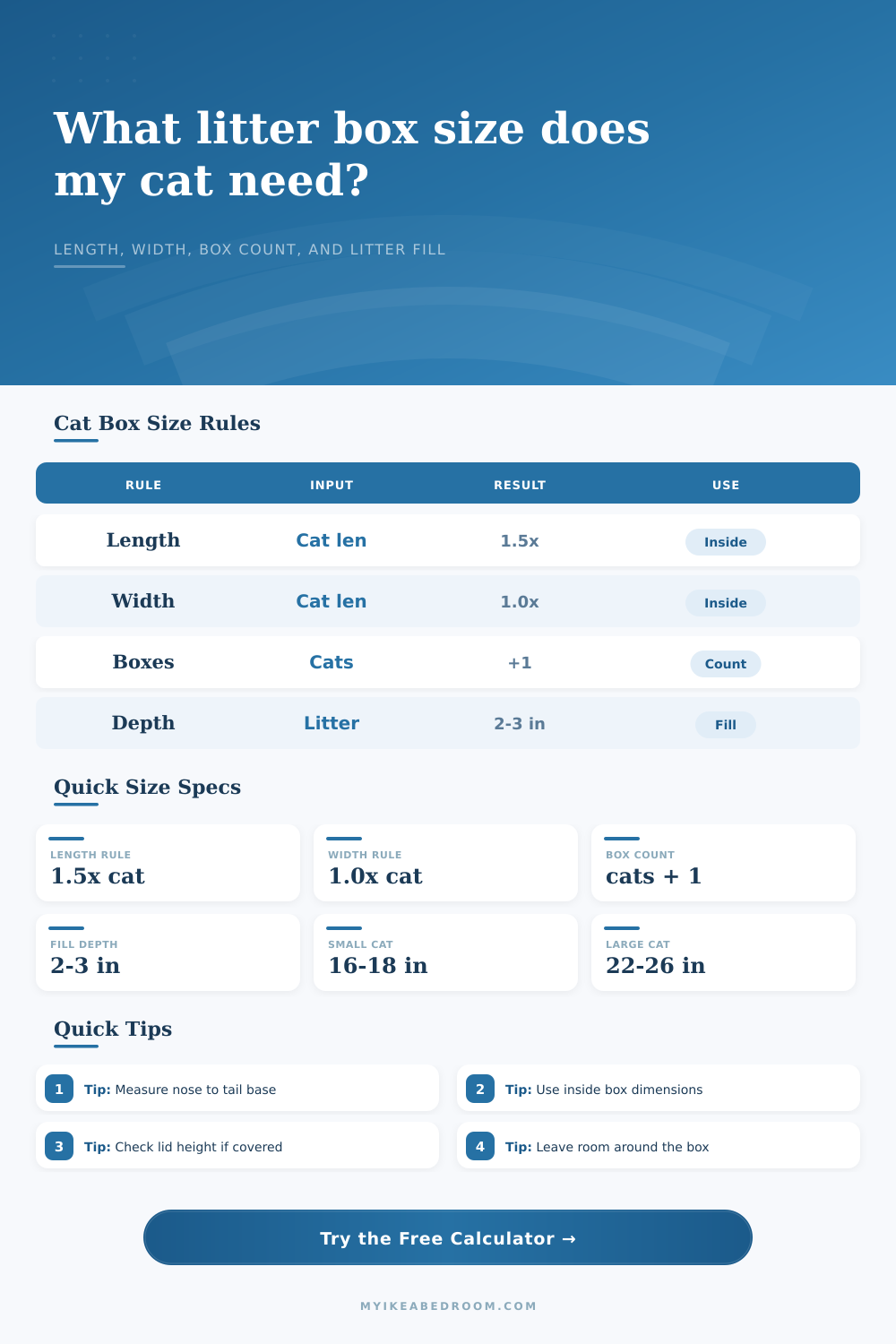
Once you know the length of your cat, the calculator above do the math for you so you don’t have to guess whether or not that tiny little one in the clearance bin will work for your feline friend. It’s pretty simple geometry. The basic rule is to make the inside length of the litter box about 1½ times the length of the cat’s nose to tail. Make width equal to the length of the cat’s body. Oddly, this includes the tail which is part of the space your cat takes up when it squats. (Measuring from the base of the tail to the nose gets you a clean number on size of the tray.) Measure when the cat is relaxed… Neither crouching nor stretched out. A stretched cat provide a maximum length that may prove difficult to find in store-bought trays; a crouched cat provides a minimum with no margin for error.
How to Pick the Right Litter Box for Your Cat
The size of the box also matter (obviously), but equally important is getting it at the right depth. Most owners underfill their boxes because they worry about cost or mess. The sweet spot is two to three inches; less than that and the cat would of have to dig down into all the litter to get to a clean spot. If there’s too much, they may feel like they are sinking in the box. Based off this, the tool figures out how much volume of litter you’ll need. This is good for figuring out if you should get a twenty- or a fifty-pound bag. You don’t want to run out in middle of a weekend trip.
Then there is the additional problem of household dynamics. The conventional wisdom is that you should have a box for each cat plus one more. But why? Capacity isn’t really the issue. Territory is. Yes, cats are territorial and may prevent anyone else from using a given box. Having a spare box avoids the bottleneck. That’s shown in the reference table at the bottom of the page for multi-cat households. Note how rapidly the overall floor area required increase.
Where do all these boxes fit? They need to be accessible yet located in relatively quiet areas with low traffic. For example, a box behind a heavy couch might indeed be out of sight… and also impossible to reach if the sofa is in the way.
There are new limitations involving covered boxes. While boxes with covers limit the interior, they also does some good things: confine smell and prevent litter from escaping. However, because of the cover plus the entry tunnel, there’s less usable floor space in the box. A big cat may find a covered box claustrophobic, like a closet. So don’t rely solely on external measurements when you’re shopping; measure interior height too. Ideally, your cat should be able to stand fully upright inside without ducking. Boxes that open on top are even more limiting in terms of height (but excellent at keeping mess contained). To account for these types, the calculator add allowances to the overall dimensions so it knows how much bigger the box must be on the outside to allow for its interior features.
And then there’s placement. Where will you put the box? The cat has to be able to get near it, go into it, come out of it, without being trapped. So what’s the rule of thumb? Leave six inches of clearance on all sides. That way, the box isn’t going to feel like a corner trap. And it provide enough room for you to bend down and scoop up without twisting yourself into a pretzel. Before you buy, measure where you think you’ll put it. Yes, you can probably find a box that fits perfectly in an extra-narrow hallway. But it may not be such a great idea. Cats want to have an open approach, they don’t want to not know who’s coming.
We’re trying to eliminate any friction in your cat’s day. If a box fits correctly, it doesn’t register: It doesn’t exist. Your cat jumps right on up, uses it as intended, and exits with no litter on their paws or elsewhere in your home. It’s not about luxurius. It’s about something simple: Comfort. Size matters. Behavior follow when the size is correct. Less mess = less stress = more peace of mind. The numbers are simply a means to that end.