Renovation Debris Volume Calculator
Estimate loose debris, compacted cubic yards, container fill, and weight from drywall, flooring, cabinet, tile, lumber, and fixture removal.
Debris Estimate
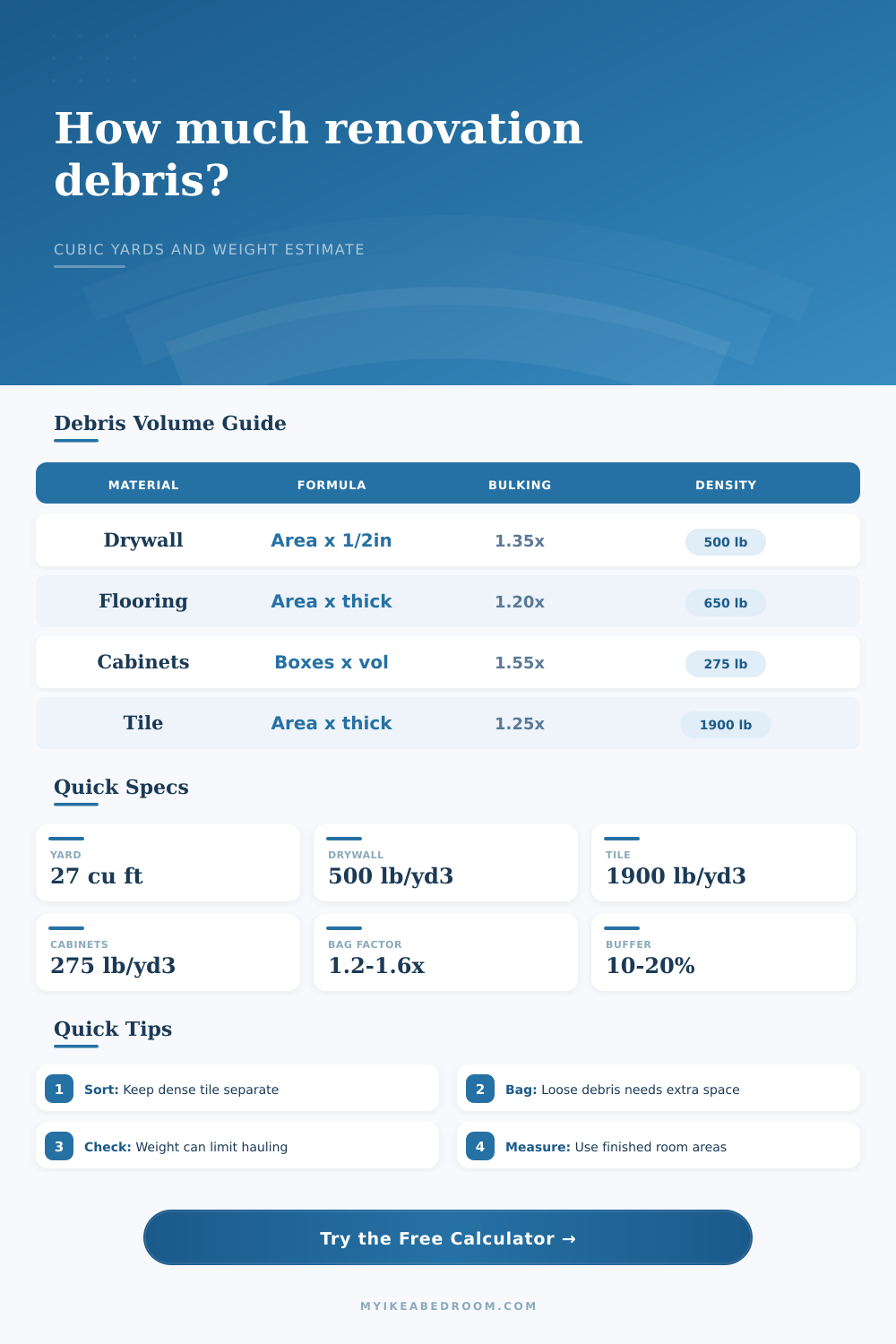
| Material | Measured formula | Loose bulking | Density estimate |
|---|---|---|---|
| Drywall and plasterboard | Surface area × board thickness | 1.35 for sheets, edges, and air gaps | 500 lb/yd³ after loose stacking |
| Flooring layers | Floor area × removed layer thickness | 1.20 for broken planks, underlay, and voids | 650 lb/yd³ for mixed flooring |
| Cabinets and wardrobes | Count × average cabinet body volume | 1.55 for bulky boxes and shelves | 275 lb/yd³ for flat pack wood units |
| Tile and mortar | Tile area × tile and mortar thickness | 1.25 for rubble and broken pieces | 1900 lb/yd³ for dense ceramic debris |
| Lumber and framing | Linear bundle volume or count allowance | 1.45 for irregular boards and fasteners | 450 lb/yd³ for mixed dry lumber |
| Fixtures and fittings | Count × average bulky fixture volume | 1.60 for sinks, doors, trim, and odd shapes | 350 lb/yd³ for mixed light fixtures |
| Layer thickness | Cu ft per 100 sq ft | Cu yd per 100 sq ft | Common use |
|---|---|---|---|
| 1/4 in | 2.08 cu ft | 0.08 yd³ | Vinyl, thin panel, underlay |
| 1/2 in | 4.17 cu ft | 0.15 yd³ | Drywall sheets or thin flooring |
| 3/4 in | 6.25 cu ft | 0.23 yd³ | Tile plus mortar or boards |
| 1 in | 8.33 cu ft | 0.31 yd³ | Thick mortar bed or stacked timber |
| 2 in | 16.67 cu ft | 0.62 yd³ | Built-up framing or chunky debris |
| Haul option | Working volume | Equivalent cu ft | Best matched debris |
|---|---|---|---|
| Pickup bed level load | 2.0 yd³ | 54 cu ft | Drywall, flooring, light fixtures |
| Small trailer | 4.0 yd³ | 108 cu ft | Bedroom or bathroom strip-out |
| Mini skip or bin | 6.0 yd³ | 162 cu ft | Cabinets, mixed room debris |
| Medium debris bin | 10.0 yd³ | 270 cu ft | Kitchen, basement, heavy tile mix |
| Large renovation bin | 15.0 yd³ | 405 cu ft | Multi-room demolition debris |
| Project | Base measurement | Typical loose volume | Weight pattern |
|---|---|---|---|
| Small bathroom tile removal | 45 sq ft at 3/4 in | 0.5 to 0.7 yd³ | Small volume, high weight |
| Bedroom drywall removal | 400 sq ft at 1/2 in | 2.5 to 3.0 yd³ | Moderate volume, medium weight |
| Kitchen cabinet removal | 14 cabinet boxes | 4.0 to 5.5 yd³ | Bulky volume, lower density |
| Deck board removal | 220 sq ft at 1 in | 2.5 to 3.5 yd³ | Air gaps can dominate volume |
Every renovation begins full of energy. And then end up as a heap of debris. The heap somehow expands at an alarming rate when you’re not paying attention. You tear out a bathroom tile; haul out a vanity; knock down a wall. You think you’ve got two wheelbarrow-loads of junk. So you go to dump it in the truck, and find that the pile has expanded by 30%.
It is not because you imagined it. Because this is physics. Debris isn’t regular or solid. There’s lots of space between all that stuff. The calculator turns square footage from your plan into actual volume of trash.
How to Calculate Renovation Waste
So how does it work? It’s all about the ratio of weight to volume. What is the difference between weight and volume? Most people don’t know. Weight is used to determine whether your load is legal to transport or unsafe to transport due to being too heavy. Volume determines how much space something takes up.
Tile and mortar is very heavy and dense. A cubic yard of tile rubble will almost be 2,000 pounds. That means you could fit a lot of tile into your small pickup bed before running out of space. However, you would still be over the weight limit.
Drywall is bulky but light. Drywall traps air. So you can put a whole bunch of drywall in a big dumpster and never have to worry about the weight, but you do need to control the volume.
Each material has an estimated density. The tool knows that while plaster might weigh the same as cabinets, the cabinets takes up more space. To get good answers, you need to get good measurements.
What will be removed? That’s your starting point. If you’re ripping out cabinet, count how many units. For flooring removal, measure square footage of the space being ripped out.
How thick is it? When removing tile, remember that tiles themselves are thin, but there’s also the mortar bed beneath the ceramic face. That adds height and thickness to the stack. An inch of old tile + adhesive has a different waste footprint than half-inch drywall. Why does the calculator request thickness? It transforms flat area into three dimensions of waste. Don’t guess at this figure. If possible, measure what’s being ripped out. And add a buffer if you suspect older construction. Older homes tend to have multiple layers of adhesive, paper, and paint, all of which pop up unexpectidly in the dumpster.
Last number depends on how you load it. A truck bed full of junk doesn’t self-pack. The stuff moves around. It leaves empty spaces. If you have smaller stuff and pack it in bags or break bigger stuff apart, that helps to reduce empty space. On the calculator, you get to choose your loading style. Throw a bunch of loose drywall scraps into a pickup? The volume calculation’s gonna be higher because they’ll bounce around and cause air pockets. Break up some tile and stack the broken pieces? That lowers the effective volume.
This explains why your visual estimate seems wrong. Your brain sees a pile of junk lying loose. When the dumpster guy takes it away, he may squish it down a bit. However, it won’t fit into 5-yard dumpster if you are visualizing 10 yards worth.
These tables is a sanity check on what you enter. They will tell you about properties of various materials and how they expand. Expansion happens in cabinets. Break a flat-pack wardrobe down and you end up with a pile of boards and metal bits. That material doesn’t compress well. That’s why the bulking factor exists. It takes into account the inefficiencies.
Why does a ton of tile hit your weight limits before you run out of space in the truck? While tile is dense and heavy, cabinets are bulky and takes up a lot of room. Knowing these numbers allows you to select a suitable sized container. You don’t want to rent a small skip and realize halfway through that a tonne won’t fit. You also don’t want to rent a huge one when all you have is drywall, because then you’re paying for air space.
The goal is not perfection (it is avoidance of surprises). Your approach to the project depends on whether you are limited by weight or volume. Does this mean renting by the pound or the size? Do you have enough room to haul off this junk, or should of you call someone? Let the tool do the math for you, while you demolish things.
Next time you see that pile of junk staring back at you, you’ll know exactly what to do with it.