Dumpster Size for Renovation Calculator
Estimate renovation debris by pile dimensions, material density, fill line, buffer, and real 10, 15, 20, 30, and 40 cubic yard roll-off sizes.
📌Renovation debris presets
📏Dumpster sizing inputs
Your renovation dumpster estimate
🧱Material density quick grid
📚Dumpster renovation reference tables
| Roll-off size | Typical outside dimensions | Usable volume at 80% | Typical load limit |
|---|---|---|---|
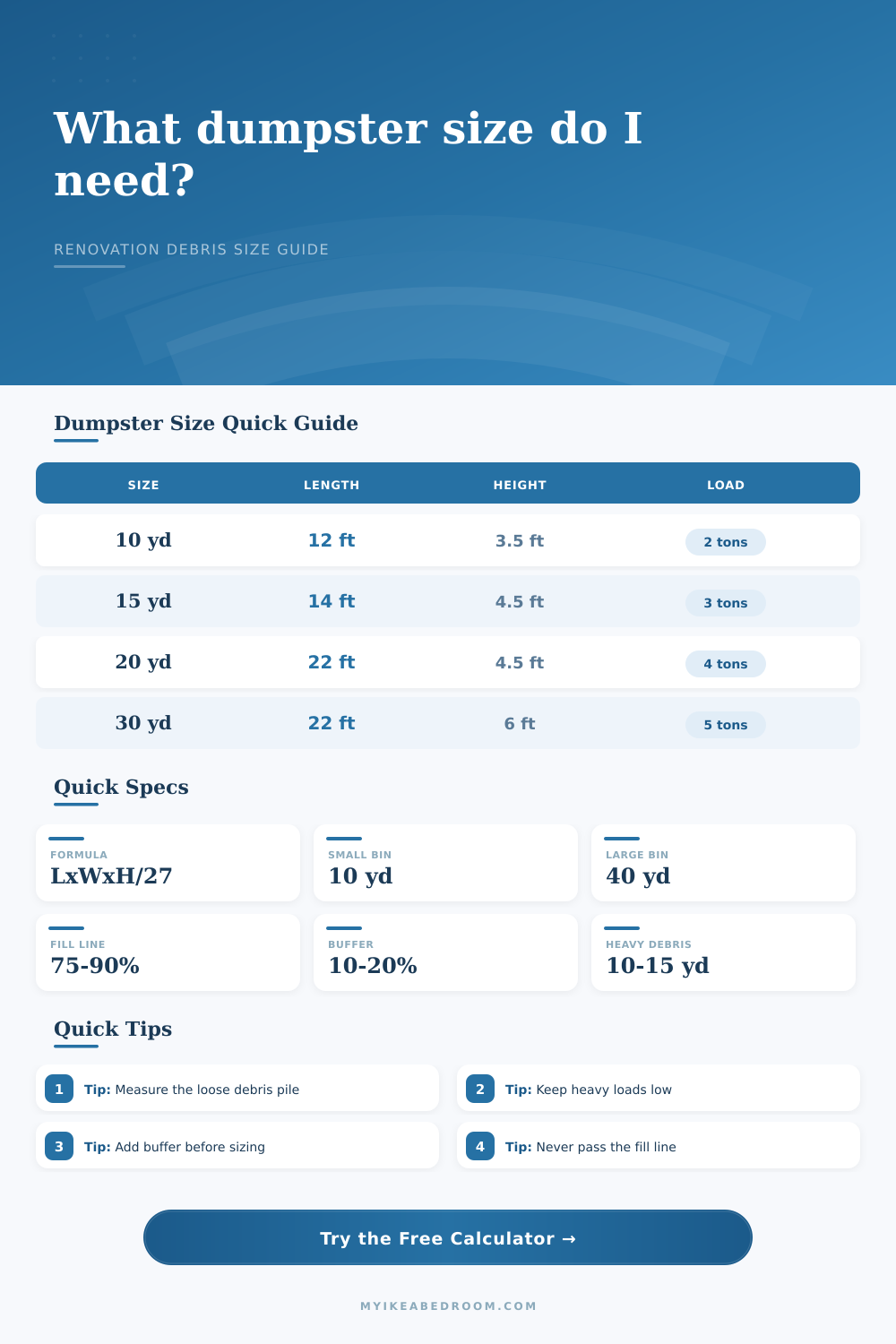
| 10 yd³ dumpster | 12 ft L × 8 ft W × 3.5 ft H | 8 yd³ when level loaded to 80% | About 4,000 lb / 2 tons |
| 15 yd³ dumpster | 14 ft L × 8 ft W × 4.5 ft H | 12 yd³ when level loaded to 80% | About 6,000 lb / 3 tons |
| 20 yd³ dumpster | 22 ft L × 8 ft W × 4.5 ft H | 16 yd³ when level loaded to 80% | About 8,000 lb / 4 tons |
| 30 yd³ dumpster | 22 ft L × 8 ft W × 6 ft H | 24 yd³ when level loaded to 80% | About 10,000 lb / 5 tons |
| 40 yd³ dumpster | 22 ft L × 8 ft W × 8 ft H | 32 yd³ when level loaded to 80% | About 12,000 lb / 6 tons |
| Material profile | Density used | Preferred dumpster sizes | Load note |
|---|---|---|---|
| Mixed interior renovation debris | 350 to 600 lb per yd³ | 10, 15, 20, 30, or 40 yd³ | Good for rooms with drywall, trim, packaging, and light fixtures. |
| Cabinets, furniture panels, and wood | 250 to 500 lb per yd³ | 10, 15, 20, 30, or 40 yd³ | Often bulky; the condition multiplier may control size before weight does. |
| Drywall and light plaster | 500 to 800 lb per yd³ | 10, 15, 20, or 30 yd³ | Keep wet plaster and dense compound separate from lighter drywall estimates. |
| Carpet, laminate, trim, and underlay | 150 to 350 lb per yd³ | 10, 15, 20, 30, or 40 yd³ | Volume usually matters more than weight for rolled flooring stacks. |
| Asphalt roofing shingles | 1900 to 2500 lb per yd³ | 10, 15, or 20 yd³ | Dense tear-off loads should stay low and level inside the bin. |
| Tile, mortar bed, and concrete pieces | 2000 to 3000 lb per yd³ | 10 or 15 yd³ | Heavy debris commonly needs more than one partial load. |
| Brick, block, stone, and masonry rubble | 2200 to 3000 lb per yd³ | 10 or 15 yd³ | Use conservative fill limits because small volume can be very heavy. |
| Fixtures, doors, trim, and mixed bulky items | 300 to 700 lb per yd³ | 10, 15, 20, 30, or 40 yd³ | Bulky doors, tubs, and cabinets may require a larger size by air space. |
| Calculation step | Formula or factor | Example | What it controls |
|---|---|---|---|
| Base debris volume | Length × width × height / 27 | 10 ft × 6 ft × 3 ft / 27 = 6.67 yd³ | Turns a measured debris pile into cubic yards. |
| Metric conversion | 1 m = 3.28084 ft | 2 m becomes 6.56 ft before volume math. | Keeps the dumpster selection in cubic yards. |
| Debris condition | 0.85, 1.00, 1.15, or 1.30 multiplier | Loose demo adds 15% before buffer. | Adjusts for compacted stacks or bulky air gaps. |
| Overage buffer | Measured volume × selected buffer | 10 yd³ with 10% becomes 11 yd³. | Covers hidden layers, broken pieces, and offcuts. |
| Fill limit | Dumpster size × usable fill percentage | 20 yd³ at 80% gives 16 yd³ usable. | Prevents debris from exceeding the top rail or load plan. |
| Weight check | Buffered yd³ × lb per yd³ | 6 yd³ tile can exceed 9,000 lb. | Flags when volume fits but weight needs split loads. |
| Renovation scenario | Measured debris pile | Material profile | Typical result driver |
|---|---|---|---|
| Bedroom refresh debris | 8 ft × 5 ft × 2 ft | Mixed interior renovation debris | Usually a compact 10 yd³ load after buffer. |
| Wardrobe and cabinet removal | 10 ft × 6 ft × 3 ft | Cabinets, furniture panels, and wood | Bulk air space can push size upward. |
| Bathroom tile demolition | 6 ft × 5 ft × 2.3 ft | Tile, mortar bed, and concrete pieces | Load limit can matter more than cubic yards. |
| Drywall partition tear-out | 10 ft × 5 ft × 4 ft | Drywall and light plaster | Volume and density are both moderate. |
| Whole room mixed renovation | 15 ft × 8 ft × 4 ft | Mixed interior renovation debris | Often selected by usable volume after buffer. |
| Masonry rubble pile | 5 ft × 4 ft × 2 ft | Brick, block, stone, and masonry rubble | Small piles may still need split heavy loads. |
💡Dumpster sizing notes
You tear out that old carpet and realize there’s more pile than you thought. Renting a dumpster help you realize what kind of surprises renovation trash can bring. Debris from home renovations are deceiving. One layer of drywall doesn’t weigh much, but it take up a LOT of volume. A few pieces of concrete tile is dense enough to snap an axle. If you underestimate, you’ll have to wait another day (or pay more) for your next pickup, or you’ll end up over-paying for unused space. Enter your pile’s size and material into this page’s calculator, and it will figure it out for you. No conversions, no coefficients, just less guessing.
Here are the first few things you need to know. For volume, a basic formula (length x width x height ÷ twenty-seven = cubic yards) tells the tool how much physical space your trash takes up. But half the story is how that stuff sits in the bin. Is it bulky? Does it contain air gaps (like loose demolition)? These factor waste space. To adjust for them, the calculator includes a condition multiplier. In other words, it asks if you’ve got a fluffy pile or a compact one. Why does that matter? The same ten-yard dumpster can be full of half a ton of loosely piled-up wood but hold just two tons of tile. That’s what folks don’t get right.
How to Choose the Right Dumpster Size
The second limitation is weight. All rentals has a max load capacity. Go past that and you’ll be paying hefty overages. This tool will check the density of the material you are throwing away. It will then compare that to your estimate of how full the truck will get. Asphalt shingles, for instance, are ridiculously heavy. Even a small amount of roofing tear-off could push past the 1-ton mark before ever reaching the rim of the dumpster. On the flipside, items like kitchen cabinets is largely about volume removal. The plywood and paneling aren’t too heavy, but they do occupy space. Because there’s so much air between those cabinet, you might need a bigger bin. Not because it’s heavy, but simply because of its volume.
To clarify that, here’s a table at the bottom of page that explains what’s volume-driven and what’s density-driven.
Add a little wiggle room as a buffer. There’s almost always something unexpected that pops up when renovating. Are you pulling up carpet? You think it will be three feet deep? Then you see that the subfloor is falling apart and there’s nasty padding underneath. Or, plaster might crumble beneath the carpet. Add a little wiggle room (ten to fifteen percent) into your quote and you’ve covered yourself. If you’re on a time crunch, renting a bigger bin for a couple more bucks is better than having your renovation come to a halt because your dumpster is overflowing!
And then there is timing. Will you be demo’ing in stages? In that case, perhaps a smaller bin will do. Or will it be all or nothing, demoing one whole floor at a time? You want to have the capacity on hand up front. Check out the “usable fill limit” setting on the tool. That takes into consideration that your dumpster won’t be filled right to the very top. There are safety rules, and there’s the matter of transport: typically you only get about eighty percent of the stated size, which means that a twenty-yard bin is actualy going to give you sixteen usable yards. Knowing this can save you from being dissapears when the driver says no more.
Last, think about where it will go. That’s right, a big ol’ 40-yard dumpster takes up a lot of room (think: long driveways). A typical garage opening will hold a ten-yard bin. Not everything the largest size is the best size. If it won’t fit on your property, then what good is it? Measure for access, not trash.
Renovating is messy. Renovating is loud. Renovating makes lots of stuff. Knowing exactly what kind of mess to expect turns cleaning into a plan instead of a guess. Measure the pile, factor in density, go by the numbers. A little thing, but it helps. It completes faster and stays on budget. The trick is understanding first what you are measuring, and second finding the room to store those measurements.