Packing Tape Roll Quantity Calculator
Estimate packing tape from carton seam length, strips per box, reinforcement pattern, roll length, and waste allowance for moving, storage, and shipping boxes.
| Pattern | Strip formula per box | Factor | Best fit |
|---|---|---|---|
| Top center seam | 1 x length seam | 1.00 | Open-top staging or very light boxes |
| Top and bottom center | 2 x length seam | 1.00 | Basic moving cartons |
| Top H-seal | 1 x length + 2 x width | 1.05 | Boxes opened soon after moving |
| Top and bottom H-seal | 2 x length + 4 x width | 1.08 | Most packed household cartons |
| Reinforced frame | 4 x length + 4 x width + 4 x height + 1 band | 1.15 | Shipping or stacked storage cartons |
| Roll label | Feet | Meters | Planning note |
|---|---|---|---|
| 55 yd | 165 ft | 50.29 m | Common hand-dispenser moving roll |
| 110 yd | 330 ft | 100.58 m | Common long packing tape roll |
| 50 m | 164.04 ft | 50 m | Metric roll close to 55 yd |
| 100 m | 328.08 ft | 100 m | Metric roll close to 110 yd |
| Box size | Outside dimensions | Top and bottom H-seal | 55 yd roll covers |
|---|---|---|---|
| Small book carton | 12 x 12 x 12 in | 8.5 ft each | 17 boxes with 10% waste |
| Medium moving carton | 18 x 14 x 12 in | 11.7 ft each | 12 boxes with 10% waste |
| Large bedding carton | 24 x 18 x 18 in | 15.1 ft each | 9 boxes with 10% waste |
| Tall wardrobe carton | 20 x 20 x 34 in | 14.4 ft each | 10 boxes with 10% waste |
| Condition | Allowance | Reason | Use when |
|---|---|---|---|
| Careful dispenser cuts | 5% | Small tabs and clean cuts | Slow packing with uniform boxes |
| Normal moving boxes | 10% | Miscuts, rework, and label overlap | Mixed household packing |
| Fragile contents | 15% | Extra short strips and re-taping | Glass, lamps, dishes, electronics |
| Dusty recycled cartons | 20% | More rejected or doubled tape | Old boxes or fast packing sessions |
First off, the math can be run for you using calculator above, but knowing what goes into it will allow you to plan accordingly.
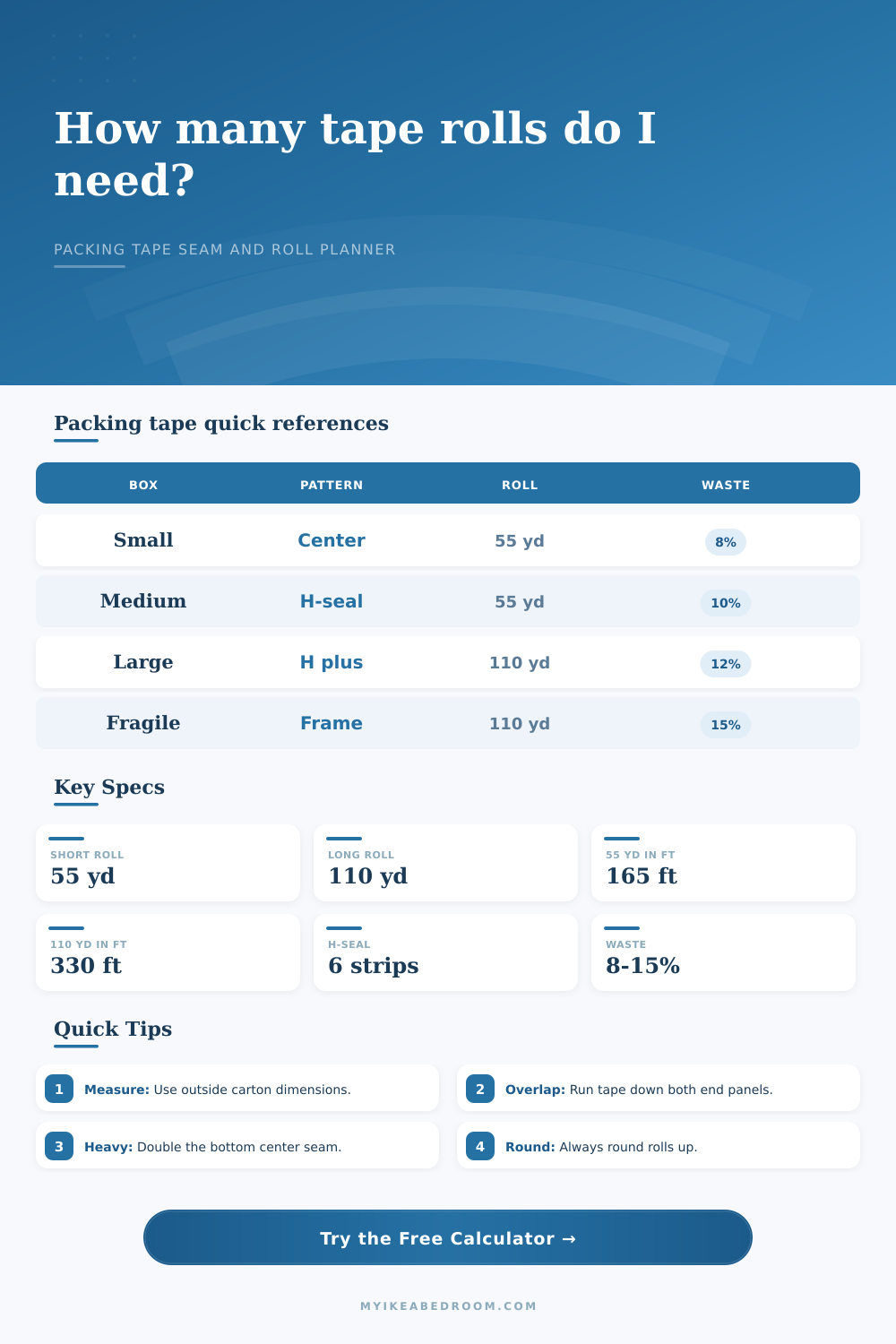
First, it’s your box size. Many folks take their measurements from inside of their box. That is a mistake. Because tape wraps around outside flaps, you want the outside dimensions. Measuring inside means you’re going to underestimate the seam length which adds up fast when you’re working with dozens of boxes. To account for this, the tool asks for your outside length, width and height.
How to Calculate Your Tape Needs
Next, it will calculate how long each strip should be depending on closure pattern selected. This is where many folks trip themselves up. They think they need same amount of tape on every box. Nope.
For instance: What’s the distinction between a full H-seal vs. What is a basic center seal? In a full H-seal there are four strips, two across the center seal plus two more along width to create a grid. That holds up well with heavy stuff like tools or dishes. With a basic center seal you have just one strip on top and another below; that’ll work OK for something lightweight like pillows or blanket. But you can’t depend on it to keep box together when it’s packed full of things that weigh more then nothing.
The calculator automatically sets number of strips based off how much reinforcement you choose, and it also factors in waste (more on this in a sec). Waste isn’t a penalty. It’s a fact of life. You’re going to have to re-tape a box because a flap slipped. You’re going to tear off more tape than you need. You’re going to overlap too far. Fifteen percent might sound pessimistic. But it’s realistic.
How long is a roll? Most packaging tapes comes in 55 yd. Rolls which work well if you’re using a hand dispenser, but go through them quickly when using large boxes. These rolls work well if you’re using a hand dispenser. However, they goes through quickly when using a box with tape dispenser. Then there’s a 110yd. It is a roll. Those feel luxurius. But it reduces the number of times you would of to stop and change the roll, so there are fewer spots where you have to overlap the ends that create potential weak spots.
How does it all shake out? There’s a handy table on page that tells you exactly how many boxes each roll would be good for. It also factors in whether you’re reinforcing corners. This is often needed if you’re packing delicate kitchen item, which requires extra tape along with belly bands. The tool accounts for this, too. All you do is enter what you’re packing.
Packing tape has another mental benefit: it prevents you from breaking momentum by running out while working through a room. You halt, then look, become irritated, then restart only to pack that box more poorly than before. With enough tape, you keep rolling along. Sounds silly? Half the challenge of shipping or moving is keeping your workflow going. You want to grab the tape, apply it and move on to the next box. You don’t need to calculate whether you have sufficient tape to complete one last seam.
The tape becomes the glue. Or the skeleton if you will, of your move. It’s what holds everything together. And when the skeleton are weak, well, the whole thing comes crashing down. By using a calculator to estimate your needs, you are not just buying supplies. It is also about buying peace of mind. It ensures that on the very last day, when you reach for the dispenser, there’ll be some left. That tiny continuity makes all the difference between a stress-free and a stressful scramble. When you know the numbers adds up, you can pack confidenty.