Bubble Wrap Length Calculator
Estimate bubble wrap roll length from item surface area, roll width, protection layers, overlap, trim buffer, and fragile item allowance.
| Shape | Formula before allowances | Good for | Dimension note |
|---|---|---|---|
| Rectangular box | 2 × (L×W + L×H + W×H) | Boxes, dressers, tables | Use packed outer dimensions |
| Flat panel | 2 × L×W + 2 × (L+W) × T | Mirrors, shelves, doors | Thickness wraps the edges |
| Cylinder | 2πr² + 2πrh | Lampshades, vases, rolls | Diameter converts to radius |
| Round flat panel | 2πr² + 2πrT | Round mirrors, tabletops | Thickness wraps the rim |
| Known area | Direct area per item | Irregular wrapped surfaces | Enter surface area in sq ft or m² |
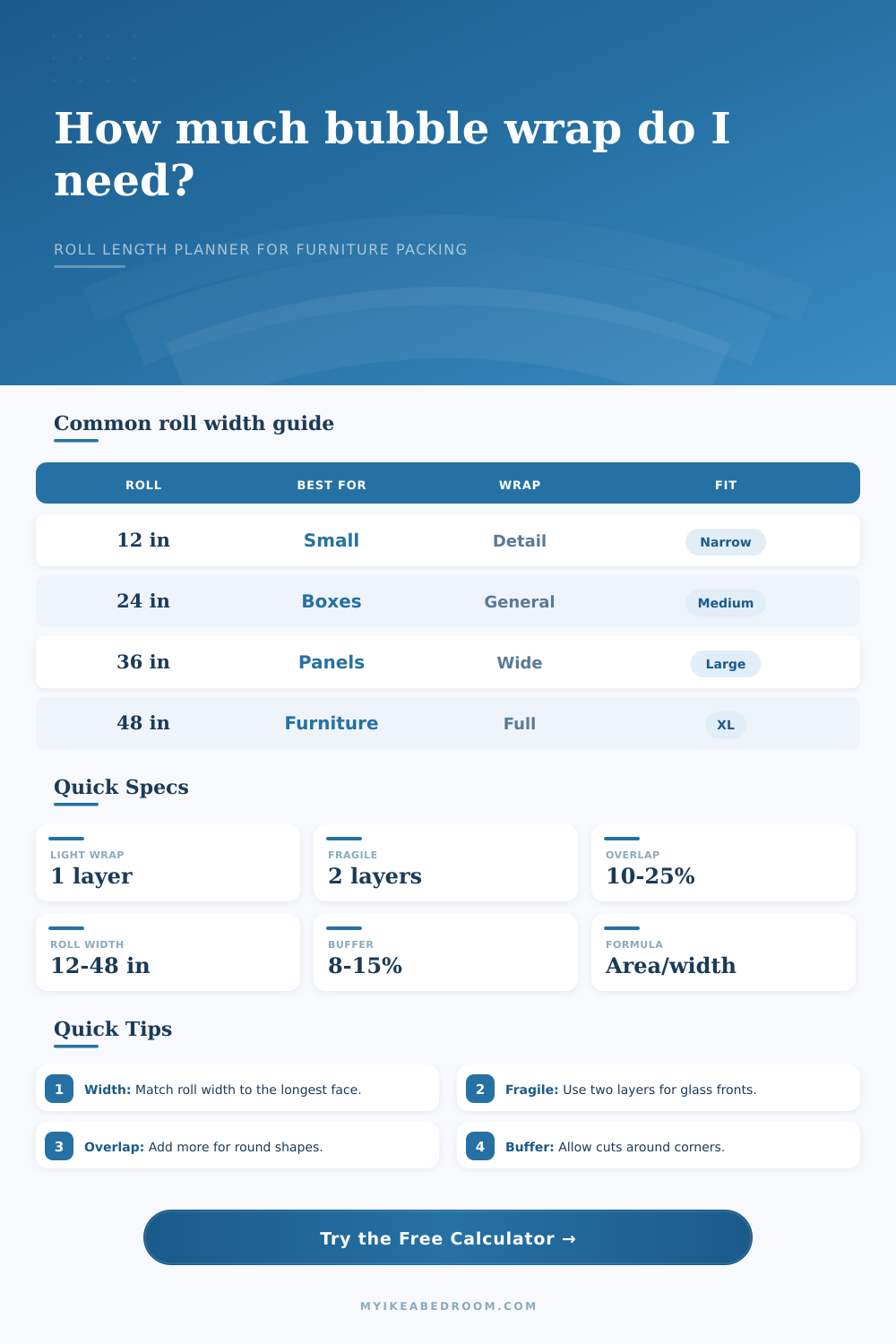
| Roll width | Width in feet | Width in meters | Best match |
|---|---|---|---|
| 12 in | 1.00 ft | 0.305 m | Small decor, narrow edges, mugs, handles |
| 24 in | 2.00 ft | 0.610 m | Boxes, drawers, lampshades, framed prints |
| 36 in | 3.00 ft | 0.914 m | Shelves, cabinet doors, picture stacks |
| 48 in | 4.00 ft | 1.219 m | Furniture panels, mirrors, wide tabletops |
| Protection level | Layers | Overlap | Fragile factor and buffer |
|---|---|---|---|
| Light | 1 layer | 10% | 1.00 factor, 8% trim buffer |
| Standard | 1 layer | 15% | 1.10 factor, 10% trim buffer |
| Fragile | 2 layers | 20% | 1.25 factor, 12% trim buffer |
| Glass front | 2 layers | 25% | 1.35 factor, 15% trim buffer |
| Deep cushion | 3 layers | 25% | 1.45 factor, 15% trim buffer |
| Item | Typical size | Suggested roll width | Protection level |
|---|---|---|---|
| Glass shelf bundle | 30 × 12 × 2 in | 24 in | Fragile |
| Mirrored wardrobe door | 90 × 20 × 2 in | 48 in | Glass front |
| Pair of bedside tables | 18 × 16 × 22 in | 24 in | Standard |
| Cylinder lampshade | 14 in diameter, 10 in high | 24 in | Standard |
| Round mirror | 30 in diameter, 2 in thick | 36 in | Glass front |
Maybe the dresser is wider then you realize when it comes time to wrap. Maybe you’ve got some bubble wrap in your hand and are wondering if you have enough. It happens on packing day. Suddenly you’re either wasting packing materials or something fragile isn’t protected.
Packing is a numbers game: use the math, and don’t trust your gut.
How to Measure Your Packing Materials
Know what you’re measuring. Most folks considers only how much material they need to cover something, without considering overlap. On a rectangular package there has to be some bubble wrap meeting itself at some point. And that seam needs additional length so it can be properly taped. If the seam doesn’t hold, the cushion won’t stay in place. This tool does all the math for you. It includes the extra length for the corners and seam allowance. It need more than just the length required to cover the area; it also needs enough length to secure coverage.
That all comes back to choosing the proper level of protection. One layer might be fine for a wood bookshelf. But you want two layers on a glass front wardrobe. The calculator will multiplys it by those factors depending on your choice. For example: if you go with glass, that increases length. So you won’t run out of wrap while working on a long panel. And that makes a difference as you load up the truck.
The other misfire occurs when you choose the wrong width of roll. A wide roll is good for big panels on furniture. Lampshades and picture frames? That is overkill. You waste money on a 48 inch long roll just to cover a 12 inch thingamajig. The type of item to be covered matches the width of the roll in the reference table. You can see if it is best covered with one sheet (wide), or several (strips). If you have an object wider than your roll then you’ll have to use parallel strips. More strips =more seams. More seams = more overlap. The calculator factor this into its calculation.
What about cylindrical items, like lamp shades? They has surface area equal to height times width, except they don’t! Because of the curves, you can’t think of it as equivalent to flat roll length. A round vase treated like a square box will result in an underestimate. The shape selector changes equation based off the curve and guarantees that the wrap fits over the curved surface with no gaps.
When you’re dealing with cardboard geometry is unforgiving. Imperfect cuts are accounted for by the trim buffers: You don’t cut a straight line, and then you never do it perfectly. You double up on corners. You rip an edge. All of these things happens. And they all add up. That’s what the buffer percentage is for: For the human factor. Because real world packing isn’t neat. There’s no such thing as planning for a perfect world in a moving van.
When you begin a room, start with the biggest pieces. And measure as they sits where they go. Don’t disassemble and stack in the hall then try to figure it out later. That way the whole length is calculated for you so you know exactly how much roll to purchase. You would of no longer have to make frantic runs to the hardware store. Guesswork becomes a shopping list. You can now wrap the big stuff confidentely.
It’s all about anticipation, not rapid response. A few extra feet of bubble wrap are inexpensive insurance. That’s the insurance the calculator shows. Listen to the math; let it convince you to purchase the additional roll. Once done, you can wrap and tighten everything. Nothing move around during the move.