Moving Truck Size Calculator
Estimate moving volume, load buffer, bulky-item allowance, and the smallest truck class that leaves practical packing room.
🏠Fast Move Presets
📦Load Details
Truck Size Estimate
🚚Truck Class Volume Grid
📏Reference Tables
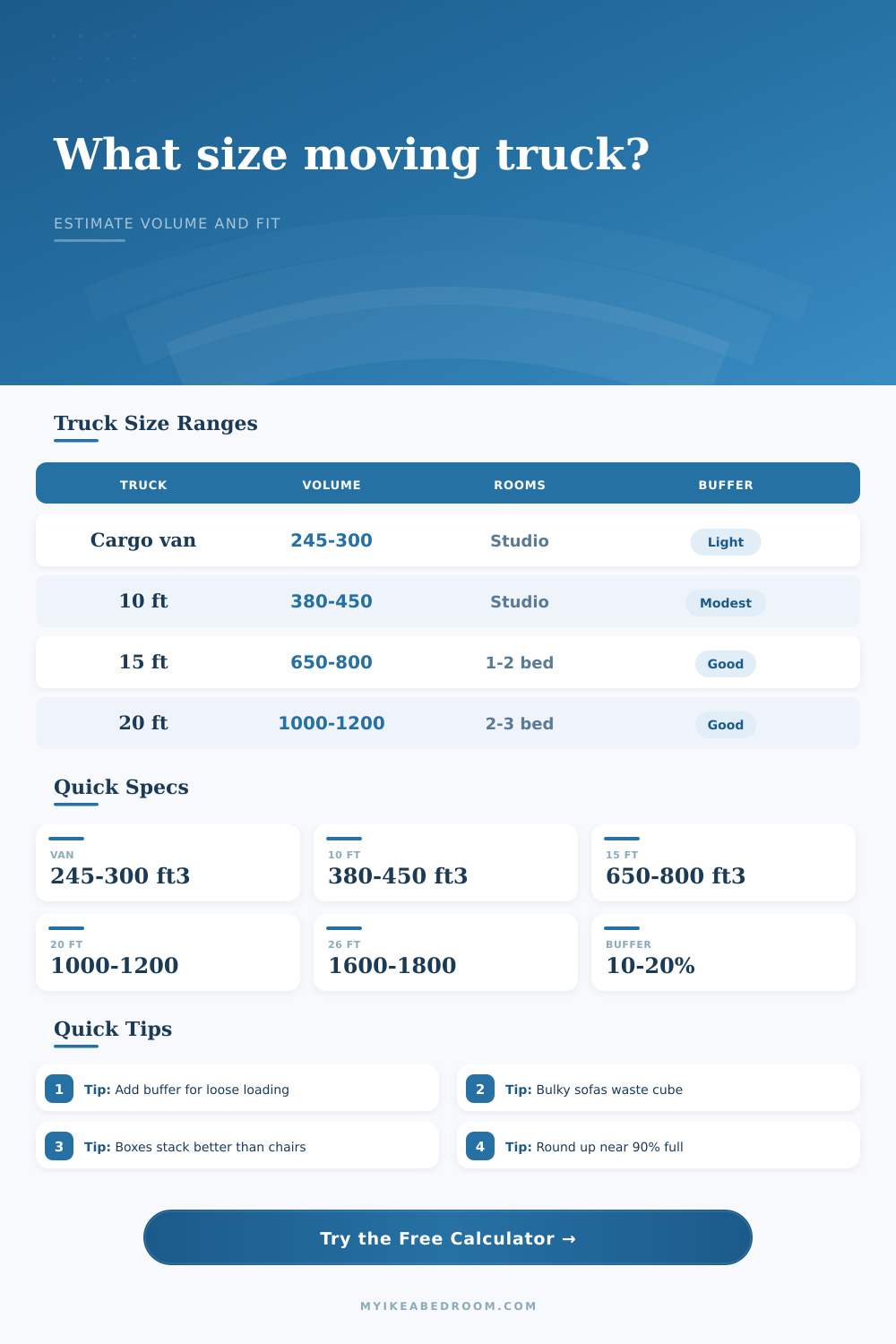
Use the tables to compare your result against common truck capacities, household volume bands, and packing assumptions.
| Truck class | Usable volume range | Typical load | Calculator cutoff |
|---|---|---|---|
| Cargo van | 245-300 ft³ | Dorm, partial studio, boxes only | Up to 300 ft³ |
| 10 ft truck | 380-450 ft³ | Studio or small one-room move | Up to 450 ft³ |
| 15 ft truck | 650-800 ft³ | 1-bedroom or compact 2-bedroom | Up to 800 ft³ |
| 20 ft truck | 1000-1200 ft³ | 2-bedroom or lighter 3-bedroom | Up to 1200 ft³ |
| 26 ft truck | 1600-1800 ft³ | 3-4 bedroom home with furniture | Up to 1800 ft³ |
| Inventory item | Volume used | Why it matters | Stacking behavior |
|---|---|---|---|
| Small box | 1.5 ft³ | Dense cartons add weight, not much cube | Stacks cleanly |
| Medium box | 3.0 ft³ | Most general moving boxes fit here | Stacks cleanly |
| Large box | 4.5 ft³ | Bulky soft goods fill space quickly | Stacks if not crushed |
| Furniture piece | 35 ft³ | Average for desks, dressers, tables | Leaves gaps |
| Large piece | 80 ft³ | Beds, sofas, appliances, wardrobes | Often dictates fit |
| Home profile | Base volume | Usually fits | Watch point |
|---|---|---|---|
| Dorm or micro studio | 150 ft³ | Cargo van | Mattress size |
| Studio apartment | 260 ft³ | Van or 10 ft | Sofa and bed |
| 1-bedroom home | 430 ft³ | 10 ft or 15 ft | Dining set |
| 2-bedroom home | 700 ft³ | 15 ft or 20 ft | Duplicate beds |
| 3-bedroom home | 1050 ft³ | 20 ft or 26 ft | Outdoor items |
| 4-bedroom home | 1450 ft³ | 26 ft | Garage storage |
| Adjustment | Multiplier | Use when | Effect on sizing |
|---|---|---|---|
| Mostly boxes | 1.00 | Square cartons and few loose pieces | No bulky add-on |
| Few awkward pieces | 1.06 | Chairs, lamps, mirror, small bike | Small cube add-on |
| Typical bulky mix | 1.12 | Sofa, bed frames, open shelving | Normal cushion |
| Many awkward pieces | 1.20 | Patio set, curves, fragile items | May move up a truck |
| Oversized garage items | 1.30 | Tools, exercise gear, long equipment | Strongly favors larger class |
🧮Truck Comparison Grid
Best for stacked boxes, dorms, and small furniture.
Works for studios when large items are limited.
Common step-up for one bedroom plus living room.
Useful for two bedrooms or a lighter three-bedroom load.
Largest common box truck class for household moves.
💡Calculation Notes
Renting a truck that’s too big means paying for half an empty cab. Renting one that’s too small mean sleeping on the sidewalk with your duffel bag. In most cases, actual pieces of furniture aren’t the difference between a huge mess and a smooth move. The difference is air around those pieces.
Moving isn’t about volume of what you own, it’s about the negative space required to pack it safely. When you’re wedging a dishwasher between boxes of books and a sofa, the sofa take up more room than you’d think. That’s the part most people don’t get right. They think in linear feet of things. But trucks is three-dimensional puzzles with dead zones created by odd shapes that are impossible to fill.
How to Choose the Right Moving Truck Size
After plugging in your inventory, the calculator above will do the math for you, no more guessing about conversions or coefficients. However, knowing why those figures go in make you think differently about how you pack.
For example, start at the bottom with base volume. Two-hundred cubic feet sounds like a lot of stuff for a studio apartment. But what’s moving in? It was just a desk and some clothes. How about a refrigerator and a king-size bed, plus a couch (or maybe a sectional). Now those big items takes over the cube count.
A standard large appliance or bed frame consume eighty cubic feet. And they don’t stack. They take up huge amount of space for just one piece of furnitures. That’s why the tool includes a bulky item factor. That considers the voids left behind by exercise equipment and chairs and curved tables that won’t change themselves into tidy rectangles.
But boxes aren’t created equal. Boxes that are small and contain heavy stuff (like books) don’t take up huge amounts of space, but do weigh more. Boxes that are big and contain fluffy things (like pillows) takes up lots of room, but do not weigh much. The calculator has ways to account for this, because unlike space, weight does count, especially when your vehicle can only handle so much.
You might be able to physically pack two hundred boxes into a cargo van, but you might also go over its payload capacity. On the other hand, filling it with two hundred boxes of linens may not leave enough room, even though it won’t go over weight. Knowing how to pack makes all the difference.
And the tool requires you to enter in numbers of small, medium, and large box because each type of box packs differently. A small box is meant to pack efficiently and tightly. A large one creates air pockets and risks crushing other boxes if stacked too high.
And then there’s the buffer. This is the most critical setting for reducing your stress. Packing like a pro with all those dollies and straps? Use a ten percent reserve. Doing it yourself (probably in the rain) while keeping an eye on the toddler who’s running loose? Use a twenty percent reserve. Need some breathing room? Bump up the buffer.
The calculator will tell you what size truck fits within its suggested volume. However, don’t assume your packing will be perfectly efficient. You probably won’t always have perfect conditions. The reference tables on the page illustrate this, giving volume ranges and corresponding scenarios in the real world.
Six-hundred- to eight-hundred-cubic feet is typical for a two-bedroom condo. That’s a fifteen-foot truck. But if you have a bunch of awkward furniture pieces, that load may stretch into the two-thousand-cubic-foot zone of a twenty-footer. Paying for the additional space is worth avoiding a second trip.
Think about the dimensions of your biggest pieces. Everything has to fit around your big stuff; think about how that changes what will go where. If your long piece (like a long dining table or a tall wardrobe) are larger than the width of the truck, guess what? You’re gonna have to angle that guy and lose some space.
That’s why the ‘bulky’ part of the equation tries to estimate the space lost by having non-rectangular things. Because rectangular things are more efficient, we add a percentage of your total volume to try to make up for your big clunky pieces. Small thing, but it makes a difference.
Boxes vs boulders: treat your inventory appropriatey. And lastly, consider the packing strategy, and don’t simply judge the final outcome by truck size. Go big if you’re on the cusp of two sizes. Usually the price difference is small when compared to the headaches of rushing your move or renting a second truck.
Packing densely isn’t the objective. The objective is getting it all in there once, safely, and with minimal exertion. Moving isn’t about moving stuff. It’s about moving your life. Treat it accordingly.
Begin with the proper truck, pack with breathing room, and anticipate the unexpected.