Airing Cupboard Shelf Quantity Calculator
Estimate how many shelves fit inside an airing cupboard, with clear linen spacing, cut sizes, board area, support notes, and ventilation allowances.
Recommended Airing Cupboard Shelf Plan
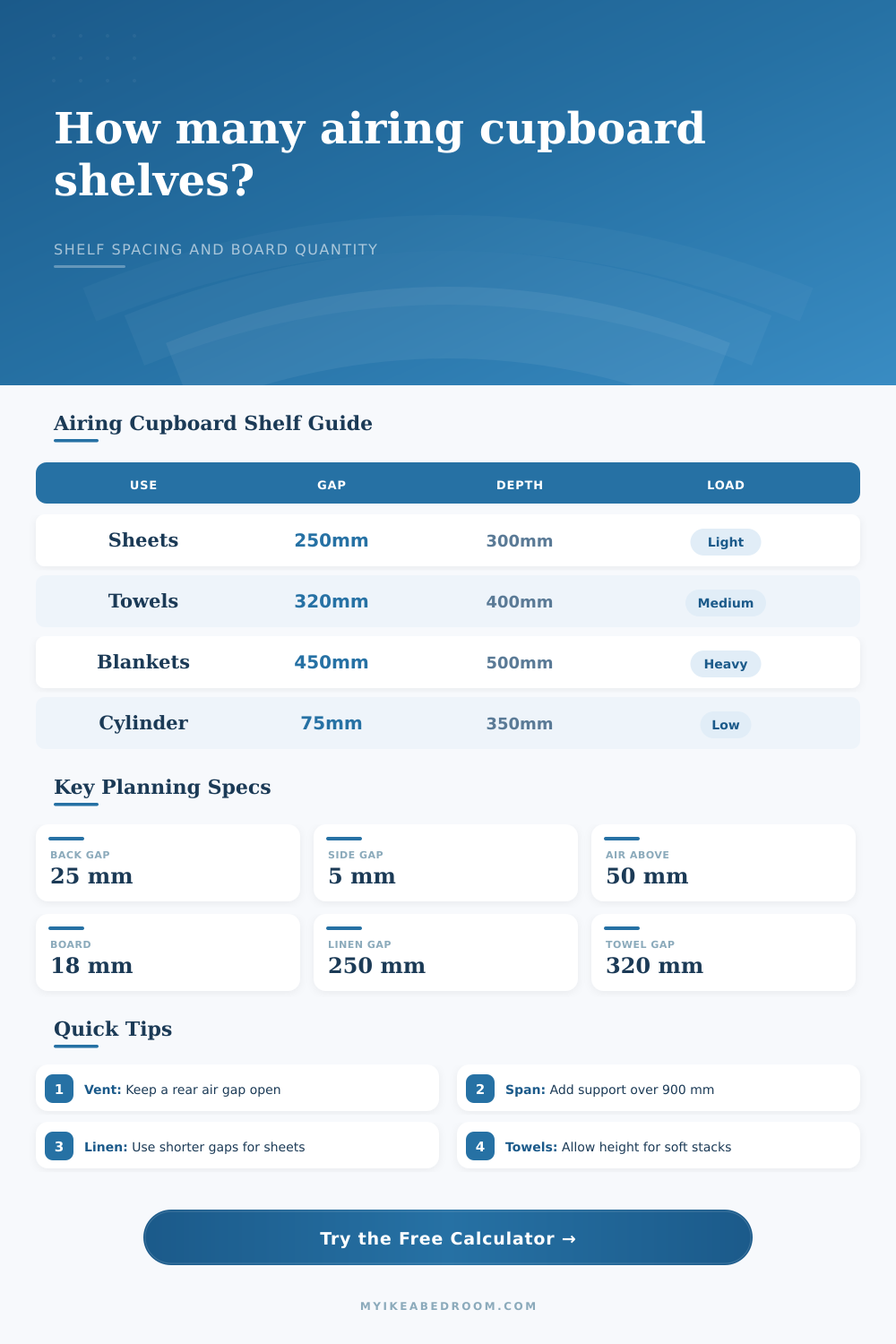
| Stored item | Typical folded stack | Comfortable clear spacing | Planning note |
|---|---|---|---|
| Pillowcases and small sheets | 120 to 180 mm | 220 to 260 mm | Good for short, tidy stacks |
| Flat sheets and duvet covers | 160 to 230 mm | 250 to 300 mm | Allows hand clearance above folded linen |
| Bath towels and hand towels | 220 to 300 mm | 300 to 360 mm | Prevents soft towel stacks from snagging |
| Blankets and bulky bedding | 300 to 420 mm | 400 to 500 mm | Use fewer shelves for bulky items |
| Clearance point | Minimum gap | Better planning gap | Why it matters |
|---|---|---|---|
| Rear of shelf to wall | 15 mm | 25 mm | Keeps warm air moving behind linen |
| Front of shelf to closed door | 10 mm | 20 mm | Avoids rubbing on doors or louvres |
| Side trimming allowance | 3 mm each side | 5 mm each side | Helps shelves lift in and out cleanly |
| Top access above final tier | 50 mm | 100 to 150 mm | Leaves space for fingers and airflow |
| Shelf depth | Best use | Typical cupboard fit | Access note |
|---|---|---|---|
| 300 mm | Sheets and pillowcases | Shallow hallway cupboards | Easy to see the back row |
| 350 mm | Mixed bedding | Compact airing cupboards | Good balance of reach and storage |
| 400 mm | Towels and duvet covers | Standard linen cupboards | Useful for two folded rows |
| 500 mm | Blankets and bulky towels | Deep utility cupboards | Keep heavier stacks low |
| Board and span | Light linen | Heavy towels | Support recommendation |
|---|---|---|---|
| 18 mm board up to 600 mm span | Well suited | Usually suitable | Side battens are normally enough |
| 18 mm board from 600 to 900 mm span | Well suited | Check deflection | Add a rear batten for deeper shelves |
| 18 mm board over 900 mm span | Support advised | Support required | Use a centre divider or front rail |
| 12 mm board at any wide span | Short spans only | Not ideal | Use thicker board or closer supports |
How many shelves can I get into my narrow tall cupboard? What fits in there, such as sheets and towels, while allowing for airflow and not too much weight? How many shelves will be effective?
If it’s small, the most surface area isn’t everything…vertical space are key. The problem is that most people think in terms of “number of boards.” That’s wrong. The limiting factor is the height available between board. It is not the number of boards itself. A pile of flat sheets require less space than a fluffy towel on a shelf. Piling it too high mean no one can pull anything out without making the whole thing fall over.
How to Fit Shelves in Your Cupboard
Enter your interior dimensions into the calculator and let it do the math. No guesswork required. You won’t have to worry about converting measurements or whether vertical configuration will make sense.
Until we stink, we don’t realize ventilation matters. In an airing cupboard, the hot water in the cylinder cause warm air to flow around stored items. However, solid shelving across the back trap moisture against the wood and fabric. To let air circulate and prevent rotting, there should of a gap of at least twenty-five millimetres behind the shelf. It freshens the linen too.
See how tiny clearances makes a working system in table of references.
Another issue is depth. A typical cupboard found in a hall is thirty centimetres deep, enough room for sheets but not so easy to grab towels from. For a deeper cupboard you can fit a half metre board (fifty centimetres). That’s fine if you want to stow blankets away but not so great when reaching for everyday items. The other thing about having things at the back of the cupboard is that you tend to forget about what’s there. A middle-depth cupboard give you room to fold things over onto each other, creating two layers, but still no digging around required.
Structural support. Eighteen-millimetre board is common. Wood has its limitations. The width of the cupboard (over ninety millimetres) can mean that wet towels pulls down on the shelf and cause slow warping of the board. It may be too late by the time you realize the shelf is permanently bowed out. A simple solution is to add a centre support (or even a rear one). No more replacing warped shelves in the future. Your tool tell you when reinforcements are needed.
Know What You Own: Different clothes require different spacing, just like delicate sheets and heavy towels. If you have more fluffy towels, adjust accordingaly. The plan will fail if you change laundry habits, so leave some extra height for new additions such as seasonal blankets or thick duvet covers. Better to have empty air space rather than a jam-packed shelf spilling over when you swing open the door.
Before you cut any wood, this tool helps you see how these tradeoffs play out through their presets. Whether it’s a deep utility closet or a narrow niche, the principles apply. You’re balancing airflow, depth and height to make something useful. It isn’t about packing in as many things as possible; it’s about fitting the right thing in a comfortabley way. When done well, the cupboard fits your bathroom routine. That linen needs to be ready, dry and accessible. With correct spacing, the cupboard becomes an asset. You’ll have left enough room to store and circulate air. Now you can easily pull that basket out.