Fridge Door Swing Clearance Calculator
Estimate the hinge-side gap, aisle swing, and full open depth for single-door, French-door, side-by-side, counter-depth, and column refrigerator layouts.
📌Choose a fridge layout preset
📏Enter refrigerator and kitchen clearances
Door swing result
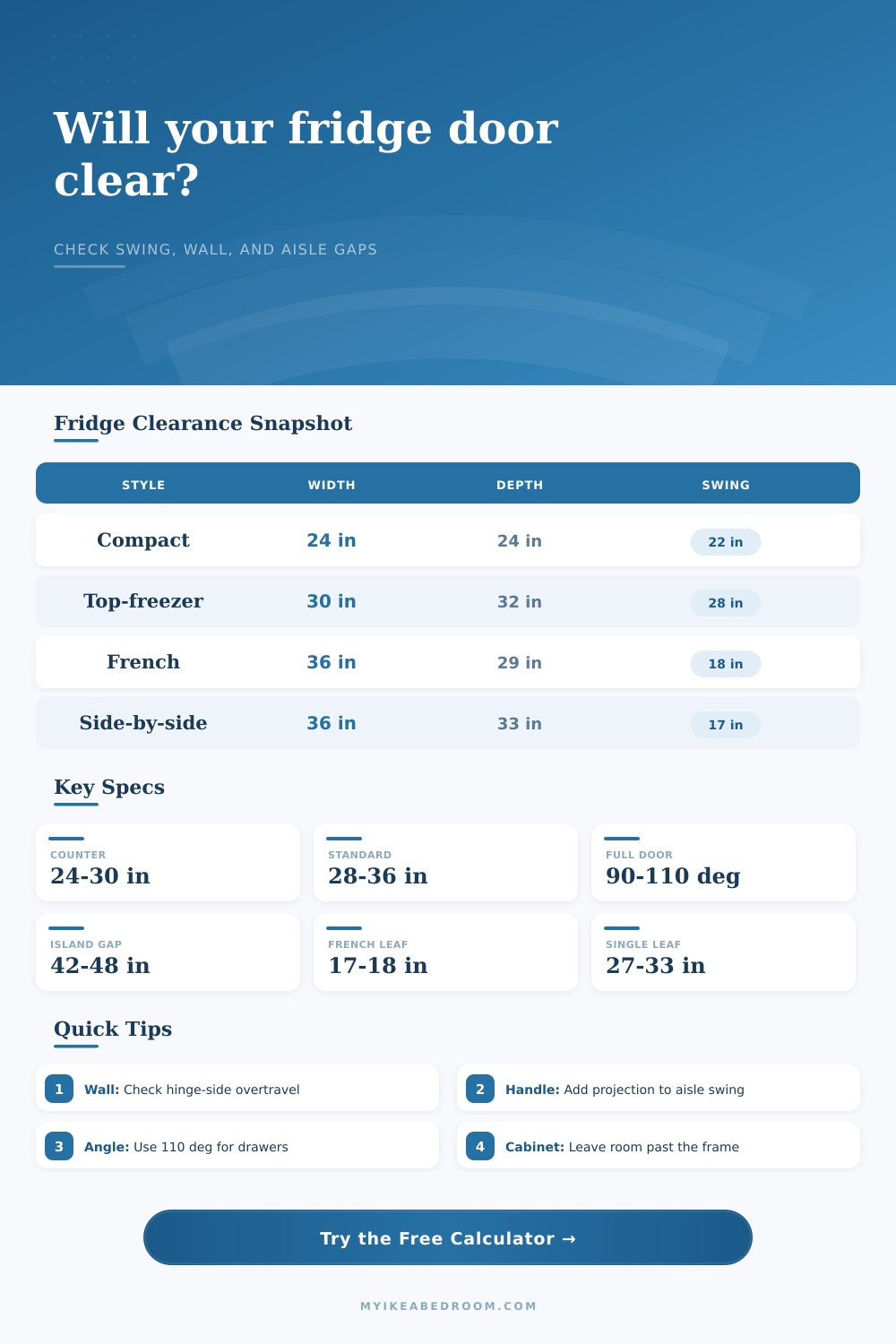
📊Clearance spec quick grid
🧊Typical refrigerator width and depth references
| Fridge type | Common total width | Depth to door face | Typical door leaf used for swing |
|---|---|---|---|
| Undercounter compact refrigerator | 18 to 24 in / 46 to 61 cm | 22 to 25 in / 56 to 64 cm | 16 to 23 in / 41 to 58 cm |
| Apartment top-freezer refrigerator | 24 to 28 in / 61 to 71 cm | 28 to 32 in / 71 to 81 cm | 22 to 26 in / 56 to 66 cm |
| Standard top-freezer refrigerator | 28 to 33 in / 71 to 84 cm | 30 to 34 in / 76 to 86 cm | 26 to 31 in / 66 to 79 cm |
| Bottom-freezer single-door refrigerator | 29 to 33 in / 74 to 84 cm | 30 to 35 in / 76 to 89 cm | 27 to 31 in / 69 to 79 cm |
| Counter-depth French-door refrigerator | 30 to 36 in / 76 to 91 cm | 24 to 30 in / 61 to 76 cm | 14 to 18 in / 36 to 46 cm per leaf |
| Full-depth French-door refrigerator | 33 to 36 in / 84 to 91 cm | 32 to 36 in / 81 to 91 cm | 16 to 18 in / 41 to 46 cm per leaf |
| Side-by-side refrigerator | 33 to 36 in / 84 to 91 cm | 30 to 35 in / 76 to 89 cm | 15 to 18 in / 38 to 46 cm per leaf |
| Built-in column refrigerator | 18 to 30 in / 46 to 76 cm | 24 to 25 in / 61 to 64 cm | 17 to 29 in / 43 to 74 cm |
🚪Door style swing factors
| Door configuration | Leaf width factor | Best use in calculator | Clearance note |
|---|---|---|---|
| Single right-hinge, opens right | 0.92 x fridge width | Right wall or tall pantry at hinge side | Largest side overtravel at 100 to 120 degrees |
| Single left-hinge, opens left | 0.92 x fridge width | Left wall or cabinet panel at hinge side | Use the actual wall-side gap, not the filler width alone |
| Top-freezer single wide door | 0.90 x fridge width | Traditional apartment and standard fridges | Freezer and fresh-food doors can have different handles |
| Bottom-freezer single wide door | 0.92 x fridge width | Wide refrigerator door above drawer freezer | Check crisper drawer pullout at the target angle |
| French-door refrigerator leaf | 0.49 x fridge width | One side of a double-door refrigerator | Each leaf swings less, but handles add aisle depth |
| Side-by-side refrigerator leaf | 0.47 x fridge width | Freezer or fridge leaf in a side-by-side unit | Door bins often need a wider practical opening |
| Counter-depth French-door leaf | 0.49 x fridge width | Flush cabinet runs and galley kitchens | Shallower case depth does not remove door swing |
| Built-in column full door | 0.96 x fridge width | Integrated tall single-purpose refrigerator | Panel-ready fronts may be thicker than freestanding doors |
🔢Door angle swing math reference
| Open angle | Forward swing into aisle | Side overtravel past hinge | Typical planning use |
|---|---|---|---|
| 80 degrees | 0.98 x leaf width plus handle | Door thickness only | Tight opening, shelves accessible |
| 90 degrees | 1.00 x leaf width plus handle | Door thickness sweep | Basic pass-fail cabinet check |
| 100 degrees | 0.98 x leaf width plus handle | 0.17 x leaf width plus door thickness | Better door-bin access near a wall |
| 110 degrees | 0.94 x leaf width plus handle | 0.34 x leaf width plus door thickness | Common crisper and shelf removal target |
| 120 degrees | 0.87 x leaf width plus handle | 0.50 x leaf width plus door thickness | Generous access, needs a larger side filler |
🏠Aisle and cabinet clearance references
| Kitchen condition | Clearance to check | Common planning range | Why it matters |
|---|---|---|---|
| Fridge opposite a base cabinet run | Closed face to opposite counter | 36 to 42 in / 91 to 107 cm | Door can open while a person stands nearby |
| Fridge opposite a kitchen island | Closed face to island edge | 42 to 48 in / 107 to 122 cm | Door swing and traffic share the same aisle |
| Hinge side against a finished wall | Fridge edge to wall face | 2 to 6 in / 5 to 15 cm | Wide single doors may overtravel past the hinge side |
| Hinge side against tall pantry | Fridge edge to pantry front | 2 to 4 in / 5 to 10 cm | Door thickness and handle can hit adjacent fronts |
| Counter-depth fridge in cabinet niche | Door face proud of cabinet | 1 to 3 in / 3 to 8 cm | Hinge must clear the cabinet frame when rotating |
| French-door next to side wall | Wall-side leaf at target angle | 1 to 3 in / 3 to 8 cm | Narrow leaf lowers swing, but handle still projects |
This happens more times than you care to admit during a kitchen remodel. That’s when you find the perfect stainless steel French door refrigerator. The one with the crisper drawers and an ice maker feels like a luxurius. And then it arrives, ready for installation, except there’s no way it fits on the wall you picked, because the door will hit the tall pantry before it has ever gotten halfway open. Blame the contractor, shrug the installer, but you’re stuck with a fridge whose doors has to be opened politely at a forty-five degree angle. A tragedy easily prevented.
Mostly because most people measure width of the appliance but ignore the geometry of the door swing. This page’s calculator performs the trigonometry for you. Turns those vague angles into real inches of clearance so that you can picture the arc before your cabinets glue themselves down.
How to Measure Space for Your Fridge Door Swing
But here’s the kicker: A fridge door doesn’t simply slide forward when opened. It pivots around a fixed point (the hinges). This creates a swinging arc, and its length depend on where those hinges are placed as well as how wide you want the door to swing open.
Standard advice found in most manuals is “Leave two inches on the hinge side.” This is a great rule of thumb but it is also a dangerously simple shortcut. Two inches is that buffer at a ninety degree open position. But many times this isn’t enough, particularly if you want to reach the door bins (or pull out the bottom crisper drawer) without banging your knuckles. For it to work fully, the door typically must be able to open more like one hundred ten degrees. When it reaches this angle, the door actualy extends further into the aisle. By definition, it will pass beyond the hinge line, often significantly beyond. This means that the door will project further into the aisleway, which may require a bigger side gap than anticipated.
Enter the exact dimensions of your fridge (width x depth), and watch closely how the tool handles the input labeled “handle projection.” That’s the gotcha number for designers. The handle-less, slick front looks so clean and efficient. But a major bar pull could extend three inches from the front of the fridge. An extra inch or two immediately means more depth needed in the aisle. And if the fridge goes opposite an island, that handle will be the chokepoint.
Maybe you’re good on aisle width, and there’s ample clearance for the fridge doors to open wide. But what happens when the handle catches the granite countertop lip? It makes the entire thing feel aggressive and cramped. It’s a tiny detail, but it sets the tone for day-in/day-out life in your kitchen.
Door configuration also matters much more then you might expect. Two narrow leaves (side-by-side) means each door swings less aggressively than one wide door (top freezer). Splitting the width into two doors (French door style) further decreases the radius of the swing. It frequently requires a deeper cabinet, though, as the doors needs more swing to reach those mid-shelves. The tool breaks this out for you, with reference tables that compare different styles of doors. For example, a 36-inch wide unit will behave very differently depending on the style. It could be a single-door unit, a double-door unit, or a column unit. The tool estimates these according to which style you choose.
You don’t have to remember any of this. Instead, you can concentrate on physical space where you want the refrigerator. The hinge side is key. Is your fridge up against a wall? Then the gap on that side must be wide enough for the door itself. It also must account for how far the door move past the hinges when opened. Or maybe there’s no wall but rather a cabinet beside the fridge? In this case, the door might hit the face of the cabinet before it opens wide enough to let you remove the drawers. Regardless, the tool figures out how much gap is necessary to achieve your desired angle.
This could be ninety degrees for easy access, or a hundred twenty for completely clear access with no obstruction when pulling out shelves. It also calculates the overall depth from the back wall to the outside of the open door. This is very important so you don’t walk past the fridge and accidentally bang your shin.
So, at the end of the day, how do you plan for door swing? How do you account for the total space an appliance occupies? Don’t forget: It’s not just about its footprint. Sure, you measure the aisle width. But what about the projection of the handle? And what about the side clearance?
You run the numbers before purchase. You won’t have to do that awkward dance of opening the door a little bit. Then step back. Open it more. Repeat.
Now, maybe you have to add an extra inch of filler. Better to know that now than after the delivery truck is in your driveway. Maybe you realize you want a slightly narrower fridge. That way you don’t discover it until it’s on the truck in your driveway.
Know before you go. Measure twice. Calculate once. Because, guess what? That beautiful new fridge won’t actualy open.