Wall Plug Quantity Calculator
Estimate wall plugs, screws, drill points, and spares for anchoring IKEA bedroom furniture to studs, drywall, masonry, hollow block, or older plaster walls.
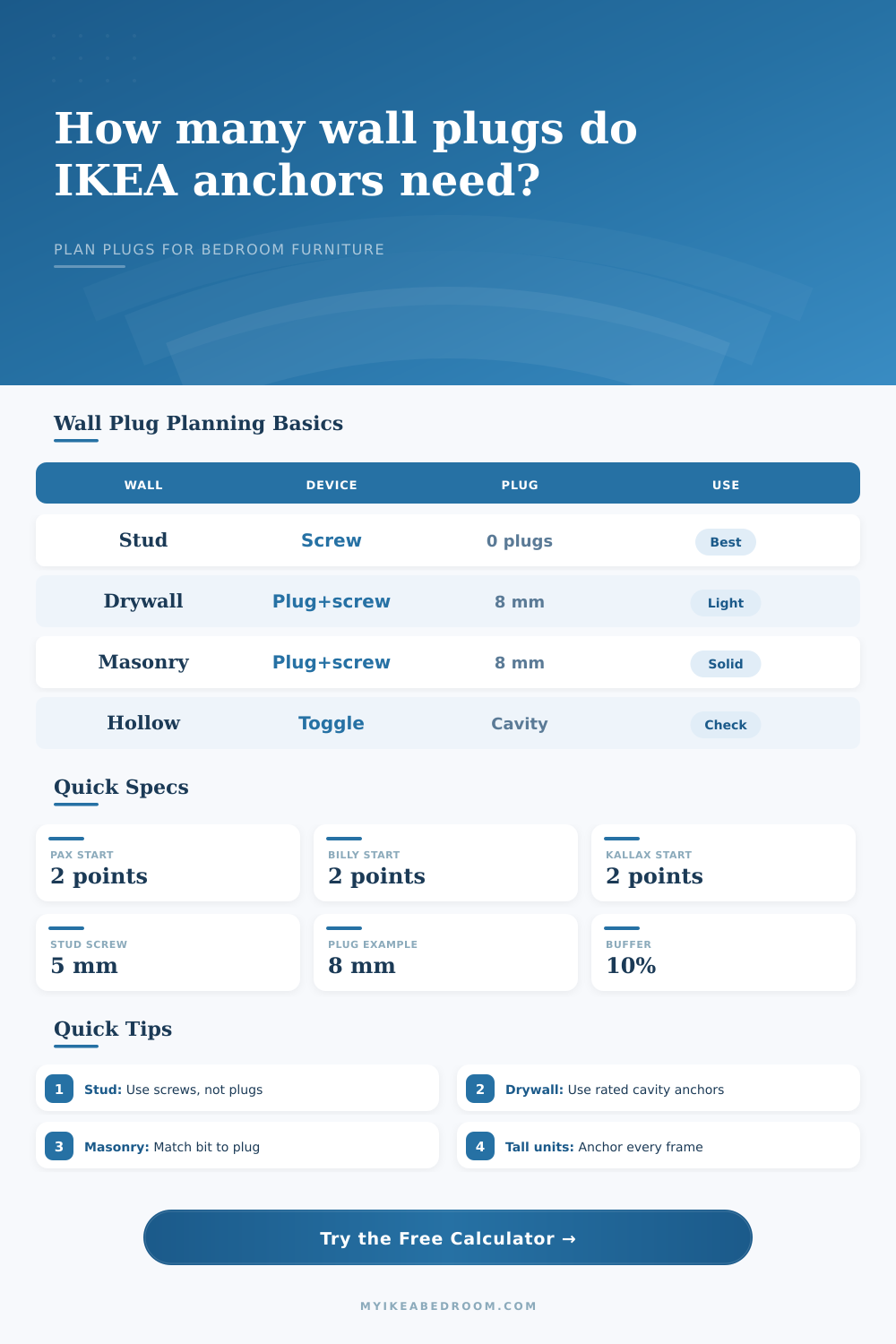
| Furniture type | Starting anchor points | Why it matters | Plug planning note |
|---|---|---|---|
| PAX wardrobe frame | 2 per frame | Tall storage is a tip-over priority, especially at 201 cm or 236 cm heights. | Count every frame; a three-frame run usually starts at 6 fixing points. |
| BILLY bookcase | 2 per bookcase | Bookcases can become front-heavy when loaded above eye level. | The 8 x 2 cm bottom cut-away helps the case sit closer to the wall. |
| KALLAX shelving unit | 2 per unit | Open cubbies invite uneven loading and child-height pulling. | Wall material decides whether you use stud screws, plugs, or toggle anchors. |
| MALM chest or dresser | 2 per chest | Drawers shift load forward when several are open. | Keep spare plugs because bracket locations often land between studs. |
| BRIMNES cabinet or wardrobe | 2 per cabinet | Closed storage can hide heavy, high shelves. | Add one extra anchor point per cabinet for uncertain plaster walls. |
| Wall substrate | Typical device | Plug count per anchor | Calculator behavior |
|---|---|---|---|
| Drywall or plaster with wood stud | Wood screw into stud | 0 plugs | Counts screws and pilot points, but no wall plugs. |
| Drywall without available stud | 8 mm plug, cavity plug, or toggle | 1 plug | Counts one anchor device for every bracket hole. |
| Concrete, brick, or solid masonry | 8 mm masonry plug with matching bit | 1 plug | Uses the plug size selected or the auto 8 mm default. |
| Hollow block or cavity wall | Toggle-style or rated hollow-wall anchor | 1 anchor | Counts anchor bodies, not basic plastic plugs. |
| Older plaster or uncertain wall | Stud screw preferred; rated anchor if no stud | 1 plug | Uses the higher buffer because failed holes are more common. |
| Anchor size | Common screw range | Common use | Quantity note |
|---|---|---|---|
| 5 mm wood screw | No plug | Direct fastening into a stud | Buy screws only; pre-drill if the screw or stud condition calls for it. |
| 6 mm plastic plug | 3.5-4 mm screw | Small rails, light brackets, light shelves | Use only when the furniture instructions and wall rating allow it. |
| 8 mm wall plug | 4-5 mm screw | IKEA-style wall anchoring examples for drywall or masonry | Good default count for many anti-tip brackets away from studs. |
| 10 mm heavy plug | 5-6 mm screw | Heavier rails or solid masonry with larger brackets | Count one plug per hole and verify bracket hole clearance. |
| Toggle or cavity anchor | M4-M6 screw | Hollow drywall, hollow block, and cavity walls | Count one complete anchor per bracket hole, plus spares. |
| Bedroom setup | Pieces | Anchor points | Plugs with 10% buffer |
|---|---|---|---|
| One PAX frame on masonry | 1 wardrobe | 2 | 3 plugs |
| Two BILLY bookcases on drywall | 2 bookcases | 4 | 5 plugs |
| Three PAX frames on studs | 3 wardrobes | 6 | 0 plugs, 7 screws |
| Tall KALLAX divider on hollow wall | 1 shelving unit | 2 | 3 cavity anchors |
| Mixed storage wall on plaster | 4 units | 10 | 13 plugs |
When you finally go to build that tall wardrobe, it’s scary. The instructions has warnings about tipping over. There is also a little plastic baggie of strange anchors. Will my wall support this? What kind do I use? Do I even need anchors at all?
If you miss a stud, which is highly likely, you definitely need anchors. A wall are a layered system of masonry, plaster, drywall, or studs. Every one must be anchored effectivly.
How to Choose the Right Wall Anchors
When anchoring into a stud, use a long wood screw; don’t use a plug. The screw will bite the timber and hold incredibly well. More times than not, however, you don’t get lucky enough to hit a stud. That’s why type and size of your plugs becomes such an important factor. A plug that fits in ordinary drywall won’t fit into concrete. For concrete, you want a hammer drill and a masonry bit. Anchors comes out when they’re under tension if you use the wrong combo.
After identifying what type of furnitures you’re hanging and which wall surface you’ll be using, the calculator does the work for you so you don’t have to wonder how many items you need. Or do I need twenty?” questions). It converts your real-life situation to a list of item you can buy.
It understands that a bookcase only has as many anchor points as its width different than a three-frame PAX wardrobe holds more anchors. And it includes a 10% safety factor. Lots of folks forget about this, until they realize they’re one anchor down when they go to install. A 10% cushion is just insurance for those times you strip out a hole or make a mistake drilling. Also, if you find some thin spots on the drywall, this will help you out too.
It’s important to know what makes a “cavity anchor” different from a regular plug. Some walls is hollow (like old apartment buildings). Standard plastic plugs won’t hold in a wall like that. They’ll just rip apart the drywall around the hole. For this type of application, you use something called a toggle bolt or special anchor for hollow walls. These things opens up on the other side of the wall. The calculator knows the difference and prevents you from purchasing the incorrect piece of hardware.
It is easy to tell them apart at the store but choosing the right one is the difference between your shelf staying up or falling down.
Always mark the wall before drilling Before moving the furniture into place, use a pencil to mark out all of the holes for your brackets. This tells you two things: Where will the stress points be? And is it soft plaster or solid masonry? If solid masonry, you’ll want a harder drill bit. If soft plaster, you may want a bigger plug. It takes five minutes of work. You will have hours less frustration. A blind guess becomes a measured plan.
It’s not about getting something together. It’s about making sure that it remain standing for years to come. And this matters if your house has any pets or kids who enjoy climbing onto handles. There is no quieter way to fail then having a loose anchor. You don’t hear it coming, until you do… Too late.
When you think through what kind (and how much) hardware will work best, you’ve eliminated the variable of improvisation. You know exactly where to go when you enter the hardware store. And then you can drill confidently knowing that the furniture isn’t going anywhere. That peace of mind lasts longer than the moment that final screw is tightened.