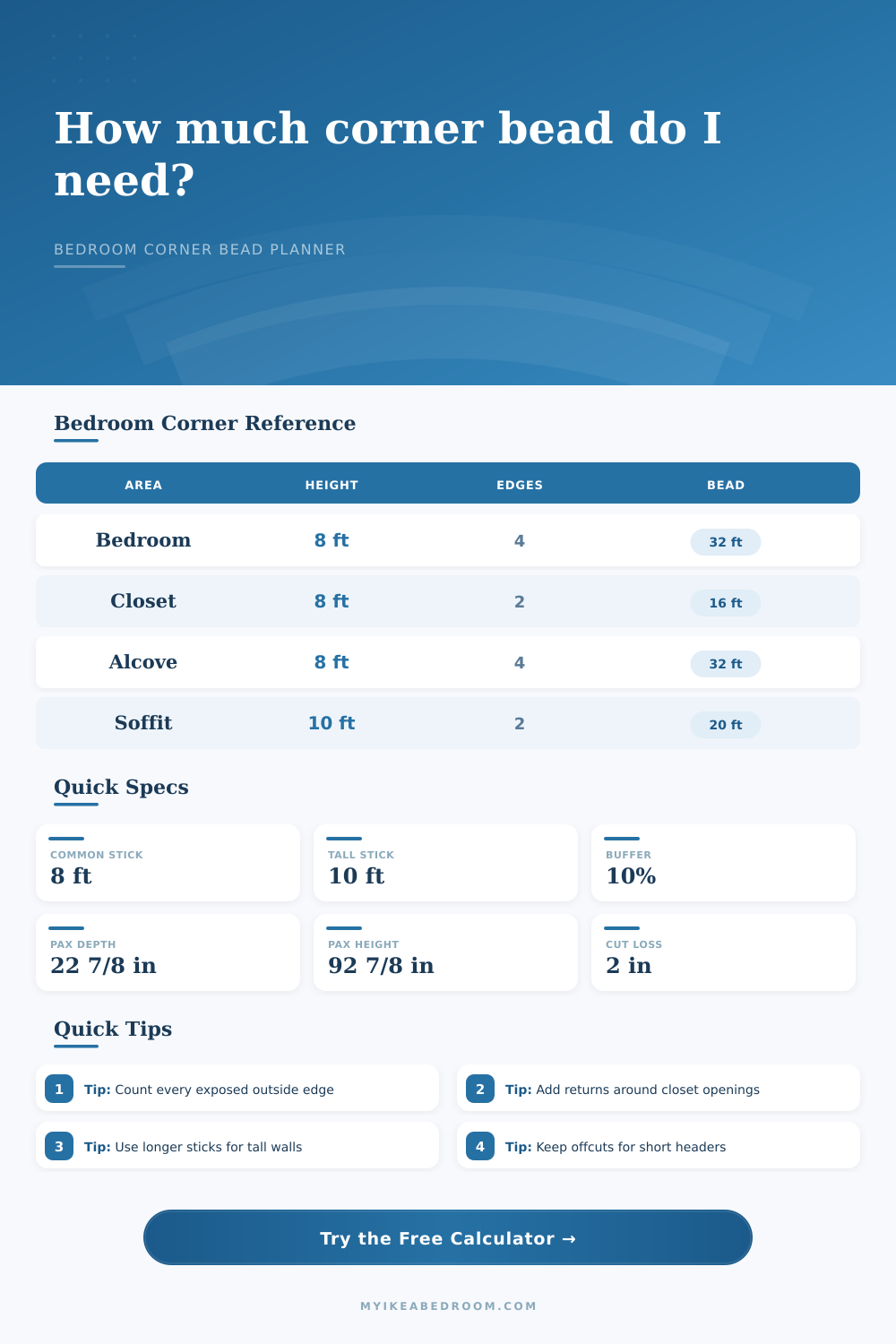
Corner Bead Quantity Calculator
Estimate drywall corner bead length, full-stick count, overage, and manageable offcuts for bedroom corners, closet returns, soffits, and wardrobe alcoves.
📌Bedroom And Closet Presets
📏Corner Bead Inputs
Corner Bead Estimate
⚒Profile Handling Weight
📋Corner Bead Stick Planning Table
| Stock Length | Best Bedroom Use | One Stick Covers | Planning Note |
|---|---|---|---|
| 8 ft / 2.44 m | Standard bedroom walls | One 8 ft vertical edge | Works cleanly on common 8 ft ceilings. |
| 9 ft / 2.74 m | Taller rooms and trim allowance | One 8 ft edge plus offcut | Useful when floors or ceilings are uneven. |
| 10 ft / 3.05 m | 9 ft ceilings and long returns | One tall edge or short pairs | Reduces splices on bedroom feature walls. |
| 12 ft / 3.66 m | Soffits and continuous headers | Long horizontal runs | Stage flat so long bead stays straight. |
🛏Bedroom And IKEA Measurement Reference
| Reference Item | Imperial Measurement | Metric Measurement | Corner Bead Relevance |
|---|---|---|---|
| IKEA PAX frame depth | 22 7/8 in | 58 cm | Use for wardrobe alcove return depth. |
| IKEA PAX tall frame height | 92 7/8 in | 236 cm | Check clearance before adding soffit bead. |
| IKEA European queen mattress | 63 x 78 in | 160 x 200 cm | Helps judge open walking space around new returns. |
| IKEA European king mattress | 71 x 78 in | 180 x 200 cm | Check layout before framing a closet bump-out. |
📐Common Bedroom Corner Scenarios
| Project Area | Typical Bead Edges | Short Runs To Add | Buffer Guidance |
|---|---|---|---|
| Plain 10 x 12 bedroom repair | 2 to 4 outside edges | 0 to 4 ft | 5% when cuts are mostly full height. |
| Reach-in closet opening | 2 to 6 return edges | 3 to 8 ft | 10% for header and jamb offcuts. |
| Wardrobe alcove or niche | 4 to 8 outside edges | 4 to 12 ft | 15% when many short pieces meet. |
| Dormer or attic knee wall | 4 to 10 mixed edges | 6 to 16 ft | 15% to 20% for angled trimming. |
🧮Cut Loss And Overage Reference
| Work Pattern | Suggested Buffer | Why It Helps | Stick Choice |
|---|---|---|---|
| Straight 8 ft verticals | 5% | Small allowance for trimmed ends. | 8 ft or 9 ft sticks |
| Closet returns and headers | 10% | Covers short offcuts around openings. | 8 ft and 10 ft sticks |
| Wardrobe alcove build-out | 15% | Allows for many inside/outside transitions. | 10 ft sticks |
| Sloped dormer or soffit | 20% | Protects against angled cut mistakes. | 10 ft or 12 ft sticks |
💡Actionable Measuring Tips
This is the Drywall Corner Bead Calculator. If a room is out of square, then no amount of three-hour-long taping will prevent a ridge from appearing like an amateur job somewhere in the bedroom corner. Corner bead isn’t trim; it’s the support that makes the thing stay shaped after the joint compound gets smoothed on top of it.
Homeowners purchase by feel: Pick up five sticks off the shelf and hope for the best. Hardly ever do they measure return wraps around the header over the window or the one around closet door. You’d think that would lead them back to supply yard, but no, it usually means a make-do splice right down the middle of this large wall section.
How to Use the Calculator
With the calculator, all you have to do is plug in your edge count and wall height, and let it crunch the numbers instead. You won’t have to guess about conversions and coefficients anymore.
First, let’s count those vertical edges. Most rooms aren’t rectangular, and even if they are, there are still four corners on a rectangular room. And then there’s the wardrobe niche or the TV nook. There is also recessed closet areas. Every exterior corner where any part of outside world can see inside needs to be covered with a bead. Inside corners generally don’t require a bead unless you’re looking for a really specfic look, but the calculator allows you to add them in if your project require it.
The height is fairly self-explanatory. How tall is your wall? Measure from finished floor to ceiling. Do not measure to baseboard! If you do, your sticks won’t be long enough. If you buy a stick for an eight foot wall, you cut it down a little bit to make it fit. You need some wiggle room.
But then there’s the tricky part: returns. Those are the short horizontal edges along tops and sides of doors, windows, closets and other opening in your house. Those are the pieces that everyone forgets about. And here’s how you enter those measurements into the calculator. It wants the total length of your short runs. Does that sound tedious? Don’t measure each individual one out. Estimate the total linear footage of all your sills and headers that require strengthening. Then add a buffer. For most bedrooms, ten percent is a safe bet. If you have a dormer, or some sort of sloping ceiling, bump that up to fifteen or twenty percent. Why? Because angled cuts use material. Straight cuts leave you with an offcut that you can use. A forty-five degree angle leaves you with scrap. This is what the tool takes into account when it changes your weights into stick counts.
The type of material makes a difference in how it feels to. The standard is paper-faced metal. It is light, flexible, and forgiving. Vinyl is heavy and won’t rust if any of the drywall gets damp while you are working on it. Galvanized steel is tough, but stiff. The calculator figures out what you think it should carry based off your selection. Think about that before loading up. Hauling around thirty pounds of paper-faced is one thing and hauling around fifty pounds of steel bead is another. You will want to stage your materials carefully. Keep the full sticks together. Separate short pieces for the returns and headers.
On the page, they have a nice reference table with it all laid out; in case you were wondering what length stock is good for what scenario, etc: For typical walls, an eight-foot stick is ideal. Go for the 10-foot stick if you have tall ceilings or want to avoid making as many joints during long horizontal runs. 12 foot sticks aren’t common but can come in handy for things like soffits. Plan ahead. What’s the longest continuous edge you’ll be working with? Get the longest stick available that exceeds that length. If you don’t, you’re going to end up cutting and splicing which creates a weak point. You should of planned better.
Use Painter’s Tape. Count Out All Outside Edges Before Buying. If there are four short headers and eight strips of tape, then you know EXACTLY how much material you’re working with. No Double-Counting. It makes the audit EASY. Match it to the Bead when you come back into the room with your Materials. You’ve got a physical mark on the wall. That is where the confidence comes from.
The math is just a formality at this point. You KNOW you’ve got enough. And more importantly, you know you’ve got the RIGHT size(s). It’s a simple trick that eliminates PANIC.