Stucco Coverage Calculator
Estimate stucco wall coverage, scratch coat, brown coat, finish coat, bag counts, acrylic pails, lath or mesh rolls, corner bead, and waste allowance from real coat thickness and texture factors.
Load a measured wall, patch, gable, garage, or whole-facade scenario with realistic coat systems and opening deductions.
| System | Scratch coat | Brown or base coat | Finish coat | Total nominal build |
|---|---|---|---|---|
| Patch skim over sound stucco | 0 in | 0 in | 1/8 in | 1/8 in |
| Acrylic finish recoat | 0 in | 0 in | 1/16 to 1/8 in | texture-driven |
| Brown coat leveling | 0 in | 3/8 in | 0 in | 3/8 in |
| One-coat stucco base plus finish | 0 in | 3/8 in | 1/8 in | 1/2 in |
| Two-coat masonry stucco | 0 in | 1/2 in | 1/8 in | 5/8 in |
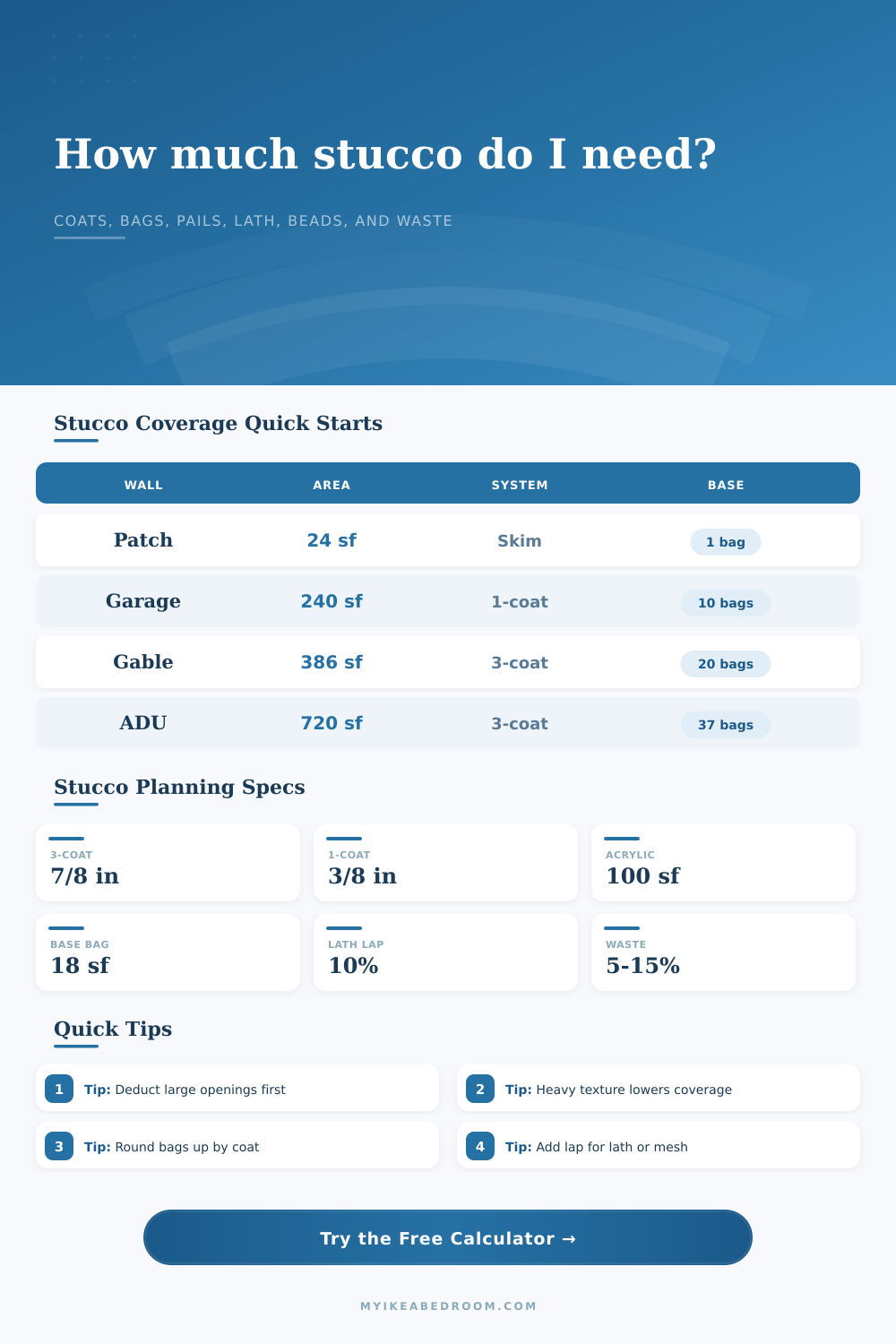
| Traditional three-coat stucco | 3/8 in | 3/8 in | 1/8 in | 7/8 in |
| Coat thickness | Volume for 100 ft² | Coverage per 1 ft³ | Coverage per 1 yd³ | Metric equivalent |
|---|---|---|---|---|
| 1/16 in finish | 0.52 ft³ | 192 ft² | 5,184 ft² | 481.6 m² per m³ |
| 1/8 in finish | 1.04 ft³ | 96 ft² | 2,592 ft² | 240.8 m² per m³ |
| 3/8 in base | 3.13 ft³ | 32 ft² | 864 ft² | 80.3 m² per m³ |
| 1/2 in base | 4.17 ft³ | 24 ft² | 648 ft² | 60.2 m² per m³ |
| 3/4 in base pair | 6.25 ft³ | 16 ft² | 432 ft² | 40.1 m² per m³ |
| Material unit | Nominal coverage | Volume basis | Best use | Calculator treatment |
|---|---|---|---|---|
| 80 lb scratch and brown base bag | about 18 ft² at 3/8 in | 0.56 ft³ | cement base coats | ceil base volume / 0.56 |
| 80 lb finish coat bag | about 100 ft² at 1/8 in | coverage-based | cement finish | texture multiplier applied |
| Acrylic finish pail | about 100-150 ft² | coverage-based | colored acrylic finish | texture multiplier applied |
| Expanded metal lath sheet or roll | about 150 ft² roll basis | area-based | framed walls | net area x 1.10 lap |
| Fiberglass EIFS mesh roll | about 475 ft² roll basis | area-based | EIFS basecoat | net area x 1.10 lap |
| Project | Typical net area | Common system | Opening deduction | Planning note |
|---|---|---|---|---|
| Small repair patch | 12-40 ft² | finish skim or patch base | usually 0 ft² | round up to full bag or pail units |
| Single garage wall | 180-280 ft² | one-coat or 3-coat | door and window area | corners and jambs add bead demand |
| Front gable wall | 300-450 ft² | traditional 3-coat | windows, vents, trim panels | gable triangle raises area quickly |
| Small addition exterior | 600-900 ft² | 3-coat or one-coat | 15-25% common | lath rolls should include lap and cuts |
| Whole facade section | 900-1600 ft² | 3-coat with acrylic finish | measure each elevation | calculate by elevation for cleaner ordering |
| Texture | Finish factor | Typical look | Effect on units | Use this when |
|---|---|---|---|---|
| Smooth trowel | 0.90x | tight, flat surface | slightly fewer finish units | thin finish is carefully floated |
| Fine sand float | 1.00x | light sand face | baseline finish units | manufacturer coverage is based on fine sand |
| Medium sand float | 1.10x | visible sand profile | about 10% more finish | common exterior float finish |
| Lace or knockdown | 1.20x | raised islands | about 20% more finish | matching older textured stucco |
| Heavy dash | 1.35x | sprayed coarse texture | about 35% more finish | coarse sand or dash aggregate is used |
Deduct the face area of windows and doors, but keep a buffer for jamb returns, corner beads, casing edges, and texture losses around those breaks.
Round base coat bags by the total base volume, then round finish units separately. Thin finish materials often run out by texture before they run out by volume.
Stucco, however, most folks think of as wall paint-thick stuff that gets slapped on. I have a stucco wall…times the height by the width and I’m off to Home Depot!” Yeah…that will usualy fail. Stucco is a layered building shell (or skin), each layer having its own material demands and volume requirement. What you’re purchasing isn’t square footage; rather, cementitious coverage. Knowing what you’re buying make the difference between guessing and succeeding.
When you enter your wall dimension and specify your coat system, the calculator do the rest. It spits out how many bags of stucco you’ll need before you spend money on materials you don’t need. But more importantly, it will tell you what the inputs mean which is necessary to avoid unnecessary cost down the line.
How to Calculate Stucco Amounts Correctly
Begin with the depth of your base coat, it’s the majority of the cost of your total project so it matters most. A traditional three-coat system add almost an inch of thickness (think: scratch & brown coats + metal lath). And then there’s a moddern one-coat polymer-modified system, which could be as thin as three-eighths of an inch. That thickness variation have major impact on the amount of volume required. You may even have existing sound surface (perhaps walls from an old house) where you’re only applying a skim finish coat, rising above wall texture by just fractions of an inch.
The tool factors all that structural information into equation. So you won’t waste time wondering if you’re going to need twenty or forty bags just based off square footage alone.
Finally, texture increase your material needs for coverage estimates. Smooth trowel finishes use less material. Texture uses more because it eats up finish faster. Heavy dashes add a layer of course sand over the surface, which in turn produce a series of valleys and peaks that require additional finish mix to reach the profile. As you can see from the reference table on the page, the difference is significant. According to the chart, each increase in dash size increases amount of needed material by about ten percent relative to a fine sand base. It is a small detail, but it matters when you run out of colored finish at sunset and have three days until delivery.
Don’t neglect support products such as corner beads, mesh and lath; each of these requires its own takeoff. For example, metal lath should of have roughly 10-percent overlap between pieces (so that it sticks in place when you start troweling). Similarly, fiberglass mesh used in EIFS systems should be ordered wider to allow for lap joints around windows and other corner. Your net wall surface area. After subtracting openings… Is what the calculator will use to calculate how many piece you’ll need. That way your material list won’t become too large with rolls you don’t actualy need.
Big door and window deductions are common sense. But remember to mentally pad for complicated cuts needed around them, too. That’s where amateurs get burned: assuming perfect conditions on the job site when there will always be some wind, mix splashed around, and imperfect trowel work. Normal application waste for a tidy rectangular wall might be five percent. But one with lots of architectural breaks, vents, and corners can easily push it up to fifteen or twenty percent. This buffer can be adjusted with the tool depending on how messy things look in real life. Better to have bought a little too much than found yourself out of finish coat on a Friday afternoon.
Patch lines: If you don’t make it all the way through a coat of stucco (especially if it’s a thick one), your patch lines will appear shortly after drying. Your goal should be having enough mix left in the pail/pan at any given time to complete a section cleanly before moving to another elevation.
Once you grasp this dynamic about volumes, stucco becomes less frightening as an estimate and more of an inventory issue, doable! It’s not just about covering surface areas, but rather creating depth and textural design that must endure for decades. Having the numbers worked out ahead of time allows the wall to be applied smoothly without pauses where there is nothing for the trowel to spread.