Concrete Footing Volume Calculator
Estimate concrete volume, cubic yards, cubic meters, bag counts, wet weight, excavation spoil, and simple reinforcing allowances for round piers, square pads, rectangular spread footings, and belled post bases.
Load a realistic post, pier, or pad scenario, then adjust the dimensions to match measured hole size and required depth.
Calculation breakdown
Bagged concrete
Best for: one to eight small post holes where mixing can happen beside the hole.
Planning basis: convert final cubic feet to bags by dividing by the bag yield and rounding up.
Watch: bag yield is volume, not bag weight; wet yield varies with water and compaction.
Ready-mix truck
Best for: many piers, grade beams, carport pads, and pours above about one cubic yard.
Planning basis: order cubic yards after adding the overage buffer.
Watch: access, chute reach, and pour sequence matter when holes are spread apart.
Fast-setting post mix
Best for: fence, mailbox, light gate, and sign posts where the product allows dry placement.
Planning basis: this calculator uses 0.50 cubic feet per bag unless adjusted by product data.
Watch: structural posts and frost areas may require conventional mixed concrete.
Formed spread footing
Best for: columns, carports, porch posts, bearing pads, and short strip footings.
Planning basis: rectangle volume equals width times length times thickness.
Watch: clean form dimensions reduce overage compared with rough hand-dug holes.
| Hole size | Cubic feet | Cubic yards | 80 lb bags |
|---|---|---|---|
| 10 in diameter x 24 in deep | 1.09 ft³ | 0.040 yd³ | 2 bags |
| 12 in diameter x 30 in deep | 1.96 ft³ | 0.073 yd³ | 4 bags |
| 14 in diameter x 36 in deep | 3.21 ft³ | 0.119 yd³ | 6 bags |
| 18 in diameter x 42 in deep | 6.19 ft³ | 0.229 yd³ | 11 bags |
| 24 in diameter x 48 in deep | 12.57 ft³ | 0.465 yd³ | 21 bags |
| Footing size | Volume each | Cubic yards | Typical use |
|---|---|---|---|
| 18 x 18 x 8 in | 1.50 ft³ | 0.056 yd³ | Small shed or stair pad |
| 24 x 24 x 10 in | 3.33 ft³ | 0.123 yd³ | Light column pad |
| 30 x 30 x 12 in | 6.25 ft³ | 0.231 yd³ | Carport or porch post |
| 36 x 36 x 12 in | 9.00 ft³ | 0.333 yd³ | Large spread footing |
| 16 x 96 x 8 in strip | 7.11 ft³ | 0.263 yd³ | Short bearing strip |
| Concrete basis | Nominal yield | Bags per yd³ | Metric yield |
|---|---|---|---|
| 40 lb bag | 0.30 ft³ | 90 bags | 0.0085 m³ |
| 50 lb bag | 0.375 ft³ | 72 bags | 0.0106 m³ |
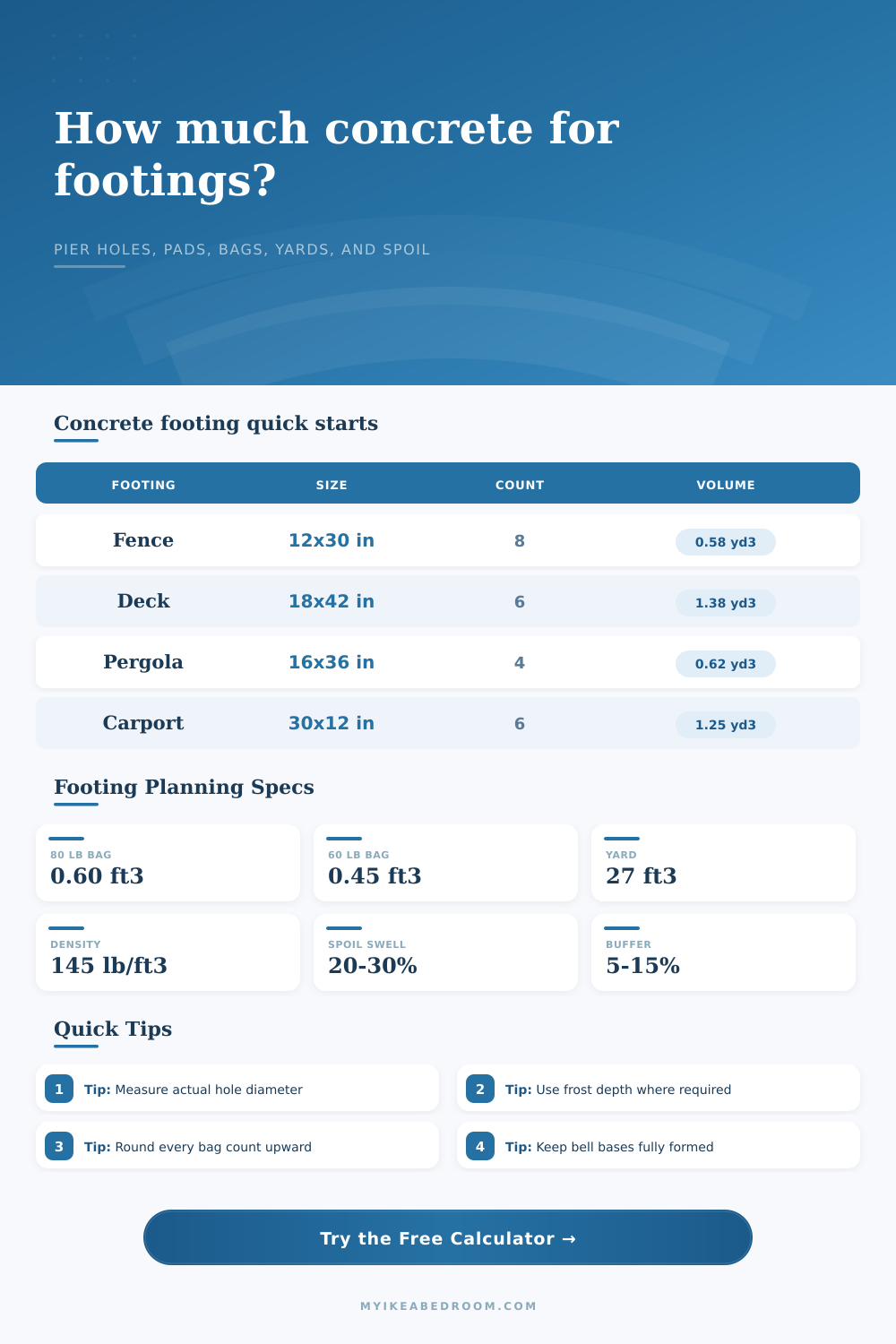
| 60 lb bag | 0.45 ft³ | 60 bags | 0.0127 m³ |
| 80 lb bag | 0.60 ft³ | 45 bags | 0.0170 m³ |
| 90 lb high-yield bag | 0.675 ft³ | 40 bags | 0.0191 m³ |
| Footing type | Rebar estimate | Spoil estimate | Use note |
|---|---|---|---|
| Round pier under 18 in diameter | 4 vertical bars plus ties | Concrete ft³ x 1.20 | Common deck or porch pier |
| Large round pier 18 to 24 in | 4 to 6 vertical bars plus ties | Concrete ft³ x 1.25 | Greater bearing and lateral load |
| Square pad footing | Two-way bottom mat | Pad ft³ x 1.15 | Cleaner forms reduce swell |
| Rectangular strip footing | Continuous longitudinal bars | Strip ft³ x 1.15 | Used below short bearing runs |
| Belled pier | Vertical cage into bell | Concrete ft³ x 1.30 | Hand-shaped base needs buffer |
Augers wander, sidewalls crumble, and hand-dug holes rarely stay perfectly round. For concrete volume, the actual average diameter controls the order quantity.
This tool calculates material quantities. Required diameter, bearing area, frost depth, reinforcement, anchor embedment, and inspection rules still come from the project design and local code.
How many times have you guessed by eye and bought more then you need? You see a hole that looks like maybe two bags will fill it, so you grab three just to be safe. Better get three…just in case. Okay, and now you’ve got extra mix from all your other holes, sitting hardening in buckets while you’re still trying to pour. Before you dig, calculate how much is actualy required so that you don’t waste money.
You don’t have to remember frustum formulas or cylinder ones because the calculator figures the geometry. From a list of choices, it calculates cubic yards from dimensions; then bags required by your supplier’s preference; and metric equivalents. You just understand that footings is structural anchors: they move the load from a deck or fence or porch down into ground, without sinking. Get the math wrong, and it will fail, and the structure sitting atop it might fall too.
How to Calculate Your Concrete Needs
Footing shape impact materials. If it’s rectangular strips or square pads, they’re going to use different amounts of material then round pier posts. Holes drilled with an auger frequently have crumbling edges, which eat up more concrete than you’d think from looking at clean hole inside a smooth cylinder. To compensate for irregular shapes you need a little bit of an overage buffer. You can add between five and twenty percent extra volume. This range protects against running out of mix while pouring. Go toward the high end if you’re digging holes by hand or in rocky soil.
One other variable that trips people up is depth. You might think 12 inches sounds deep enough to bury a fence post, but the frost line here where I live is deeper then that. When the soil freezes, it expand and pulls everything sitting on top of unfrozen soil upward. That means that if your footings are not buried beneath the frost line, posts will pop up in winter then settle back down come springtime. Depending on how deep you enter for depth, the calculator automatically changes its volume calculation based off what code requires (or how much research you do). It also factors in the use of a belled base, which give taller things such as pergolas added stability.
Logistics are different when using premixed bags instead of ready-mix trucks. For small projects, you get a strong, even mix in convenient bags. Just know that bagged concrete has a nominal yield and requires perfect mixing conditions and no waste. The number of 80-pound bags needed per cubic yard is listed on reference tables, so you can do some mental math in the hardware store. Because not all of the mix will adhere perfectly to your tools, or stay in the bucket, expect some spillage. Round up your bag count always because it’s cheaper to carry one more bag than drive back for another load.
But then there is the reinforcement. Which adds a layer of complexity that volume alone doesn’t cover, though the calculator does estimate weight. For example, steel rebar protects against cracking (under load) and gives tensile strength. This calculator will help estimate the weight and spoil but won’t tell you how much bar you’ll need (and what size), or how many ties you’ll need given your soil conditions. This takes some engineering judgment, or checking your local building codes, for that kind of detail.
You should of checked your measurements twice. It’s good to know how much weight all those pours are going to be so you can work out the logistics for moving everything in and around. There is two tons per cubic yard, and one way to move it is by hand. A good plan for how and when to get it from Point A to Point B is important.
Whether it’s a simple mailbox base or a complex carport foundation, precision is no waste when it comes to working with concrete. Whether you’re trying to pour an entire carport foundation or just a small base for your mailbox, careful measurement means getting just the right amount of concrete and a flat, sturdy structure. Precision also means not having extra concret laying around and knowing what exactly needs to go where from day one.