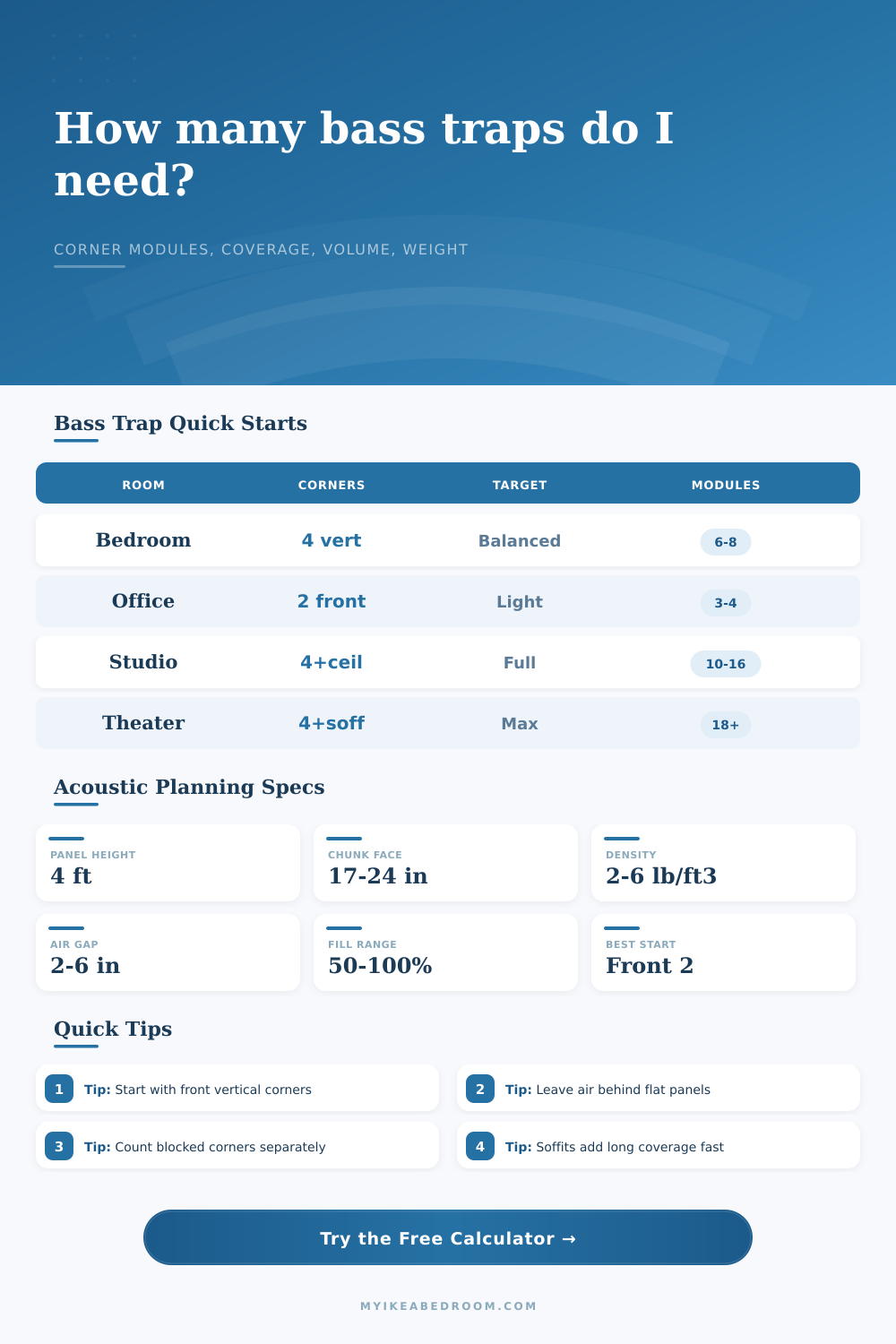
Bass Trap Quantity Calculator
Estimate how many bass trap modules fit your room corners, how much corner length they cover, the absorber volume inside them, and the approximate loaded material weight.
Choose a layout that resembles your room, then adjust blocked corners, ceiling runs, module width, absorber style, and target fill.
Wardrobe blocked corner
Quantity effect: subtract one full height corner before calculating.
Use ceiling runs above storage only if the face of the trap remains exposed.
Bed headboard corner
Quantity effect: short modules can still count if the lower part is hidden.
Plan coverage above the headboard when floor clearance is limited.
Mineral wool panel
Material effect: rectangular volume equals width × thickness × height.
A 2 to 6 inch rear air gap improves low-frequency reach.
Triangular superchunk
Material effect: triangular volume equals face width squared divided by 4.
Best when a corner can stay permanently filled from floor to ceiling.
| Target | Selected corner fill | Planning buffer | Typical use |
|---|---|---|---|
| Light control | 50% of chosen corner length | 0% | Desk corner, casual bedroom, or one listening seat |
| Balanced bedroom | 75% of chosen corner length | 5% | Bedroom listening, gaming, streaming, and small music rooms |
| Recording room | 100% of chosen corner length | 10% | Tracking, mixing, voice-over, and instrument practice rooms |
| Critical listening | 100% of chosen corner length | 15% | Theaters, control rooms, and symmetrical monitoring layouts |
| Trap profile | Module height | Volume formula | Default density |
|---|---|---|---|
| Straddling panel | 4 ft | face width × core thickness × height | 2 to 3 lb/ft³ |
| Triangular superchunk | 2 or 4 ft | face width² / 4 × height | 2 to 3 lb/ft³ |
| Ceiling soffit block | 4 ft | triangular face area × run length | 4 lb/ft³ |
| Membrane hybrid | 4 ft | face width × sealed depth × height | 6 lb/ft³ |
| Room layout | Primary corner network | Balanced 75% of 4 vertical corners | Full perimeter option |
|---|---|---|---|
| 10 ft × 10 ft × 8 ft office | 72 linear ft | 24 linear ft before buffer | 40 ft ceiling-wall run |
| 12 ft × 14 ft × 8 ft bedroom | 84 linear ft | 24 linear ft before buffer | 52 ft ceiling-wall run |
| 15 ft × 20 ft × 9 ft theater | 106 linear ft | 27 linear ft before buffer | 70 ft ceiling-wall run |
| 18 ft × 24 ft × 9 ft studio | 120 linear ft | 27 linear ft before buffer | 84 ft ceiling-wall run |
| Module | Face width | Core volume | Weight at density |
|---|---|---|---|
| 4 in panel, 4 ft tall | 24 in | 2.67 cu ft | 5.3 lb at 2 lb/ft³ |
| 6 in panel, 4 ft tall | 24 in | 4.00 cu ft | 12 lb at 3 lb/ft³ |
| 18 in superchunk, 2 ft tall | 18 in | 1.13 cu ft | 2.3 lb at 2 lb/ft³ |
| 24 in superchunk, 4 ft tall | 24 in | 4.00 cu ft | 10 lb at 2.5 lb/ft³ |
Corner priority: If you cannot treat every corner, calculate the front left and front right wall-wall corners first, then add rear corners, then wall-ceiling runs. Symmetry around the listening position usually matters more than filling one random corner completely.
Furniture allowance: Tall wardrobes, bookcases, beds, and doors reduce usable trap height. Count only exposed corner length where the absorber face can see the room; hidden material behind furniture does less acoustic work.
Studio monitors are sold for their ability to render what you’re hearing accurately; however, since bass is very sensitive to the dimensions of a room, not its speakers, small spaces can be unpredictable. As bass waves encounter corners, they bounce back into each other and stack up to form standing wave. This results in music sounding muddy or boomy from certain seating location. You could spend more on gear, but this issue is typically solved by treating your walls. Use something dense enough to absorb the energy being reflected back rather than bouncing it off a surface. To treat for bass you need to fill volume with heavy stuff that will slow sound wave down until it loses its energy as heat.
Common wisdom says to tack up some thin foam panel onto wall, but that’s not very effective at taming lows (you want density and thickness!). To find out how much material you should of use, enter your room’s shape and the type of trap you’re building (profile). The calculator then determines how much material are needed.
How to Fix Bass Problems in Your Room
If you make a superchunk corner trap it can hold less material per square foot than a flat panel, but it perform better because it spans area where pressure is greatest. The physical effect of sound-absorbing materials depends on what kind of trap you use: does it take up a lot of floor and wall space, or can you use an air gap to save room width? In one extreme case, a whole chunk of sound-absorbent material (a superchunk) takes up the whole corner of the room, with maximum absorption at the cost of consuming wall real estate and floor space. In another version, a flat panel hung off a frame creates an air gap that increases low-frequency absorption but doesn’t consume so much width. Switching between them in the tool gives you a feel for the tradeoffs, more acoustic coverage vs. It offers less visual clutter.
The tool will give you an estimate of how heavy your core material will be too (useful if you’re lifting any of those thing up by yourself). Furniture gets in the way of perfect acoustic plans, but there it sits. If you’re like me and have a studio set up at home then a wardrobe across one back corner won’t let you do a floor to ceiling trap on that corner. The calculator will take this into account by letting you deduct any corners that is blocked from treatment. So instead of wasting money by ordering treatment for areas behind furniture you can focus on just those corners nearest to your listening post that are visible on the front wall.
Often this is all that’s needed as symmetry matter over completeness. For example, treating two identical front corner balances the stereo image, keeping the image focused regardless of whether or not you’ve treated the back of the room too.
The density of the core material is critical to its effectiveness. Light fiberglass will allow lower frequencies to pass through if it is not deeply embedded. In contrast, thicker and denser materials like mineral wool can fit into tighter space while still being dense enough to work effectively. The chart below details commonly used densities and explains why using a heavier core is more than just a shipping expense, it’s also acoustically necessary to capture those pesky low end notes.
Avoid extra trips to the hardware store by planning it out. Ordering the right amount is key; not enough leaves gaps that ruin your treatment and wastes your money, but buying too much clutters your room and drains your budget. Before you cut any wood, estimate its total weight and core volume so that you can confidently make an organized shopping list. You will no longer have to guess how much sheet insulation to purchase or how much weight your floor joists can supports.
A balanced room is the goal, not a dead room. It is a place where the bass sits where it should in the mix instead of taking over the conversation. Identify the corners that are important to your listening position. Fill them with mass to dampen standing waves, and start there. Measure the results by ear and be careful to add more treatment if necessary because sometimes less is more when you’re trying to tame the worst resonances of a space without killing off the naturally liveliness of the space. The idea is control, not elimination.