Acoustic Panel Coverage Percentage Calculator
Estimate how much of a room surface is covered by acoustic panels, how that changes after NRC absorption weighting, and how many panels are needed for bedrooms, offices, gaming rooms, studios, and media spaces.
Load a room size, target surface, panel size, panel count, panel material, and acoustic target. Then adjust any field for your own layout.
Fabric Sofa
Absorption role: Helpful at speech frequencies when placed away from bare corners.
Planning use: Supports comfort but does not replace first-reflection panels.
Thick Rug
Absorption role: Reduces floor bounce and brightness above the low bass range.
Planning use: Pair with wall panels for balanced vertical and side reflections.
Bookcase
Absorption role: Mostly scattering and diffusion when shelves have varied depths.
Planning use: Helps break flutter echo but is not counted as panel face coverage.
Heavy Curtains
Absorption role: Moderate high-frequency absorption, especially with deep folds.
Planning use: Useful near glass, but thicker panels handle broader frequencies.
| Room use | Light treatment | Balanced treatment | Heavy treatment | Typical goal |
|---|---|---|---|---|
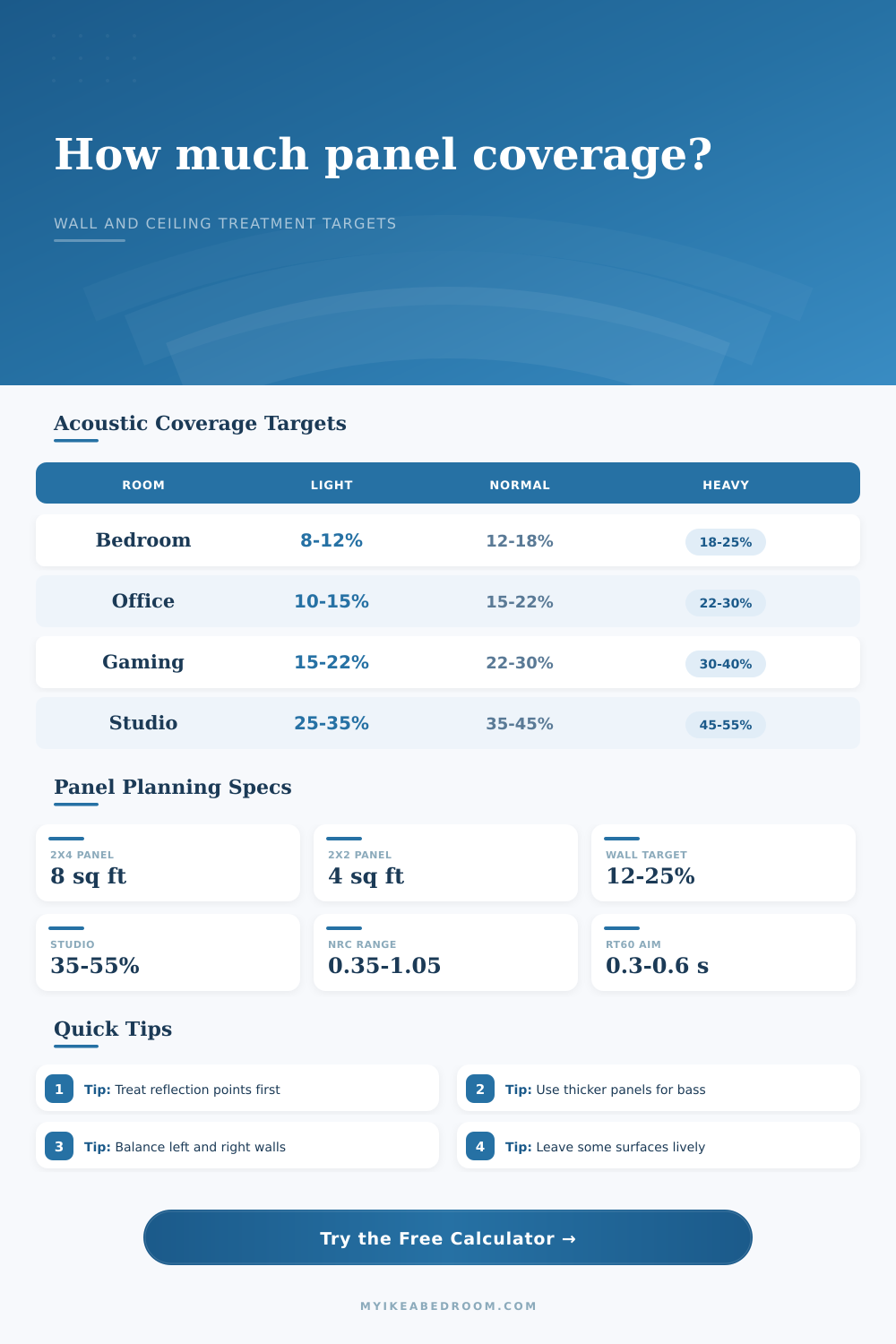
| Bedroom or nursery | 8-12% of selected walls | 12-18% | 18-25% | Reduce flutter while keeping the room natural |
| Home office and calls | 10-15% | 15-22% | 22-30% | Improve speech clarity and reduce slap echo |
| Gaming or media room | 15-22% | 22-30% | 30-40% | Control reflections around speakers and displays |
| Music practice room | 20-30% | 30-40% | 40-50% | Lower harsh reflections without making it dead |
| Podcast or vocal recording | 30-38% | 38-50% | 50-60% | Create a drier voice capture zone |
| Treatment surface | Formula in square feet | Best for | Coverage meaning |
|---|---|---|---|
| First-reflection wall zones | 0.35 x all wall area | Bedrooms, desks, stereo listening | Panels cover the most important reflection zones |
| Front and back walls | 2 x width x height | TV rooms, gaming rooms, recording desks | Coverage across the two short walls |
| Side walls only | 2 x length x height | Speaker side reflections and flutter paths | Coverage across the two long walls |
| All wall surfaces | 2 x (length + width) x height | General room absorption planning | Panel area as a percent of total wall area |
| Walls plus ceiling | wall area + length x width | Studios, practice rooms, hard floors | Panel area compared with walls and ceiling together |
| Ceiling cloud only | length x width | Desk clouds, drum rooms, vocal zones | Coverage of the ceiling plane only |
| Panel size | Face area | Metric area | Panels for 100 sq ft | Typical placement |
|---|---|---|---|---|
| 24 in x 48 in | 8.00 sq ft | 0.74 m2 | 13 panels | Side walls, front wall, ceiling clouds |
| 24 in x 24 in | 4.00 sq ft | 0.37 m2 | 25 panels | Modular grids and small reflection zones |
| 16 in x 48 in | 5.33 sq ft | 0.50 m2 | 19 panels | Narrow wall bays and door-side layouts |
| 12 in x 12 in | 1.00 sq ft | 0.09 m2 | 100 tiles | Small foam or felt patterns |
| 600 mm x 1200 mm | 7.75 sq ft | 0.72 m2 | 13 panels | Metric broadband wall panels |
| 48 in x 48 in | 16.00 sq ft | 1.49 m2 | 7 clouds | Ceiling clouds over desks or seating |
| Material or assembly | Planning NRC | Best frequency range | Coverage adjustment | Notes |
|---|---|---|---|---|
| 2 in fabric-wrapped mineral wool | 0.95 | Broadband mids and highs | Count near full face area | Reliable first-reflection panel choice |
| 4 in broadband panel with air gap | 1.05 | Lower mids through highs | Strong absorption-weighted coverage | NRC can exceed 1.00 in lab ratings |
| 1 in open-cell foam tile | 0.40 | Upper mids and highs | Needs much more area | Useful for flutter, weak for low frequencies |
| 2 in acoustic foam wedge | 0.70 | Mids and highs | Moderate absorption-weighted coverage | Less broadband than dense fiber panels |
| 12 mm PET felt panel | 0.35 | High frequencies | Decorative partial coverage | Good for visual wall fields and light echo |
| Wood slat over mineral wool | 0.80 | Mixed absorption and scattering | Count as partial broadband treatment | Backing depth strongly changes result |
Coverage target tip: For normal bedrooms and offices, start with the first-reflection zones before treating every wall. A lower percentage in the right places usually performs better than thin panels spread randomly.
Absorption balance tip: If the calculator shows high physical coverage but low absorption-weighted coverage, the panel material is probably too thin or too low in NRC for the room goal.
These are acoustic panels. If you’re here, you probably want to buy some acoustic panel because your room sounds like a tin can. Most people slap up a few squares of foam and wonder why echo is still there. The problem isn’t usually the material; it is the math. It’s about the math. You must cover enough surface area so as to absorbs enough of the sound waves bouncing around your room.
That calculator calculates your current surface area. It shows what that means for absorption and how many panels you need to get where you want to be. Begin with either one of the room presets or input your dimensions. Length. Width. Ceiling Height. All this data tell you the total amount of space to be treated.
How to Calculate Acoustic Panels for Your Room
Next, choose which surfaces will be covered. Maybe it’s simply the closest reflection points right around your ear. Perhaps it is the entire ceiling and walls. This makes a difference as “percentage of coverage” is actualy a ratio. It calculates the ratio of your panel surface area to the total area being covered. Ten percent coverage on your side wall appears very different than ten percent coverage in an entire room.
So we have our dimensions. What’s the next critical input? It is the panel material. Not all panels absorbs sound the same. A low noise reduction coefficient means a thin foam tile stops high frequencies but allows bass to bounce right through it. High NRC: A thick, fabric-wrapped mineral wool panel absorbs more energy across a wider range of frequencies.
The calculator accounts for this. It provides two results: first, physical coverage, which is just the visual percentage of wall covered by panels. Second is absorption-weighted coverage, which account for how well those panels actualy stop sound. Fifty percent thin foam might absorb less energy in a room then twenty-five percent thick wool.
Homeowners typically overestimate their required amount of treatment. They desire to totally quiet the room. But when a space becomes overly dry, it sound unnatural and flat. You lose the sense of size and air. It feels like there is no air or sense of space. Balanced targets are indicated on the table on the page.
For comfort, most bedrooms require just eight to twelve percent coverage. Media spaces like gaming rooms may need up to twenty to thirty percent to manage reflections off screens and speakers. Recording studios demand even more, sometimes up to forty to fifty percent, as needed for keeping vocal recordings clean. You aren’t trying to kill the soul of the room, but rather tame the slap echo.
And then there’s furnitures. Thick rugs can absorb high-pitched sound bouncing off the floor. Heavy curtains will help with reflections off windows. But they’re an inconsistent element. They don’t replace dedicated panels for mid-range frequencies where speech clarity lives. The panels you install will be the main factor in this equation, and that’s why the calculator treats them as such. How much your sofa absorbs is dependent on its depth, its material, and its distance from wall.
Plan location prior to purchase. Treat the first reflection points. These are the locations on the wall behind where you sit to listen and between which your speakers is placed. These will yield the greatest improvement with the smallest application of materials. Spreading out panels around all the walls may result in achieving only 20% coverage yet missing the critical reflections causing flutter echo. Balance is important here, symmetry also helps. Treating both side walls similarly maintains a centered stereo image.
Don’t freak out if the math tells you that you need thirty of these things to get up to the goal level of absorption. Phase in the install. Install the ones that correspond to the first reflection. Hear how it sounds. Add additional absorbers if it’s still too muddy/bright. Check the absorption-weighted number: does your existing material do enough? If not (even though there’s a lot of it physically), try adding some airspace behind them, or switching to something thicker. You should of tried different thicknesses first.
Acoustic treatment isn’t all or nothing. Fill every square inch with foam? No. Acoustic treatment is controlling energy where it needs to be controlled. It should provide clarity, not sterility. Find the sweet spot with the tool. Plan your installation instead of doing it on a whim. Target the midpoint in your room’s targeted range. Measure by % of absorption, not visual coverage. Make the room sound comfortabley, controlled, and natural for how you plan to use it.