Hot Tub Pad Size Calculator
Estimate the pad footprint, support area, concrete or base volume, filled spa load, bag count, and bulk material for square, rectangular, and round hot tub pads.
Choose a real spa size to fill the calculator, then adjust clearance, weight, water capacity, or pad material.
Full calculation breakdown
Patio lounge set
Typical load: 10 to 25 psf while occupied.
Usually spreads weight through chair feet and tables, so pad area is mainly about layout space.
Outdoor dining set
Typical load: 20 to 45 psf during use.
Chairs move around the table, so clearance matters more than a fixed heavy footprint.
Filled hot tub
Typical load: 70 to 125 psf for many portable spas.
Water creates a permanent load that should be calculated from the filled spa footprint.
Swim spa
Typical load: 90 to 160 psf depending on gallons.
The long footprint raises total pad volume even when the load per square foot looks moderate.
| Item | Formula value | Metric equivalent | Used in calculator |
|---|---|---|---|
| Water weight | 8.34 lb per US gallon | 0.998 kg per liter | Water load = gallons x 8.34 |
| Bather allowance | 185 lb per person | 83.9 kg per person | Bather load = people x 185 |
| Square footage | Length x width | sq ft x 0.092903 | Pad area and tub footprint |
| Round footprint | 3.1416 x radius squared | sq m from converted radius | Round tub and pad area |
| Load pressure | Filled lb / tub sq ft | 1 psf = 0.04788 kPa | Filled load result card |
| Spa type | Tub footprint | Pad footprint | Pad area | Typical water |
|---|---|---|---|---|
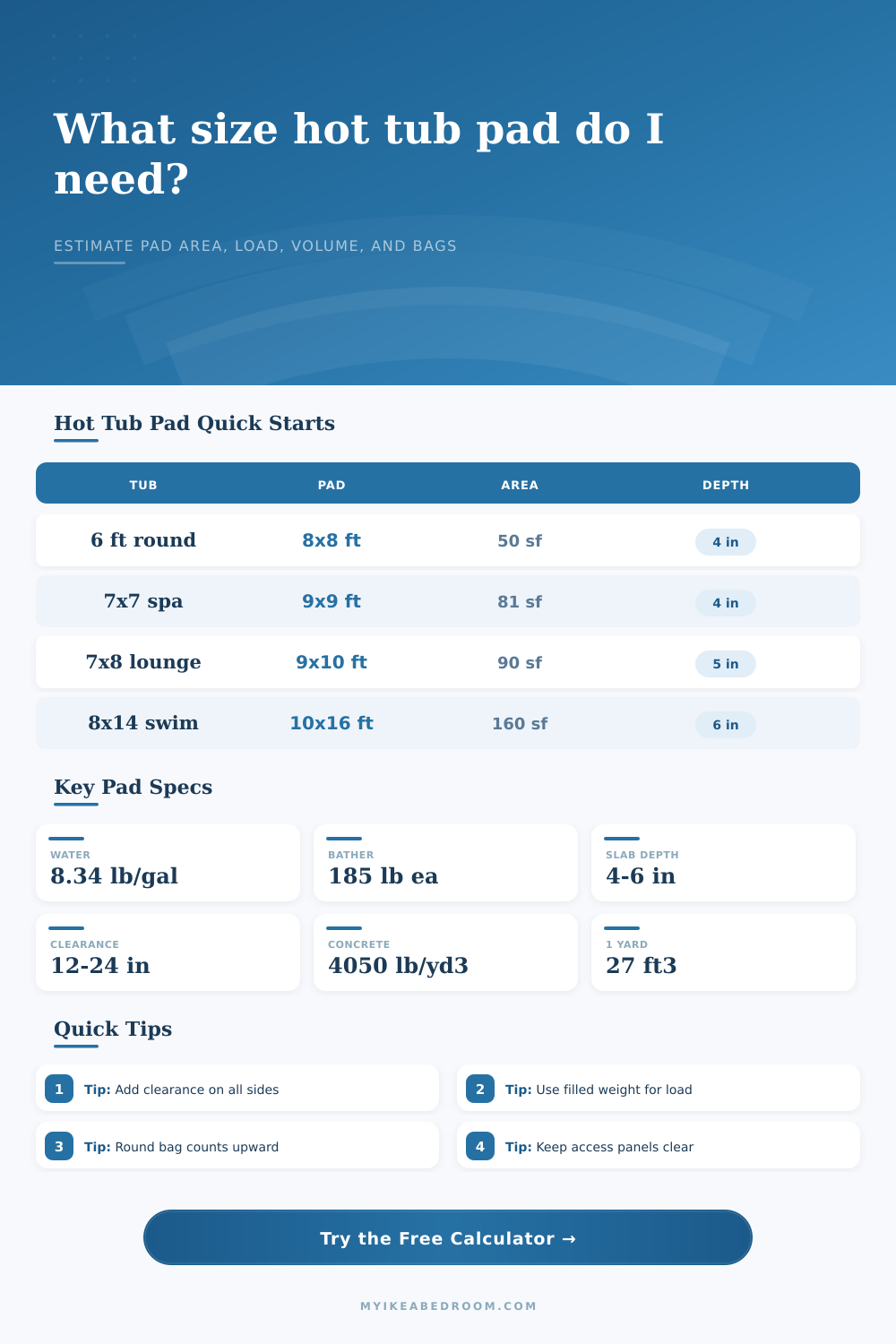
| Compact round inflatable | 6 ft diameter | 8 ft diameter pad | 50.3 sq ft | 210 to 260 gal |
| Small plug-in square | 6.5 x 6.5 ft | 8.5 x 8.5 ft | 72.3 sq ft | 250 to 320 gal |
| Four to five person spa | 7 x 7 ft | 9 x 9 ft | 81 sq ft | 320 to 400 gal |
| Lounge spa | 7 x 8 ft | 9 x 10 ft | 90 sq ft | 375 to 475 gal |
| Large square spa | 8 x 8 ft | 10 x 10 ft | 100 sq ft | 450 to 600 gal |
| Swim spa | 8 x 14 ft | 10 x 16 ft | 160 sq ft | 1,200 to 1,700 gal |
| Pad depth | Volume per 100 sq ft | Metric volume | 80 lb concrete bags | 0.5 cu ft aggregate bags |
|---|---|---|---|---|
| 4 in | 33.3 cu ft / 1.23 cu yd | 0.94 cu m | 56 bags before buffer | 67 bags before buffer |
| 5 in | 41.7 cu ft / 1.54 cu yd | 1.18 cu m | 70 bags before buffer | 84 bags before buffer |
| 6 in | 50.0 cu ft / 1.85 cu yd | 1.42 cu m | 84 bags before buffer | 100 bags before buffer |
| 8 in | 66.7 cu ft / 2.47 cu yd | 1.89 cu m | 112 bags before buffer | 134 bags before buffer |
| Material | Density used | Bag yield used | Bags per cubic yard | Calculator buffer |
|---|---|---|---|---|
| Ready-mix concrete | 4,050 lb per cu yd | 0.60 cu ft per 80 lb bag | 45 bags | 8 percent |
| Crushed stone | 2,700 lb per cu yd | 0.50 cu ft per small bag | 54 bags | 12 percent |
| Crusher run | 2,750 lb per cu yd | 0.50 cu ft per small bag | 54 bags | 12 percent |
| Paver base aggregate | 2,650 lb per cu yd | 0.50 cu ft per small bag | 54 bags | 12 percent |
So you’ve got your portable hot tub delivered and it’s sitting on its pallet, just waiting to be placed in its new home. Before you ask the guys to lift it out of the truck onto your lawn, test the surface where it will sit. If you underestimate weight distribution, it could crack driveway and/or cause the entire structure to sink down into the lawn. The weight of all the water and equipment can do some serious damage if the base isn’t solid. Not only does this mean there won’t be enough room to walk around it…but that you might end up damaging your yard.
The foundation of any hot tub (referred to as a hot tub pad) is more than just piece of concrete. It is a structural foundation that has to resist soil compression. It must also resist hydrostatic pressure from water above it and dynamic loads from bathers getting in and out. Each gallon of water weigh approximately eight point three pounds, which makes water a surprisingly heavy thing. A typical spa measures seven by seven feet so if we fill that with 400 gallons of water, we have close to three thousand pounds of water resting on a hot tub pad of less than 50 square feet. Add the weight of bathers, pumps, and shell. This brings the total load on your hot tub deck to almost six thousand pounds. Without some type of engineering to support the ground underneath this load, it will shift and eventually fail.
How to Build a Strong Base for Your Hot Tub
To find out exactly what footprint you need for your model, follow the link above to a calculator. It will tell you minimum footprint required based off your cabinet size. You should also add additional spacing for clearances. This is so the tub does not sit right up against the outside of its supporting base. There must be enough room under the spa to allow proper air flow and some wiggle room for any settling or cleaning access. When the spa extend past the base this concentrates loads dramatically in the corners and can cause failure of the supports.
To decide on materials you have to sacrifice either drainage or rigidity. Concrete offers a solid, immovable platform that distributes weight evenly across its thickness. For smaller units four inches thick should suffice. Larger, heavier swim spas may need six inches of reinforced concrete to prevent cracking under the weight. An alternate material is gravel which allows water to run off rather than collect at the foot of the unit. But gravel needs to be compacted and placed in layers with geotextile fabric, otherwise loose rock will migrate over time. So you’re deciding between making a flat rock pad or having better drainage.
Based on these measurements, it calculates how many bags of materials will be needed. What most people find is they order exact amount that is calculated out and end up running short. You’ll need extra material for compaction, spillage, and leveling uneven ground. The calculator also provides a cushion to the final number based off volume to make sure you don’t run out mid install. It then rounds up on the bag numbers making sure you’ll have all the gravel or concrete to complete your project without having to wait on another delivery.
The requirements for footing depend on what kind of soil you have, too. A clay soil will need more depth, as it swells and contracts with moisture changes (expanding in wet periods, shrinking in dry ones). On sandy soils that drain fast, the ground can shift. Unless you live in a place where this is normal (as opposed to typical uniform support), you might need even more depth then recommended here, depending on local conditions. Dig down first to inspect your soil; it’s easier, and cheaper. Than fixing problems later.
It must hold up to being filled and emptied several times per year. Every fill and empty will change the stress on the pad. That means that the pad structure has to absorbs those stresses and not degrade. Ideally, a good pad should outlast the spa (usually 15-20 years). Cutting corners on the base now can lead to major issues down the road, where a bad slab may need to be replaced this coming winter. Invest wisely in enough aggregate now; don’t penny pinch and then have to pay big time later. No quick fixes here; it’s all about physics and smart planning.
Water has weight, as does the cabinet, which won’t be denied. But you can plan to deal with their influence. Volume of materials and right dimensions go a long way toward mitigating any structure-related problems into a doable weekend endeavor. We’re looking for something solid and flat, set it and forget it time for fun in the sun! Plan well from the get-go, and the install will go well.