Artificial Grass Quantity Calculator
Estimate artificial turf roll length, strip count, seam count, turf area, waste allowance, joining tape length, infill quantity, and pile-direction layout score for balconies, pet runs, play zones, putting corners, rooftops, and garden shapes.
Load a turf shape, roll width, pile direction, seam allowance, perimeter cut margin, waste, tape buffer, and infill rate, then adjust any field.
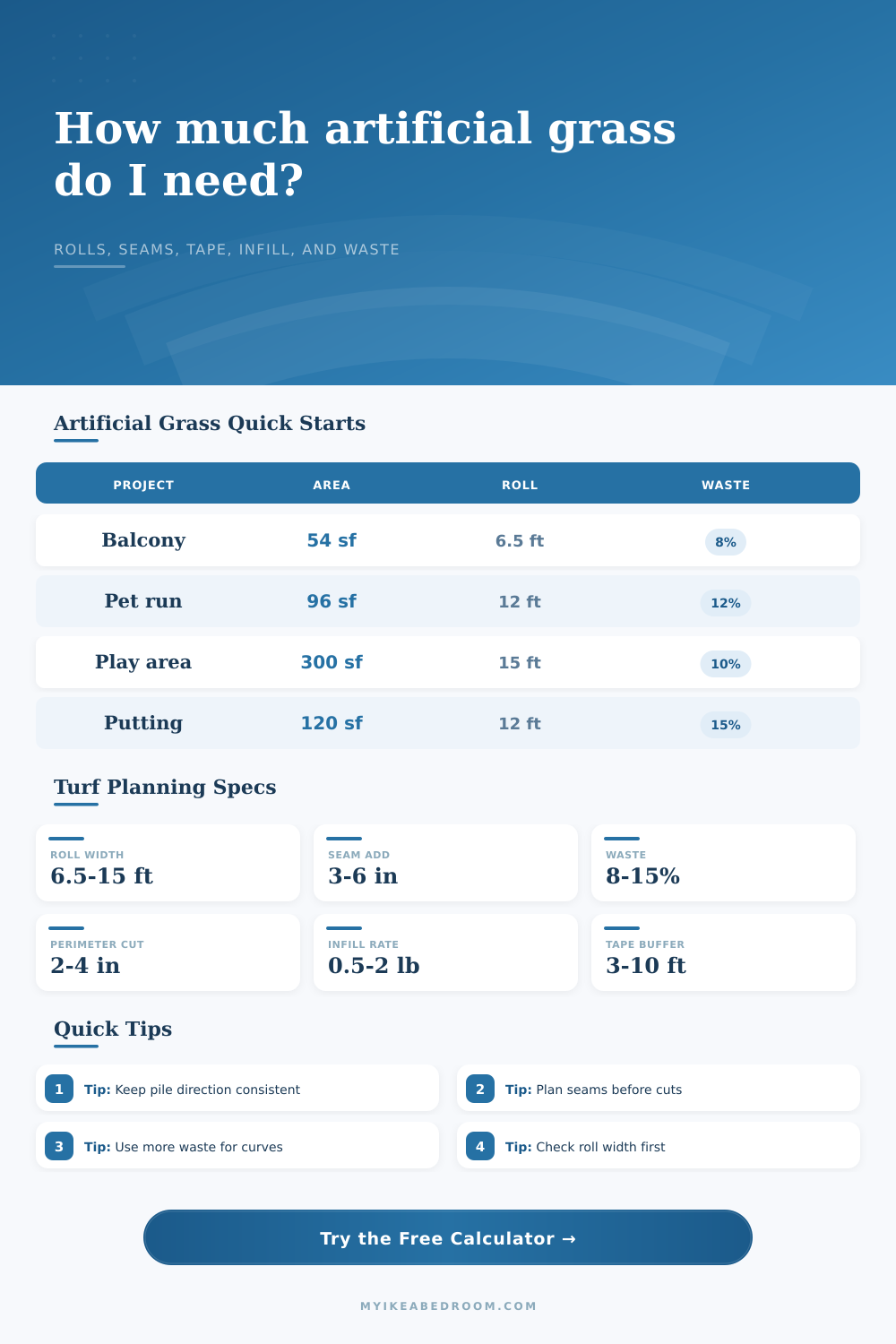
Balcony Turf
Typical roll: 6.5 ft to 12 ft wide.
Waste: 6 to 10 percent for straight rail edges.
Best layout: pile runs toward the main view when seams stay low.
Pet Turf
Typical roll: 12 ft or 15 ft wide.
Waste: 10 to 15 percent for drain cuts and gates.
Best layout: fewer seams across the main traffic lane.
Play Lawn
Typical roll: 15 ft wide where available.
Waste: 8 to 12 percent for rectangular zones.
Best layout: pile aligned across all strips, not mirrored.
Putting Turf
Typical roll: 12 ft or 15 ft wide.
Waste: 12 to 18 percent for curves and fringe cuts.
Best layout: planned seam locations away from cup lines.
| Roll width | Best fit area width | Likely seams | Planning note |
|---|---|---|---|
| 6.5 ft roll | Small balconies and runners | 0 to 2 seams | Useful where elevator or tight access limits roll handling. |
| 12 ft roll | Pet runs, side yards, patios | 0 to 1 seam on many narrow jobs | Good balance of fewer seams and easier handling. |
| 15 ft roll | Play areas and lawns | Lowest seam count on wide rectangles | Often reduces tape length but may increase offcut on narrow strips. |
| Custom narrow roll | Putting lanes or roof paths | Depends on direction | Check pile direction before choosing a strip orientation. |
| Shape | Turf area formula | Perimeter formula | Waste cue |
|---|---|---|---|
| Rectangle or strip | Length x width | 2 x length + 2 x width | 8 to 10 percent works for square cuts. |
| L-shaped area | Length x width minus cutout squared | Outer rectangle plus two cutout legs | Add waste for inside-corner trimming. |
| Triangle corner | 0.5 x length x width | Two legs plus diagonal | Diagonal offcuts often need 12 percent or more. |
| Custom measured area | Entered area | Entered perimeter | Use field measurements for curved gardens. |
| Use case | Planning rate | Result formula | Notes |
|---|---|---|---|
| Balcony or display turf | 0.4 to 0.7 lb per sq ft | Area x rate | Low traffic turf may need only light blade support. |
| Pet run | 0.8 to 1.2 lb per sq ft | Area x rate | Use the product-specific drainage and odor-control guidance. |
| Play lawn | 1.0 to 1.6 lb per sq ft | Area x rate | Higher traffic usually needs more even brushing and support. |
| Putting corner | 1.5 to 2.2 lb per sq ft | Area x rate | Putting surfaces depend on turf style and desired speed. |
| Project | Starting dimensions | Roll direction cue | Typical waste |
|---|---|---|---|
| Balcony turf | 9 ft x 6 ft rectangle | Pile toward view, if seams stay acceptable | 6 to 10 percent |
| Pet run strip | 24 ft x 4 ft strip | Run pile with length to keep seams long and few | 10 to 15 percent |
| Play area | 20 ft x 15 ft rectangle | Use widest roll, align every strip the same way | 8 to 12 percent |
| Putting corner | 12 ft x 10 ft L-shape | Avoid seams through cup and stroke lines | 12 to 18 percent |
| Irregular garden | 145 sq ft custom | Measure the perimeter before choosing roll width | 12 to 18 percent |
Do not flip one strip to save offcut unless the visual direction still matches. Reversed pile can look like a different color even when the turf comes from the same roll.
Waste allowance covers trimming and offcuts, while joining tape follows seam length. Add a tape buffer for starts, stops, curves, and repairs near drains or posts.
Then you find yourself standing on bare ground with a realization: Your lawn is going to be very green, very soon, and also perhaps very expensive if you fail to do this right. Artificial grass is like paint for most homeowners; you figure, I’ll order enough rolls to cover my lawn area, then I’ll cut them to fit. Turf doesn’t shrink, it doesn’t stretchs, and it won’t forgive sloppy arithmetic at the end. That’s why most people gets this wrong.
Once you enter your measurements into the calculator above, it will do the heavy lifting for you. It saves you from having to guess how much extra waste allowance you should of add to something that is curved instead of flat. Waste isn’t some abstract concept; it’s a pile of offcuts left in your driveway until you plan to handle them.
How to Plan Your Fake Grass Project
What does all this mean? Let’s start at the beginning: Why did the tool request shape before asking for size? A rectangle is easy to handle because straight cuts mean less trimming and less waste. A triangle or an L-shape introduces diagonal cuts, which means more waste creeping into your budget. A perimeter cut margin is also added when the calculator handles anything that doesn’t look like a rectangle. This happen because you can’t line up the straight edge of the roll with the curved edge of your flower bed without giving up some material.
That’s what the layout score on the output represents. It’s not a judgment about how good-looking your project looks; rather, it’s a diagnostic of how much friction you’ll encounter during install. A higher number mean there are fewer seams and less need for tape. This creates a more uniform surface and makes it less likely that seams will show through later.
I said seams were the weak spot for any turf install, and that’s true. But it is not because they fail. They’re the weak spots because you can see them. If your pile isn’t going the same way on both sides when you join a strip, you have a visible break (and you’ve created a bit of a trip hazard). Seam allowance is accounted for in the calculator, it’s the amount you’ll trim off to line up your edges perfectly. And it will account for joining tape as well, with a buffer since nothing goes exactly according to plan in real world.
Two seams? You’ll think “oh, I only need 50 feet of tape.” But then you hit a tree root or a drain pipe, and make another cut. A four-foot buffer isn’t padding; it protects you against one of those awkward stops in the middle of the work.
Another variable is infill quantity, which seems like an afterthought until you are actualy standing on your flattening lawn. The tool automatically factors this in based off what kind of turf you have. For example, a high-traffic pet run require more support than a decorative balcony strip. Less granular matter gets the job done for lighter-traffic spots; high-use play zones need enough weight to stabilize the backing and hold the blades up right. Skimp on this part, and the turf mats down beneath your feet, its resilience lost in mere months.
The tables is a start, a reference, but your own real-world pattern of use will help determine if you’re inclined towards the one-pound-per-square-foot end of things (or more like two).
The choice of roll width is both a geometry problem and a logistics problem: Obviously wider is better (fewer seams) except that it’s harder to transport (up narrow stairways, around tight corners). The calculator lets you compare these tradeoffs by showing how strip count changes with width. Width. Two narrower rolls may be easier to manage than one wider, despite the small increase in seam count. That’s where layout score comes back into play. It flags cases where an extra seam can be tolerated due to handling issue, and other times it cannot.
All in all, however, I’d say the bottom line for fake turf is that you need careful planning up front so that what you get looks easy down the road. While the calculator help take out the guesswork of how much material is needed, it’s no substitute for thoughtful prep. Plan out your space well, evaluate how you’re going to get the rolls where they need to go, and determine pile direction before making the initial cuts. Once you have the numbers, it is simply a matter of executing, and knowing ahead of time how many seams you will have makes this part a lot less stressful. If you do the math right, the green carpet won’t be the only thing looking good.