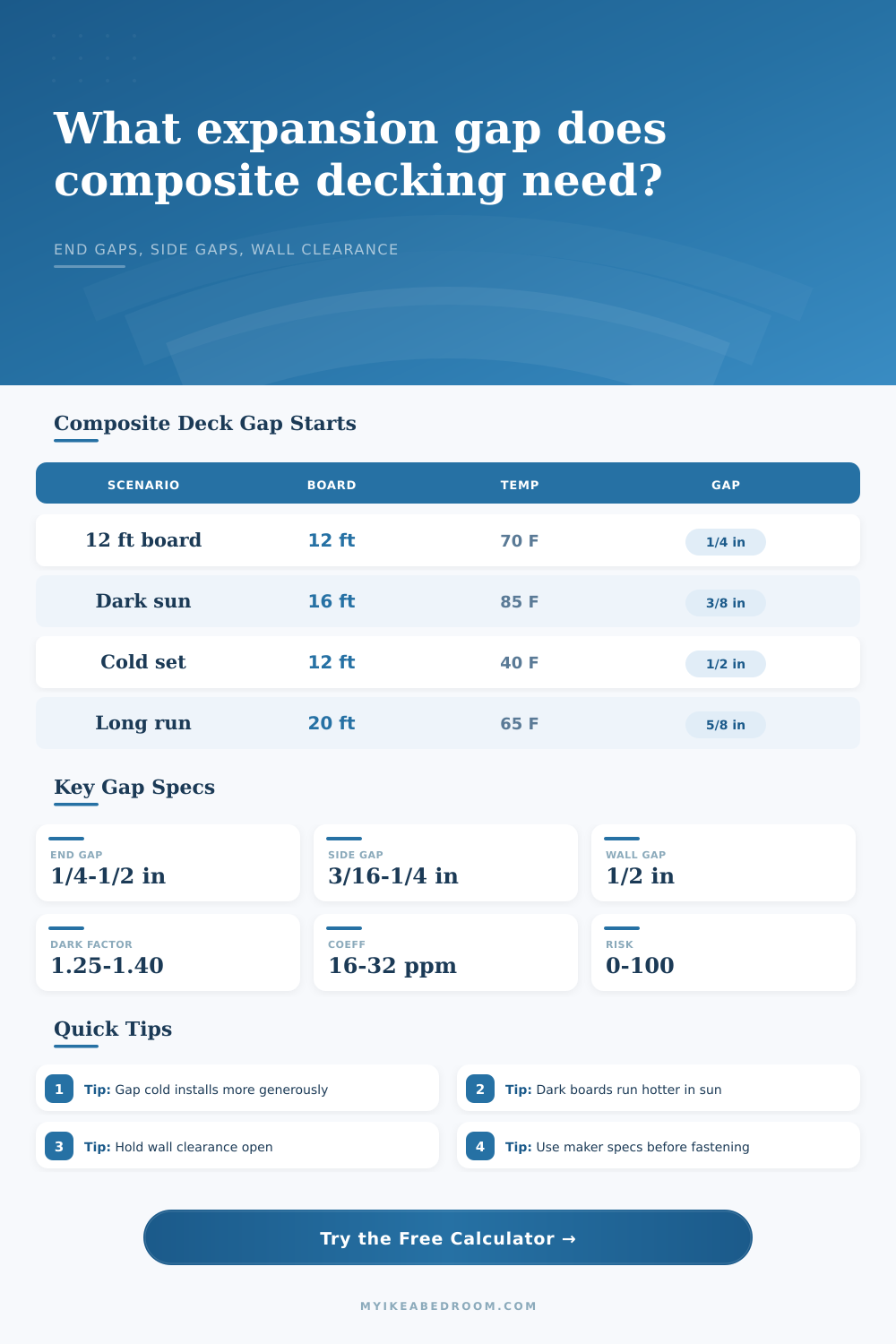
Composite Decking Expansion Gap Calculator
Estimate thermal board movement, recommended butt-end gap, side gap, wall clearance, cumulative long-run movement, and a risk score for composite, capped composite, PVC, and mineral composite deck boards.
Each preset loads board length, install temperature, expected seasonal temperatures, material coefficient, target gaps, color heat factor, and longest end-to-end run.
Expansion gap results
| Result | Formula | What it means | Planning note |
|---|---|---|---|
| Hot expansion | Length x coefficient x hot temperature rise x heat factor | Board growth from install temperature to hottest board temperature | Used to size the end gap and wall clearance |
| Cold contraction | Length x coefficient x cold temperature drop | Board shrinkage from install temperature to lowest board temperature | Used to flag wide winter opening potential |
| Recommended end gap | Greater of target gap or hot expansion plus reserve | Minimum butt-end space for the selected board | Manufacturer instructions should be the final authority |
| Cumulative movement | One-board expansion x boards in longest run | Total potential movement across a continuous end-to-end line | Useful near picture frames and fixed borders |
| Material category | Typical coefficient | Best gap focus | Use this when |
|---|---|---|---|
| Mineral-based composite | 10 to 16 ppm/F or 18 to 29 ppm/C | Perimeter clearance and picture frames | Product literature lists a low movement board |
| Wood-plastic composite | 16 to 24 ppm/F or 29 to 43 ppm/C | End gaps at butt joints | Standard capped composite deck boards |
| HDPE-rich composite | 24 to 34 ppm/F or 43 to 61 ppm/C | Long runs and hot sun exposure | Plastic-rich boards or high heat sites |
| Cellular PVC decking | 28 to 40 ppm/F or 50 to 72 ppm/C | End gaps, breaker boards, and fixed edges | PVC or polymer deck boards in full sun |
| Board exposure | Heat factor | What changes | Calculator use |
|---|---|---|---|
| Light board or shaded balcony | 1.00 | No extra hot-side multiplier | Use for covered decks and pale colors |
| Medium color with mixed sun | 1.10 | Slightly higher board surface temperature | Use for ordinary part-sun layouts |
| Dark board in normal sun | 1.25 | Hot-side expansion receives a larger allowance | Use when boards feel noticeably hotter than air |
| Dark board in full sun heat | 1.40 | High heat magnifies end-gap demand | Use for exposed south or west facing decks |
| Deck condition | Typical end gap target | Typical side gap | Typical wall clearance |
|---|---|---|---|
| Warm install with short 12 ft boards | 1/4 in or 6 mm | 3/16 in to 1/4 in | 1/2 in or 13 mm |
| Cold install before summer heat | 3/8 in to 1/2 in | 1/4 in | 1/2 in to 3/4 in |
| Dark boards in direct sun | 3/8 in or greater after formula check | 1/4 in | 5/8 in or greater if fixed |
| Picture-frame or breaker-board detail | Formula gap plus reserve | Manufacturer clip spacing | Hold fixed-edge clearance open |
| Long end-to-end board run | Check cumulative movement | Keep drainage side gap open | Break movement with planned seams |
Dark composite can run far hotter than nearby air. If you only know air temperature, choose a stronger heat factor or use the deck-board surface temperature after sun exposure.
Picture frames, house walls, posts, and breaker boards are where small gap errors become visible. Keep perimeter clearance open and split long runs where the cumulative movement gets high.
It’s a nice straight line. You have a board in your hands made from composite material and a drill. Summer comes around, hot days warm up the deck, and boards expands until the seams dissapears. Now they might be buckling up on each other or even crowning. What happened? Often, you installed them on a warm day and didn’t think about what the surface temp would be like when you installed the floor.
Sure, composite decking holds up great. It’s low maintenance. But it also expands with heat. If you don’t give yourself room to grow, you’re going to have some funky looking distortion in your deck. The temperature of the air is not the same than the temperature of what you’re working with outside. Maybe your phone reads seventy degrees out there so you space the boards a quarter inch apart. That’s not the case with that dark plank. In direct sunlight it will be absorb sunlight and feel like a hundred and twenty degrees or more.
Why You Must Leave Space Between Deck Boards
Why does this matter? Because wood expands according to its material temperature and not the temperature of air around it. There is a reason the calculator gives you the right math for your situation. Plug in the details and it’ll tell you if a quarter inch or half inch are the way to go. It is physics, not guesswork.
The rate of expansion is different based off the type of material as well. You can choose between PVC, a capped version, a mineral mix or even wood-plastic composites. And each expands at different rates. For example, a dense mineral composite doesn’t expand and shrink as much with temperature changes as a cellular PVC board. So for every degree that the temperature change, it will move more. Install them side-by-side and one will fit perfectly in place while the other will try to bulge into joist space. Adjust your gap strategy to match the material properties.
Decking has cumulative movement. Long runs of decking will show this movement. Each board expands perhaps a sixteenth of an inch between winter and summer. That sounds insignificant. But times 20 (boards laid end to end) and you see the cumulative effect. At the far end, total move may exceed an inch. The problem arises if there is insufficient perimeter clearance. Instead of moving outward as they should, expansion forces push upward, forming ridges around all four sides. A table show board length and material properties. These are small details, but they are important for the long life of the structure.
Certain conditions make for tricky installs. Laying down decking in January? Well, guess what, your boards will be contracted and already short. So you think, oh I’ll just use a smaller gap because it’s shorter! That is wrong. Now you has to give them even MORE space because they will expand in the summer. If you install it too tight in the middle of winter, it would of buckle by July. This is one of those counterintuitive things that trip up a lot of folks who are thinking about the immediate temperature only.
Before you drive in that first screw: Step back. Examine the plank color. Note the extremes of your local temperatures. Measure distance between the boards across the deck. That moment’s math will save you from weeks of repairs down the road. Let ’em breathe; they’ll stay smooth for years.