Decking Clip Quantity Calculator
Estimate deck board rows, joist crossing count, hidden clips, starter clips, edge clips, spares, and box quantities for grooved or edge-fastened decking layouts.
🔧Decking Clip Presets
Load a common deck scenario, then adjust the actual board width, gap, joist spacing, clip box size, and waste percentage.
⚙Deck Fastener Inputs
Decking Clip Results
📦Clip Pack Comparison
🗒Clip / Board Comparison Grid
Grooved Composite
Usually one hidden clip at each board gap and joist crossing, with starter or edge clips on the outside rows.
PVC Decking
Often follows composite-style clip counts, but expansion gaps and border details can add edge fasteners.
Hardwood Boards
Clip systems may use specialty biscuits or screws; dense boards can need extra edge and butt-joint allowance.
Picture Frame
Perimeter boards may need starter, edge, or doubled clips where field boards meet the border frame.
📊Decking Fastener Reference Tables
| Deck length | 12 in spacing | 16 in spacing | 24 in spacing |
|---|---|---|---|
| 8 ft run | 9 crossings | 7 crossings | 5 crossings |
| 12 ft run | 13 crossings | 10 crossings | 7 crossings |
| 16 ft run | 17 crossings | 13 crossings | 9 crossings |
| 20 ft run | 21 crossings | 16 crossings | 11 crossings |
| Deck width | 3.5 in board | 5.36 in board | 5.5 in board |
|---|---|---|---|
| 4 ft wide | 13 rows | 9 rows | 9 rows |
| 8 ft wide | 26 rows | 18 rows | 17 rows |
| 12 ft wide | 40 rows | 27 rows | 26 rows |
| 16 ft wide | 53 rows | 35 rows | 34 rows |
| Style | Starter row | Far edge row | Use when |
|---|---|---|---|
| Standard starter and edge | 1 per crossing | 1 per crossing | Common grooved board layout |
| Starter only | 1 per crossing | Not counted | Far edge is face-screwed or trimmed |
| Double edge | 1 per crossing | 2 per crossing | Perimeter or high-hold edge details |
| Face-screwed outer rows | Not counted | Not counted | Hidden clips start after outer rows |
| Project | Assumption | Base clips | Boxes at 90 |
|---|---|---|---|
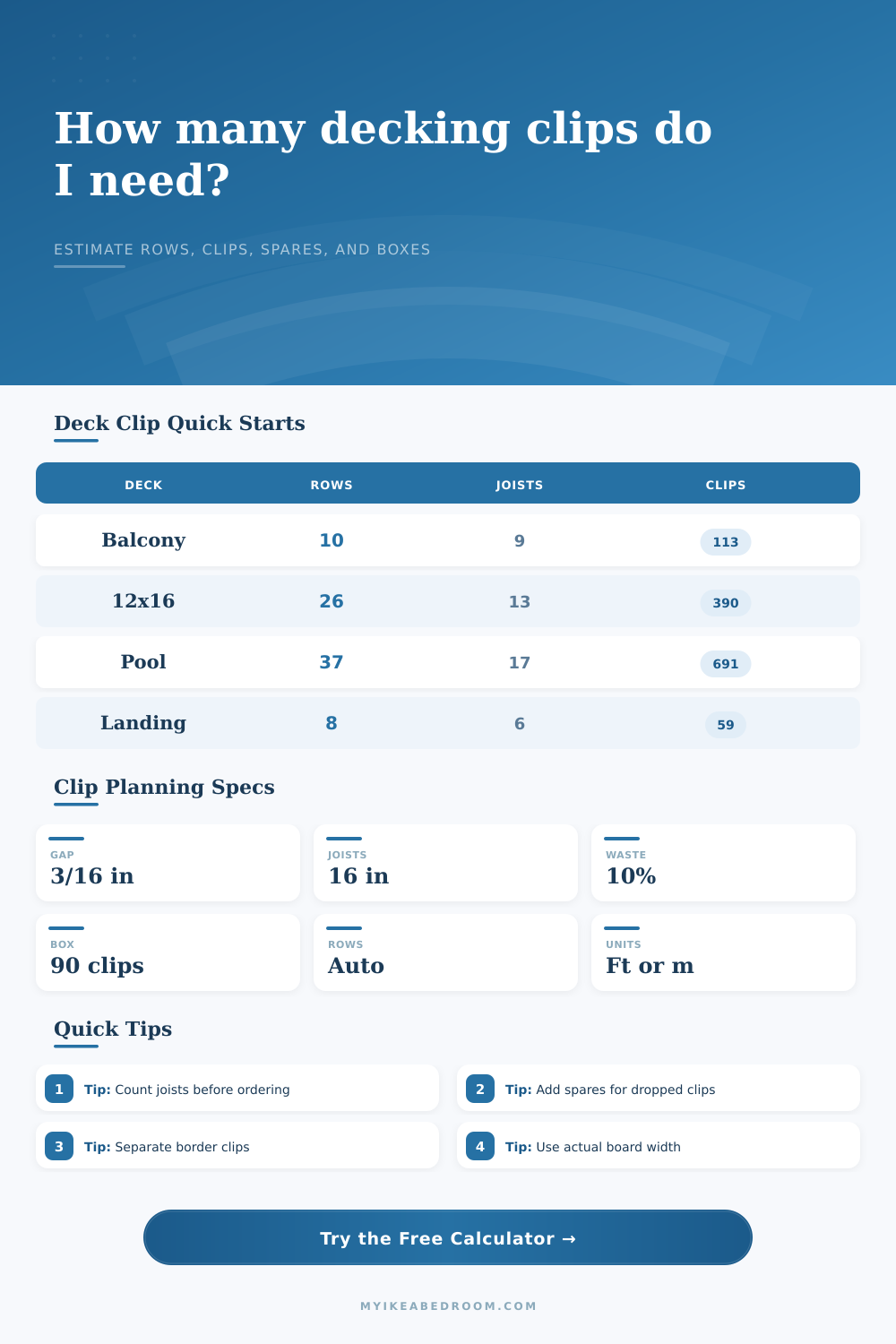
| Small balcony deck | 4.5 ft x 8 ft, 16 in joists | 103 clips | 2 boxes |
| 12x16 patio deck | 5.5 in boards, standard edge | 364 clips | 5 boxes |
| Picture-frame border | 12 ft x 18 ft, border allowance | 493 clips | 7 boxes |
| Pool deck section | 16 ft x 18 ft, tight joists | 628 clips | 8 boxes |
💡Deck Clip Tips
There’s one particular type of moment in deck-building where you enters a state of panic. You’ve ordered the lumber, cut the joists, and confidently slapped down a couple row of decking. Suddenly, you’re three rows away from being done, and your local hardware store are out of the hidden fasteners you need. And all they have available is little blister packs.
You could order them now and wait days for shipping, but who wants to spend a bunch of money on random leftover box? Now you have a storage issue with stuff nobody want. This scenario also stops project dead while you make a trip to store. Buying enough fasteners before you buy a single plank isn’t just convenient; it prevents those logistical and financial surprises that stall the process. The above calculator do that math for you so you never has to experience that same situation again.
Why You Need to Calculate Your Deck Clips First
To do that, you have to know what drive the amount of clips in the deck. Most folks assume it’s just the overall area of the deck (i.e., all the deck’s sq ft). Nope. It’s the number of times your decking boards spans the underlying structural joists beneath them. For each board crossing a joist, you must have a fastening point to hold it firmly. So when the tool requests the length and width of your deck, it’s because that data define the number of rows and thus the number of joist crossings per row.
The tool also require the actual width of your boards… Not their nominal widths as stamped on the packaging. A nominal six-inch board actually measures less, like five-and-a-half inches wide, so it will requires more rows to reach the same width. That’s more joist crossings, which equals more clips. Guessing incorrectly about this fraction is leading cause of running out of material.
Another thing that affect the count is that each deck has a beginning and an end to its rows of decking. Typically you need some sort of clip to hold down a deck’s first board (a starter clip) and another to hold down the final board (an edge clip). Occasionally, your system will include the same item for both, but more often you’ll need specific hardware for each edge. Depending on which type of system you choose, this is accounted for by the calculator.
Building a picture-frame border, where you have two boards instead of one around the perimeter, dramatically increases the need for fasteners. And it’s those boundary conditions that cause all the estimate-to-reality differences. The reference table on the page explain how varying edge styles change the overall number needed.
There is also a silent but significant factor in all this: Material type. Clips hold tight yet has to give when the deck moves due to temperature changes. And composite materials do just that, expand and contract. So the clips have to accommodate that (though not too much). PVC behaves differently; sometimes you need to be very exact on how far apart they’re installed to avoid buckling. Maybe hardwood needs screws rather than hidden clips altogether.
By default, the tool assumes a regular profile… The one most commonly used for composite or PVC decks, with grooves for the clips, since that’s where the technology shines. For any other profile (including specialty biscuit fasteners or metal rail systems), the equation will changes. If your material behaves strangely, consult your own manufacturer’s install guide. The calculator provides a solid starting point for what’s common in most residential applications… But can’t anticipate all the proprietery stuff out there.
The other thing we tend to avoid thinking about until it happens is waste. I can’t tell you how many times I’ve seen people cut clips out of their hand and let them fall into the joist bays. They cut boards too short and has to finish off with rows of partial board that must be secured quickly. Industry standard is to add 10 percent for waste. That seems like overkill, especially if you’re cutting out each piece individually by hand, but it will keep you from running out at the end of your project. This buffer is added for you automatically by the tool and rounded up to full boxes. Because clips are sold in specific quantities, you know how many boxes to purchase to start with so you do not ended up needing to buy a partial box later.
Deck building is half planning, half execution. The old adage ‘measure twice, calculate once’ sounds cliche, yet there’s good reason behind that saying. Once the flooring is installed, you cannot see the joists, so you have to trust your prep. Take the time to order replacements just in case and get those numbers correct now when you still have time to do so. Having a good estimate will keep your budget intact as well as keep the project running on schedule. If you do your homework up front, you never experience that first moment of panic. You should of prepared better for the extra material.