Retaining Wall Drainage Gravel Calculator
Estimate clean drain rock for a retaining wall backfill column, including pipe displacement, bedding depth, fabric wrap area, waste, weight, bags, and bulk volume.
📌Wall Drainage Presets
⚙Calculator Inputs
Drainage Gravel Results
🧱Gravel And Drainage Material Comparison Grid
📋Drainage Column Sizing Table
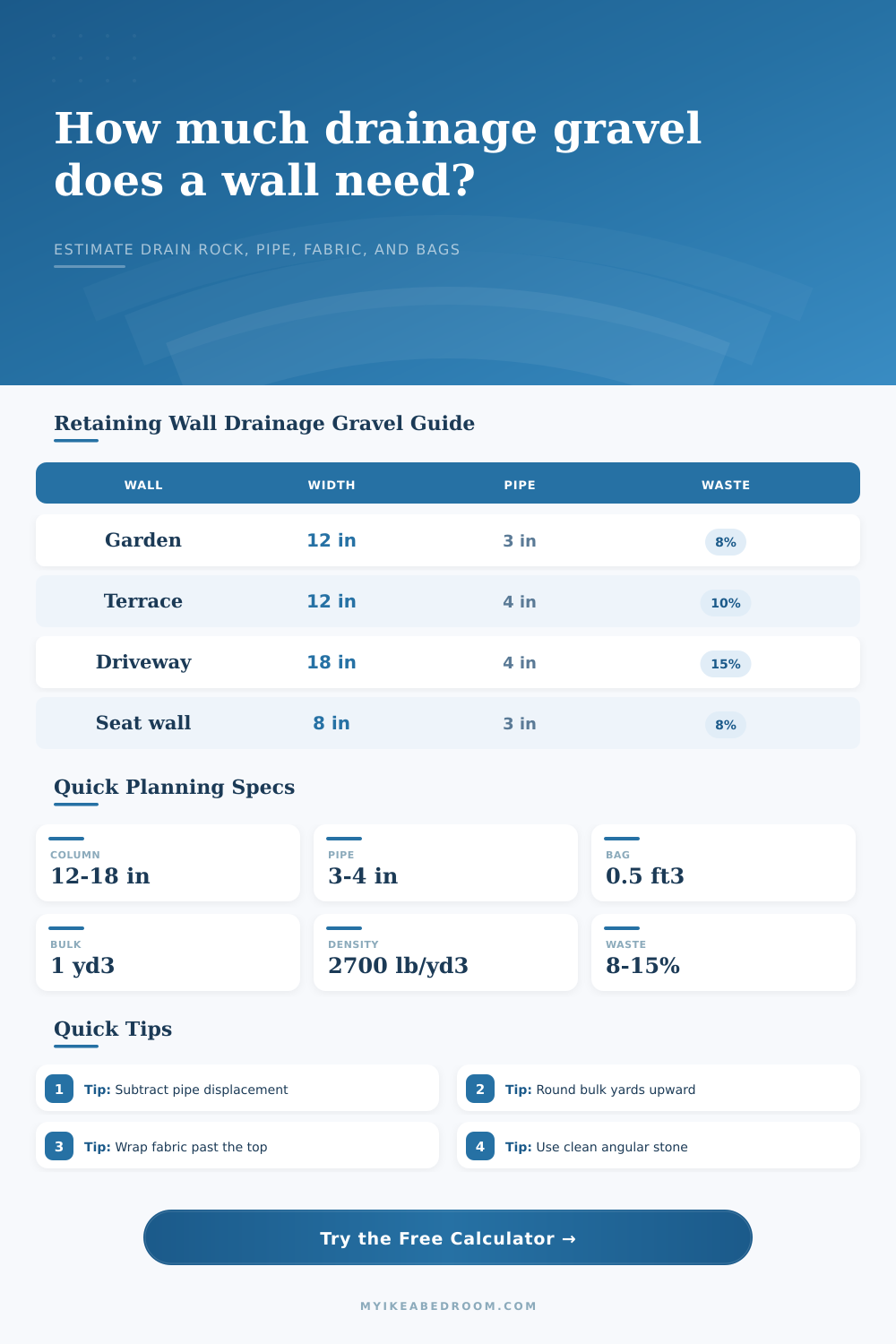
| Wall condition | Typical column width | Pipe diameter | Planning note |
|---|---|---|---|
| Low garden wall | 8 to 12 in | 3 in | Use for short landscape walls with easy outlet access |
| Terrace wall near planting beds | 12 in | 4 in | Good default for many block and timber retaining walls |
| Driveway or surcharge edge | 12 to 18 in | 4 in | Increase waste and confirm the structural design separately |
| Raised patio wall | 12 to 18 in | 4 in | Plan extra bedding around outlets, corners, and cleanouts |
| Seat wall or planter edge | 6 to 10 in | 3 in | Smaller column can be enough when water load is modest |
📦Bags And Bulk Conversion Table
| Package size | Volume per unit | Units per yd³ | Best use |
|---|---|---|---|
| Small bag | 0.4 cu ft | 68 bags | Short repairs and top-up gravel |
| Standard bag | 0.5 cu ft | 54 bags | Small planter and seat wall projects |
| Large bag | 0.75 cu ft | 36 bags | Garden walls where access is narrow |
| Contractor bag | 2.0 cu ft | 14 bags | Medium walls with hand loading |
| Bulk loose stone | 1.0 yd³ | 27 cu ft | Long wall runs and driveway edges |
Bulk yards are shown for volume planning only; always round up for uneven excavation and corner returns.
⌀Pipe Displacement Reference
| Pipe diameter | Displacement per 10 ft | Displacement per 3 m | Calculator use |
|---|---|---|---|
| 3 in pipe | 0.49 cu ft | 0.014 m³ | Common for small garden drains |
| 4 in pipe | 0.87 cu ft | 0.025 m³ | Common perforated wall drain pipe |
| 6 in pipe | 1.96 cu ft | 0.056 m³ | Large outlet or high-flow collector |
| No pipe allowance | 0 cu ft | 0 m³ | Use when pipe is outside the gravel quantity scope |
🧵Geotextile Wrap Table
| Wrap option | Fabric faces counted | Area model | Best planning use |
|---|---|---|---|
| No fabric area | None | 0 sq ft | When fabric is handled in a separate takeoff |
| Back face only | One vertical face | Length x height | Simple separation layer behind gravel |
| U-wrap column | Back, bottom, and front | Length x (height + 2 widths) | Common envelope for drainage stone |
| Full envelope wrap | Back, front, top, bottom | Length x (2 heights + 2 widths) | Cleaner separation in silty soils |
💡Planning Tips
The problem: Most retaining walls fall apart not because their building blocks is inadequate, but because they hold water behind them. Sounds easy enough, but how much drainage gravel do you need? What’s the difference between the volume of gravel you’ll need versus the voids that will be filled with the perforated pipe? How much waste and compaction allowance should of you plan for when figuring out how many bags vs. Bulk yards to buy? This is a tricky calculation that our above calculator does for you after you enter details of your wall. So no more guesswork (no half empty trucks or leftover rock).
Gravel backfill is more than just filler. It’s actualy a working part of the drainage system and requires proper sizing to remove water before it creates hydrostatic pressure against structure behind it. The wall height number are simply the amount of vertical surface you’re attempting to protect. A terrace retaining only three feet of soil has much lower water loading compared to an eight foot high walk-out basement retaining wall. So the size of the required volume is proportional to the difference in elevation.
How to Calculate Drainage Gravel for Your Retaining Wall
But everyone screws this one up by failing to account for drain tube itself. All those inches of perforated four inch diameter drain pipe occupy physical volume within your gravel column. If you base your stone calculation on gross rectangular volume without deducting for how much pipe will displace, then you’re paying for something that doesn’t exist. The calculator does this for you, so you get a true net volume reflecting how much void space the rock must pack into.
How wide should your drainage column be? That depends off cost and performance. If you’re making a wall for a terrace or garden, a typical twelve-inch-wide column of drain pipe will do job nicely. It is large enough to catch moderately heavy rain, but not so big as to waste precious stone. If you’re constructing near a driveway, or are working in soils prone to clogging easy with silt, make the column eighteen inches wide; that provides more room for water to pass through and better filtration of sediment.
The bottom line: It’s a compromise between initial cost versus longevity. Narrowing the drain may save dollars now…but mean digging it back out in five years because soil has plugged up drainage passages. Another surprise for homeowners is the fabric wrap. Geotextile fabric keeps the soil at bay. This ensures your nice clean drainage stone doesn’t get filled with fine soil and turn your nifty gravel bed into a mucky spongeland.
The calculator has several wrap options, ranging from a bare minimum of just covering the back face to a complete wraparound (bottom + front + sides). A U-wrap (covering sides + back) is plenty for most uses; enough to keep the soil out but let water flow in. Since fabric rips easy as you stretch it around corners and pull it over rough excavation beds, its a good idea to add some overlap allowance. It is cheap insurance against bad install.
Now that you know how much you’re working with, bags or bulk? That’s totally up to you: Bulk (by the cubic yard) are far cheaper; and besides cutting down your man-hours, you can order just enough for the job instead of getting stuck with half a dozen bag of leftover fill dirt. On the other hand, if your back yard is a tight squeeze with skinny gates, hauling in a dump truck might not be possible, but at what cost? You may need to pay a premium price by the bag, even if it means buying something like fifty-four bags to get job done safely. The tool will let you convert your total into a number of bags. This lets you make a direct comparison side-by-side without doing any math at the loading dock.
Building a retaining wall is a war between two forces: moisture and gravity. Gravity’s force (the weight of the soil above) doesn’t change, but you do get to dictate direction of the water. If you get the amount of material correct in your drainage layer, what happens when it rained all last spring? Your wall didn’t swell up like a balloon because it couldn’t hold anymore. It stayed solid and dry. If you plan ahead for how much pipe and waste will take up space, it eliminates future headaches.