Stepping Stone Spacing Calculator
Estimate stepping stone count, actual gap, center spacing, curve extra, coverage area, and comfort score from path length, stride, stone size, path shape, reveal, user group, and units.
Start with a common stepping stone path, then adjust the length, stride, stone diameter, curve allowance, end reveal, and user group for the real route.
Current spacing readout
Enter the path dimensions and calculate to see the stone rhythm.
Formula used: effective path = measured path + curve extra; usable run = effective path - start reveal - end reveal; actual gap = (usable run - stones x stone length) / spaces.
Count selection: the script checks nearby whole-stone counts and chooses the layout closest to both target gap and comfortable stride spacing.
| User group | Typical center spacing | Comfort gap target | Calculator scoring note |
|---|---|---|---|
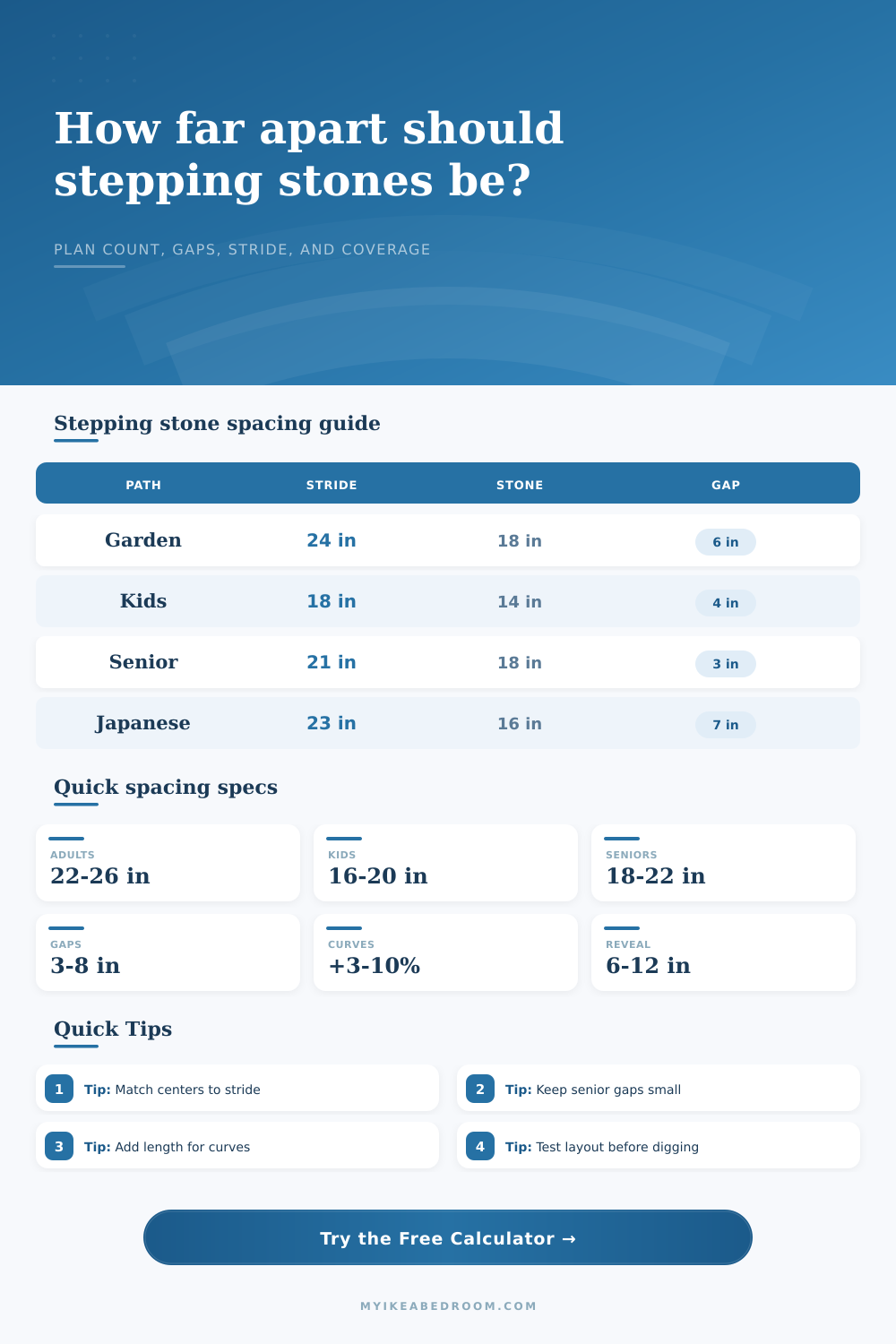
| Adults | 22 to 26 in center-to-center | 4 to 8 in | Best score when center spacing lands close to entered stride. |
| Kids | 16 to 20 in center-to-center | 3 to 5 in | Penalizes long gaps more heavily because steps are shorter. |
| Seniors | 18 to 22 in center-to-center | 2 to 4 in | Favors larger stones, smaller gaps, and lower curve allowance. |
| Mixed family | 20 to 24 in center-to-center | 3 to 6 in | Balances adult stride with safer gaps for occasional users. |
| Decorative occasional path | 23 to 29 in center-to-center | 5 to 10 in | Allows wider visual spacing with a comfort penalty if too long. |
| Path shape | Built-in extra | Good use | Planning note |
|---|---|---|---|
| Straight path | 0% | Side yards, patio-to-shed paths | Use the measured centerline length directly. |
| Gentle curve | 3% | Soft garden bends | Add a little length so edge gaps do not tighten on the outside. |
| Curved flowerbed edge | 7% | Border paths and planted beds | Works well when the route has one clear arc. |
| S-curve path | 10% | Long visual garden routes | Extra length helps keep stone centers from drifting too far apart. |
| Offset Japanese-style rhythm | 5% | Deliberate left-right step pattern | Comfort depends more on center rhythm than a perfectly even gap. |
| Stone diameter or length | Round coverage each | Common gap range | Best path feel |
|---|---|---|---|
| 12 in | 0.79 sq ft | 2 to 4 in | Kids paths, small decorative side routes |
| 16 in | 1.40 sq ft | 3 to 6 in | Compact garden paths and Japanese-style rhythm |
| 18 in | 1.77 sq ft | 4 to 7 in | Most adult garden stepping paths |
| 24 in | 3.14 sq ft | 4 to 9 in | Main paths, senior-friendly layouts, larger slabs |
| 30 in | 4.91 sq ft | 6 to 10 in | Large natural slab walks and broad garden routes |
| Project | Length and shape | Typical stone count | Spacing note |
|---|---|---|---|
| Garden path | 24 ft gentle curve | 12 to 14 stones | Usually comfortable with 18 in stones and 5 to 7 in gaps. |
| Side yard | 32 ft straight | 16 to 18 stones | Straight runs tolerate more regular center spacing. |
| Kids play path | 14 ft straight | 9 to 11 stones | Short stride means small stones still need tight gaps. |
| Patio-to-shed | 36 ft utility route | 16 to 19 stones | Use larger stones to keep utility walking comfortable. |
| Curved flowerbed path | 28 ft curved edge | 14 to 17 stones | Curve extra can add one stone compared with a straight estimate. |
Dry-lay before digging: Mark the first and last reveal, place the calculated count, then walk the path naturally before cutting turf or gravel.
Use the shortest regular stride: For shared paths, size the center spacing around the shortest frequent user so taller users can take a relaxed step.
Most folks purchase stepping stones because they are simply pretty rock for the garden. This results in a path where you trip on the first stone and hop around the third. The rhythm of your path is far more important then any particular rock. Moss won’t hide the fact that something is amiss if the spacing feels off. Think stride before style here.
It is easy to talk about, but it is hard to do in the dirt without measuring twice and cutting turf once. This online calculator does all that for you. It figures the math using geometry. There is no need to get down on your hands and knees fighting with a tape measure or breaking out a protractor.
How to Plan Your Stepping Stones
It accounts for length of your path, the size of the stone, and who will be walking on it. Then it tells you a number that actualy fits. How? Well the trick is the ‘curve allowance’ input. Straight line= easy math. A slight curve around a flower bed= invisible added length on the centerline. If you don’t add that invisible length to your measurement your stones bunch up starting from the beginning then run out before the end. Add three to seven percent depending on how tight the arc is and keep the gaps honest.
The difference is who is walking where. An average adult stride are about twenty-four inches from heel to heel, which is a comfortabley space for just strolling or lugging in those pots. Kids should be shorter, of course. Because they often need tighter spaces, sometimes as close as eighteen inches between centers, no one wants them to climb up a ladder. Seniors: Larger stones and less distance are good. The comfort score considers this mix of users. It tells you if your plan is too aggressive for its main user. You may adore a wide Japanese style gap but that doesn’t matter if your knee-out-of-whack guest can’t clear it without thinking twice.
The visual rhythm is set by the size of the stones themselves. Eighteen-inch round pavers are a nice size, they fill up enough space to make you feel like they’re actualy on the ground but still allow mulch or soil to frame them. Thirty-inch bluestone is bolder (and requires heavier lifting and digging), but fills in the gaps more completely.
The calculator shows you approximately how far your turf will go, and thus how many square feet you’ll have to yank out. It also provides a real gap measurement. Don’t guess at what gap you want to achieve, then hope it all works out. The calculation goes both ways. You can choose the number of stones (fix the count) and live with whatever the gap becomes. Or choose the gap (fix that) and tolerate fewer stone.
Lay it out first. It is non-negotiable. First lay out the stones on the ground where they’ll land, then walk it. Jump to the next. Sit on one. Feel how far each stone reaches. Tighten things up if your foot needs to stretch too far. Open it up if you feel cramped. A number on the screen makes for a great start, but gravity and body awareness gets the last vote. When you find the rhythm that feels natural, mark those spots with something (string or spray paint). Now you can dig with confidence knowing it’s going to flow.
Stepping stone installation is not about precision, but more like a pattern. A hard grid in a garden is sterile. Rotating one stone slightly this way, another that, gives it some life while never breaking stride. The tool will allow straight lines and curves, but not the charm of imperfections. Set your stones in gravel or sand (firmly). Maintain even center spacing between stones, though not too precisely. Let them breathe. Ensure their tops are flush with the turf surface (no catching toes on their edges).
You want a walkway that fades into the scene until you realize what’s there: an appreciation for the space below your feet. It is easy to walk on. Enough room between elements so that when you walk it all falls into place effortlessly. It is a bridge from one structure to another, shed to patio, in my case, but no thinking is required as you go along. The body inhabits the design as much as the eye does. The math matches the way we move, making the garden feel friendlier to enjoy. The exercise is to make it easy to use; that’s why you do it.
Begin with the arithmetic. Test it by walking it. Create something that lasts.