Driveway Paver Quantity Calculator
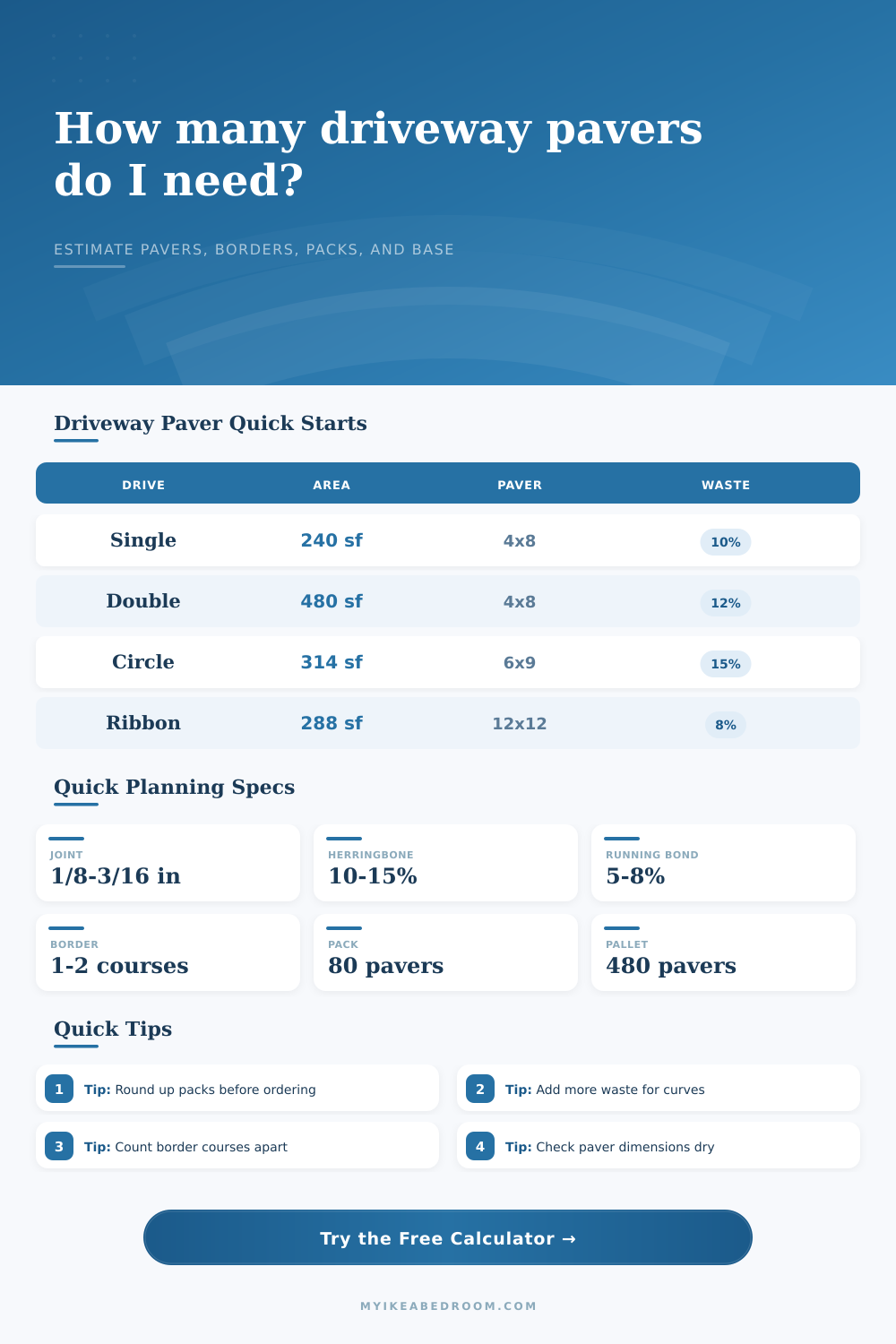
Estimate paved area, paver modules with joint width, field pavers, border courses, edge cut waste, pack and pallet counts, and a base coverage proxy for driveway layouts.
🧱Driveway Presets
Load a driveway shape, paver size, joint, waste, border course, edge cut condition, and pack size, then adjust any value.
⚙Paver Calculator Inputs
Driveway Paver Quantity Results
📊Paver And Material Comparison Grid
📋Reference Tables
| Shape / layout | Area formula used | Perimeter proxy | Best use |
|---|---|---|---|
| Rectangle or straight run | Length x width | 2 x length plus 2 x width | Single and double straight driveways |
| Flared apron or fan end | Length x width x 1.12 | Rectangle perimeter x 1.08 | Street aprons with wider entry points |
| Tapered average-width drive | Length x width x 0.92 | Rectangle perimeter x 0.98 | Driveways narrowed at one end |
| Curved driveway allowance | Length x width x 1.08 | Rectangle perimeter x 1.18 | Soft curves with extra edge cutting |
| Circular or oval turn pad | Length x width x 0.785 | Oval perimeter approximation | Round courts and oval parking pads |
| Two-strip ribbon driveway | Length x width x 0.60 | Rectangle perimeter x 1.45 | Two paved tire strips with open center |
| Paver nominal size | Module with 1/8 in joint | Approx pavers per sq ft | Layout note |
|---|---|---|---|
| 4 in x 8 in brick | 4.125 in x 8.125 in | 4.30 | Works well for 45 or 90 degree herringbone |
| 6 in x 9 in rectangle | 6.125 in x 9.125 in | 2.58 | Balanced driveway field and border sizing |
| 8 in x 8 in square | 8.125 in x 8.125 in | 2.18 | Easy grid planning with moderate cuts |
| 8 in x 16 in plank | 8.125 in x 16.125 in | 1.10 | Low piece count but long edge cut pieces |
| 12 in x 12 in slab paver | 12.125 in x 12.125 in | 0.98 | Quick coverage for straight areas |
| Pattern or edge condition | Typical waste | Cut allowance | Calculator note |
|---|---|---|---|
| Stack bond or simple running bond | 5 to 8 percent | Low | Best for square rectangles and repair panels |
| Basketweave or modular mixed field | 8 to 10 percent | Medium | Allows sorting and ordinary driveway edges |
| 45 degree herringbone | 10 to 15 percent | High | Diagonal starts and side cuts increase waste |
| Curved apron, circle, or drains | 15 to 20 percent | Complex | Radius cuts and short pieces need more margin |
| Planning item | Formula | Typical value | Use in result |
|---|---|---|---|
| Pack count | Total pavers divided by pavers per pack | 80 pavers | Rounded up to full packs |
| Pallet count | Total pavers divided by pavers per pallet | 480 pavers | Rounded up to full pallets |
| Base volume proxy | Area x base depth divided by 27 | 6 in depth | Shown as cubic yards and cubic meters |
| Area coverage proxy | One cubic yard covers 324 sq ft at 1 in | 54 sq ft at 6 in | Checks aggregate coverage by depth |
💡Paver Quantity Tips
A driveway is a simple rectangle. Most folks assume they know how much material their driveway will require: just multiply length by the width, right? Done! Except it doesn’t work that way for pavers. No, sir. Because each paver is a distinct tile with set dimensions, you can’t melt one into another to span a gap. And no, you won’t be pouring a truckload of concrete onto uneven edges. You can’t pour a paver over a crooked edge either.
The trick is getting enough (but not more than) pavers before you’ve started laying them down. If you order too few, you’ll have mismatched batches. Manufacturers don’t hold the same dye lot in inventory year after year. Order too many and you’re stuck with dozens of heavy bricks sitting in your garage, collecting dust. How do you know if you’ll need a little extra for a curved apron? Would you guess right?
Why Use a Paver Calculator?
The calculator will do all that math for you. Simply enter your measurements and select your pattern. No guesswork required.
What’s occupying your driveway? It is the tricky part. When you look at a paver, it’s more than its face size. That includes the width of its joint (the area of empty space filled by sand). For example, if you’re laying standard concrete pavers, which generally feature an eighth-inch-wide joint, that tiny gap really starts to add up over a two-thousand-square-foot driveway. The tool automatically accounts for the size of this module. So when you get your count, it will reflect not just actual footprint but the spacing in between as well.
This can be important: Joint width is the most frequent cause of why DIYers comes up short at the ends. They may believe they’ve got enough bricks to cover middle. But when you tally up all those joints, it adds up fast; and the perimeter gets eaten away sooner than expected.
The waste profile changes dramatically with patterns. Straight layouts like a stack bond or running bond are most efficient. Five to eight percent extra is all you’re looking at (for cuts and breakage). If you want something visually appealing as well as structurally strong, such as a herringbone pattern, plan for more waste. This is especially true at a forty-five degree angle. Diagonal angle cuts produce weird offcuts that can hardly ever be used anywhere else in the field. The percentage shown on the calculator accounts for this, depending on which pattern you select. It recognizes that beautiful angles come at a material price. Not much of a tradeoff, but it will protect you against running out of full units halfway through job.
A second element of complication comes from curves and flared aprons. A straight driveway has two long edges and then two shorter edges. A circle, or even just a semi-circle as a turn pad at the end of a driveway, creates a constantly changing perimeter. More edge cuts is needed. Often leading to smaller but now worthless pieces of scrap. The shape input applies coefficients to the perimeter and area to help estimate this increased waste. The longer the perimeter, the greater the waste. If there are multiple shapes instead of one long slab, like when a ribbon drive is cut into two separate strips, there is much more total edge. More edge equals more cuts. More cuts = more waste. Knowing this relationship helps find out if a complex design will be worth the added material expense for your particular budget.
Another frequently forgotten variable are border courses. How many times have you framed your main field and then added a different colored border or even a second row of border pavers? Don’t mix those into one count or you will get confused. When it comes time to lay multiple sections, you won’t remember which batch was mixed together. The calculator separates that out. So now it tells you how much you need to frame the perimeter versus how many you need for the main interior area. This separation is needed for both staging material on site and ordering material. Don’t have your crew wasting their time sorting out piles all mixed up.
And then there’s what lies below those pavers. No point in having a lovely surface if it settles in soft ground. This tool has a rough idea of the amount of aggregate base you should of require underneath your paving. Remember: aggregate is compacted stone. How much do you need? Depending on local engineering specs, that varies, but knowing roughly how many cubic yards you’ll need gets you closer to a cost for the whole project.
If all goes well, remember that pavers are just half the equation. After you know your quantities, round up to full packs/pallets. Paving suppliers typically sells by the pallet load (or by the box of units). Buying in bulk can simplify your life logistically. And it always comes in handy if you ever need some spare pieces to fix a few cracks later on. Order with a bit of a buffer; gravity and geometry don’t always align actualy.