Garage Epoxy Flake Quantity Calculator
Estimate floor area, net broadcast area, flake pounds, kilograms, bag count, coating coverage, and extra margin for garage epoxy flake broadcasts.
🏠Garage And Slab Presets
⚙Calculator Inputs
Flake Quantity Results
🧱Flake And Coating Comparison Grid
📋Broadcast Rate Reference
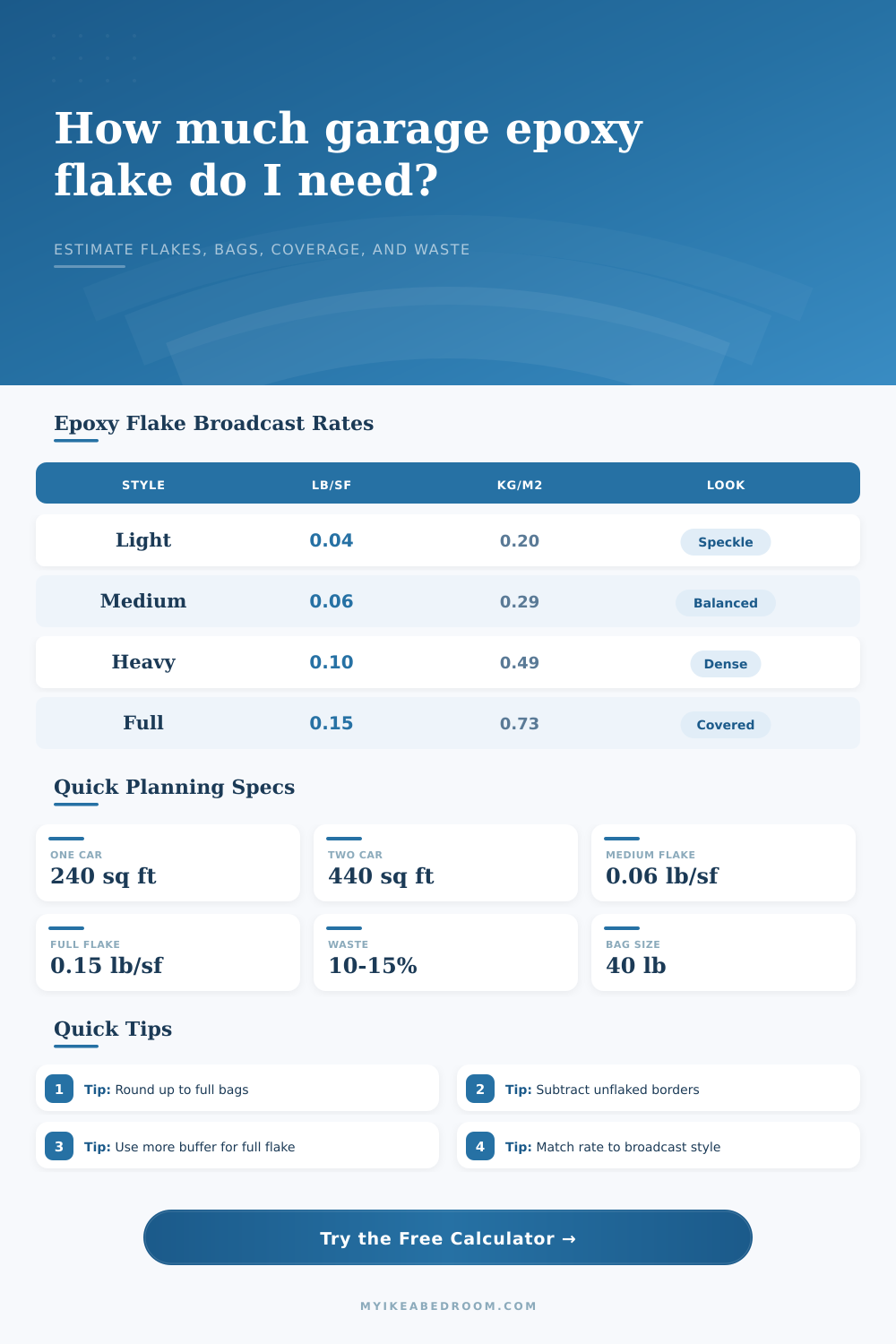
| Broadcast style | Typical rate | Metric rate | Coverage appearance |
|---|---|---|---|
| Accent scatter | 0.02 lb/sq ft | 0.10 kg/m² | Open decorative speckle with visible base color |
| Light broadcast | 0.04 lb/sq ft | 0.20 kg/m² | Light pattern with easy visual spacing between flakes |
| Medium broadcast | 0.06 lb/sq ft | 0.29 kg/m² | Balanced garage finish with steady color distribution |
| Heavy broadcast | 0.10 lb/sq ft | 0.49 kg/m² | Dense finish with small base-coat windows |
| Full broadcast | 0.15 lb/sq ft | 0.73 kg/m² | Covered look where flakes dominate the floor surface |
| Full to rejection | 0.18 lb/sq ft | 0.88 kg/m² | Excess-flake broadcast intended to fill the wet coating |
📦Bag Count Planning Table
| Garage size | Area | Medium flake | Full flake |
|---|---|---|---|
| Compact one-car | 216 sq ft | 15 lb before waste | 33 lb before waste |
| Standard one-car | 240 sq ft | 15 lb before waste | 36 lb before waste |
| Standard two-car | 440 sq ft | 27 lb before waste | 66 lb before waste |
| Deep two-car | 528 sq ft | 32 lb before waste | 80 lb before waste |
| Workshop bay | 360 sq ft | 22 lb before waste | 54 lb before waste |
Use the calculator for final bag rounding because waste, excluded areas, and bag size can change the result.
⚖Coating Coverage Check Table
| Surface stage | Area used | Texture factor | Planner note |
|---|---|---|---|
| Base coat before broadcast | Full floor area | 1.00 | Used for wet broadcast bed |
| Light or medium topcoat | Net flake area | 0.90 | Open texture keeps coverage close |
| Heavy topcoat | Net flake area | 0.75 | Dense texture lowers spread rate |
| Full-flake topcoat | Net flake area | 0.62 | Scraped flakes need more film build |
| Masked border or partial zone | Subtracted area | 0.00 | Removed from flake pounds only |
🎨Blend And Uniformity Table
| Color blend | Uniformity effect | Best use | Calculator adjustment |
|---|---|---|---|
| Low contrast blend | Forgiving | DIY garage floors | Adds 2 score points |
| Balanced multi-color blend | Very forgiving | Most garages and shops | Adds 3 score points |
| High contrast blend | Shows thin spots | Intentional graphic floors | Subtracts 3 score points |
| Single dominant color | Shows direction | Subtle modern finish | Subtracts 2 score points |
| Custom blend sample | Depends on sample | Matched design palettes | No score change |
💡Planning Tips
You know what? Most garage floor jobs begins with big dreams and conclude at the home improvement store purchasing another box of flake. Why? Because your concrete’s spongy like its covered in saran wrap yet appears as smooth as glass; and you’re not aware of volume required to hide all this. That’s where the calculator comes into play. It do the math for you after you input your measurements (no guessing on conversions or coefficients). Simply type in your garage’s length and width, select your broadcast style and let the magic happen. The result? A tangible figure rather then a wishful estimation.
Broadcast density is the most important choice. Light: You’ll see plenty of base coat and have a speckled look with some light scatter. It looks moddern and clean, but it must be perfectly applied because thin spots is immediately apparent. Medium is the sweet spot for most homeowner because it provides a good balance between evenly distributed color and an un-messy appearance. The Heavy/Full option are a uniform and very dense surface with flakes dominating. Hides imperfections in the concrete well, but will require much more material. Because of this the calculator adjust the pounds per square foot required according to which option you choose.
How to Calculate Your Garage Floor Materials
Don’t neglect the border set up. Lots of folks will cut out the border and hide it behind a wall or wheel stop to prevent an ugly edge. Don’t forget to deduct the portion that won’t be flaked when figuring how much flake to order. Otherwise, you’ll end up purchasing additional flakes that you’ll never apply. That being said, treat the entire floor surface as the area that will recieve base coat coverage. Even if it doesn’t receive any flakes, the epoxy base should still cover it. This prevents running out of binder at the worst time.
People also skimp on handling and waste buffer. Your concrete floor isn’t a perfectly cut rectangle with clean edges. Things like uneven throwing arcs, wind, and kick-up causes this. These factors cause you to lose material. Ten to fifteen percent waste factor will cover these losses. Dense broadcasts don’t forgive so if you’re doing a full flake job, go higher. A small coverage dip appear like a bald patch on your lawn. That’s why I have an extra margin field in the calculator. It adds a separate planning buffer after the waste calculation. Consider this insurance against tricky corners and uneven throwing hands.
The last step that will cost you money is bag rounding. If you missed it, you can’t purchase partial bags of epoxy flakes. The bagger round up to whole 40 lb. Bags according to how much you calculate you need. So you’ve got plenty to do edge work and other touch-ups. It must also account for variations in flake density (some colors are more pigmented than others) and the fact that high contrast blends display every flaw, whereas low contrast blends hide any minor inconsistency. Accordingly, the calculator increase its uniformity score based on what color blend you select.
The amount of flake isn’t all that matters; there’s also a big deal about what percentage of the item is covered. How much topcoat and base do you think you’ll use? That’s part of what it calculates too. Because a thick flake spread will increase the surface area so greatly, it figures in how much material will be lost with the texture. You have less square footage to cover per application, which means you must roll harder with your roller, thus reducing your coverage rate. This creates dry areas in the finished paint. The page explains how texture impacts coverage by providing a chart (table) that shows that smooth coats is rated at 100% coverage while maximum flake jobs only hit 60%.
Planning takes more time than applying. Measuring twice and calculating once prevents a last-minute rush during a hot weekend. Once the epoxy starts curing, there’s no stopping it until dry! With the calculator, all supplies are accounted for before you even mix. No guessing required when ordering supplies. The calculator turns abstract area numbers into concrete bag counts and gallon totals. Gallons equals gallons. Knowing exactly how much of everything you need allows for doing the work instead of planning it.
Begin with a good slab that’s been prepared and then follow the math with your shopping list. Preparing and having the right estimate are two of the keys to success (or at least not having a DIY disaster). Before you grab a grinder, use the tool to nail down those numbers. You will have less stress, more savings, and a floor that looks just like you had planned for on the showroom floor. All that work up front would of been worth it each time you pull into the garage.