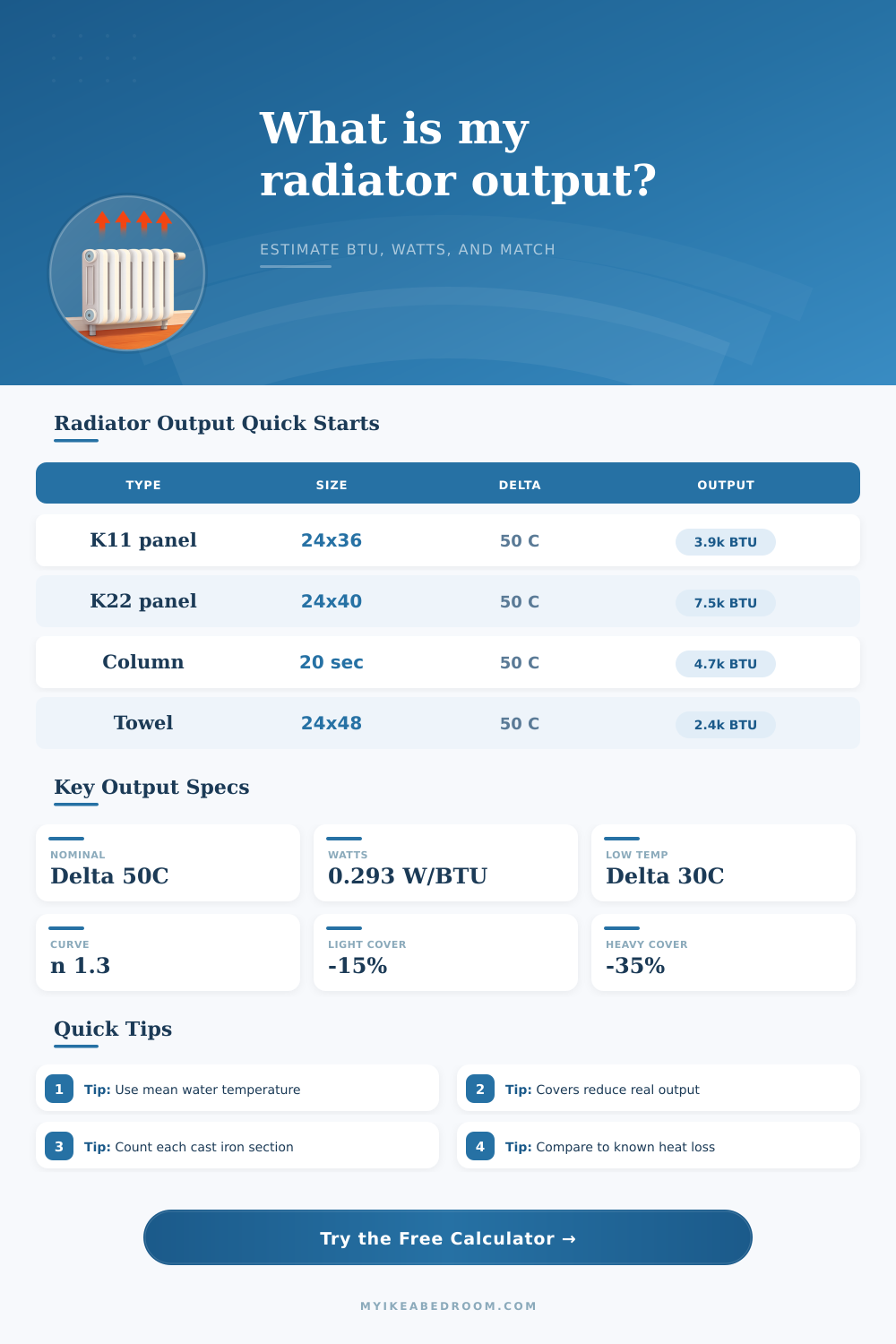
Radiator BTU Output Calculator
Estimate the heat output from an existing radiator by size, radiator type, water temperature, room temperature, Delta-T correction, section count, paint or cover derate, watts, and output per foot.
Presets load common radiator styles and starting dimensions. They estimate existing output at the entered operating temperature rather than sizing a new radiator from room area.
Single panel
520 BTU/h/sq ft at Delta-T 50C.
Low depth and gentle output. Often found where wall space is generous.
Single convector
780 BTU/h/sq ft at Delta-T 50C.
Rear fins lift the output without making the radiator much wider.
Double convector
1,350 BTU/h/sq ft at Delta-T 50C.
A common K22 estimate for compact wall radiators with two panels and fins.
Column or cast iron
Section based rather than face-area based.
Count sections and use depth to approximate exposed heated surface.
| Radiator type | Calculator basis | Nominal Delta-T 50C estimate | Best for | Watch item |
|---|---|---|---|---|
| Single panel K10 | Face area | 520 BTU/h per sq ft | thin radiators | low output per foot |
| Single convector K11 | Face area | 780 BTU/h per sq ft | compact bedrooms | dust in fins |
| Double panel K20 | Face area | 950 BTU/h per sq ft | moderate wall space | depth allowance |
| Double convector K22 | Face area | 1,350 BTU/h per sq ft | common high output | cover clearance |
| Triple convector K33 | Face area | 1,800 BTU/h per sq ft | short wall runs | deep projection |
| Towel radiator | Face area plus depth | 500 BTU/h per sq ft | bathrooms | towels block heat |
| Mean water minus room | Delta C equivalent | Approx factor | Typical system | Calculator formula |
|---|---|---|---|---|
| 90 F | 50 C | 1.00x | traditional rating point | (Delta C / 50)^1.3 |
| 72 F | 40 C | 0.75x | reduced water temperature | lower output |
| 54 F | 30 C | 0.52x | condensing boiler range | large derate |
| 45 F | 25 C | 0.41x | low temperature heating | very large derate |
| 108 F | 60 C | 1.27x | hotter legacy operation | higher output |
| Condition | Factor | Output change | When to use it | Calculator effect |
|---|---|---|---|---|
| Clear radiator | 1.00 | 0 percent | open top and front | no derate |
| Fresh paint only | 0.97 | -3 percent | normal repaint | minor reduction |
| Heavy paint layers | 0.92 | -8 percent | old cast iron surfaces | surface derate |
| Open grille cover | 0.85 | -15 percent | vented cabinet or screen | moderate derate |
| Restrictive cover | 0.65 | -35 percent | tight enclosure | large derate |
| Delivered output vs target | Indicator | Meaning | Likely symptom | Next check |
|---|---|---|---|---|
| Below 75 percent | Short | radiator output is low | room may lag | check water temp |
| 75 to 95 percent | Close low | near target but lean | slow warm-up | review cover factor |
| 95 to 115 percent | Matched | near entered target | normal balance | verify heat loss |
| 115 to 140 percent | Strong | useful output margin | fast response | balance valve |
| Above 140 percent | Oversized | well above target | possible overshoot | lower flow or TRV |
Temperature tip: Use the mean water temperature: add supply and return, then divide by two. A lower return temperature can reduce output more than the radiator size suggests.
Cover tip: A shelf, cabinet, towel, or tight grille can cut delivered heat. If the radiator feels hot but the room stays cool, check airflow first.
The heat doesn’t work. Or rather: you’re standing before a warm radiator that don’t actualy do anything except fail to heat the room. The boiler lights up. The thermostat is set. But still, nothing. What’s wrong?
Usually, it’s a matter of misalignment: Your unit isn’t sized for space, so even though it may look like a big unit, it can’t produce enough heat given certain conditions. The size of metal housing matters less then what happens within. Ignore the exterior and consider physics.
Why Your Radiator Is Not Hot Enough
Delta T is the key variable and stands for difference between the ambient air temperature in your room and the temperature of water coming from the boiler’s radiator. Manufacturers rate their units based off a “standard” delta of 50 Celsius (about 90 degrees Fahrenheit). But condensing boilers typically operates with lower flow temperatures, which means your system will rarely run exactly at this point.
A higher output occur when the water entering unit is hotter than the room air. The opposite is also true. The output plummets drasticly whenever the water isn’t so hot compared to the room air. Plug in your own temperature values into the calculator and it do all this math for you. Because heat doesn’t transfer in a linear fashion, it accounts for a correction curve, so a little drop in temp mean a big reduction in warmth.
Construction type matter just as much as temperature. For example, a double convector unit has two panels and rear fins. This type of unit will move more air than a single panel radiator without fins. The extra surface area give you more heat transfer with fewer litres of water.
Then again, an older cast iron column radiator do it another way; that kind of thing depends on the number of sections and their depth rather than the surface area of the front. That requires a little more thinking: how many actual section does it have? Measure across them all; that’s your number. It is a small point, but it completely change the starting figure.
The most frequent cause of dissatisfaction with current systems is probably obstruction. That’s why a nice new coat of paint won’t reduce output significantly (a couple percent). But something like a decorative wooden cover with a tight-fitting door can slice effective output by 30-35%. It may be so hot to the touch it feels like it will burn your skin, but this is because it’s trapping the heat around itself instead of radiating it in the room. You want the air moving or you’re not getting warm.
The tool takes these reductions into account to show you what the radiator realy gives you vs what it was rated at in a laboratory with clear airspace. In addition to heat loss coefficients (above), you’re going to want to think about the relationship between supply and demand: If you have a big, open room with high ceilings or lots of windows, it’s got a higher heat loss coefficient. That means your calculated output may not be enough for space.
In this situation, no matter how many times you tweak the thermostat, you’re never going to make up the difference, your system just doesn’t have the power to fill out its envelope. Too much output? You’ll have overshoot. You get the boiler kicking off, but then the room is overheated. That means you should of know the numbers on both sides of the equation in order to find the happy medium.
In the end, it’s a balancing act between the world around you and the tools at your disposal. It’s about transferring heat into a vessel (the radiator). You also tweak it for real world factors such as water temp, construction type, and physical obstructions. So instead of fighting a cold room you’re solving a heat equation; moving from guessing to knowing. Not only do you have a hot radiator but also a comfortabley house.